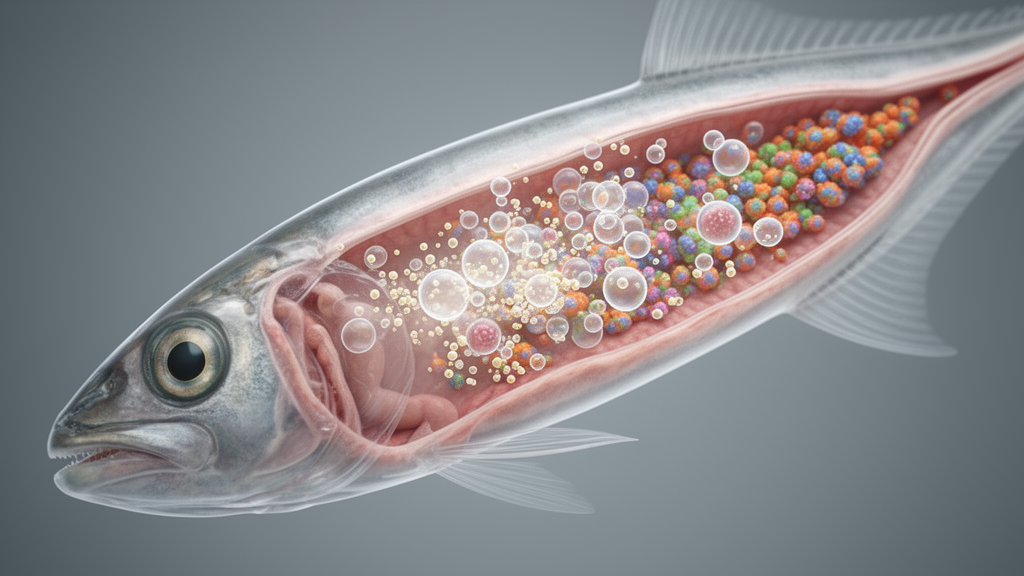
Marine fish larvae experience pronounced physiological remodeling as they shift from maternal yolk reserves to exogenous feeds, yet the functional contribution of the gut microbiome during these developmental bottlenecks has remained difficult to quantify. In a study published in Frontiers in Physiology, researchers at the Instituto de Ciencias Marinas de Andalucía and commercial hatchery Futuna Blue España established the first quantitative framework demonstrating that the resident intestinal microbiota provides measurable hydrolytic enzyme activity that complements endogenous digestion during critical larval transitions in greater amberjack, Seriola dumerili. By tracking larval ontogeny from 10 to 60 days post-hatching, the research team revealed that the enzymatic repertoire of the gut microbial community expands in concert with host tissue differentiation and shifting dietary substrates, reaching its highest relative functional contributions during co-feeding stages when endogenous host enzyme levels undergo temporary declines.
The successful production of commercially valuable pelagic marine teleosts is frequently constrained by elevated larval mortality and variable performance during the early life stages. In intensive aquaculture systems, expanding production capacity requires improving larval resilience and nutrient assimilation during the sequential introduction of live feeds and dry formulated rations. While developing marine fish larvae progressively differentiate their gastrointestinal tract and synthesize pancreatic and brush border enzymes, the digestive tract remains structurally incomplete during early ontogeny. Historically, nutrient breakdown, absorption, and assimilation have been evaluated almost exclusively as host-dependent physiological processes. Although the vertebrate gut microbiome is broadly recognized for its participation in immune modulation and overall metabolic homeostasis, empirical evidence directly measuring microbial enzymatic activity within dissected marine fish larval intestines has historically been lacking.
To overcome these limitations and determine whether intestinal bacteria function as active metabolic partners during development, the researchers sampled greater amberjack cohorts across five distinct nutritional intervals. Cultured under controlled recirculating aquaculture conditions at 24.5 degrees Celsius, 35 grams per liter salinity, and a 14-hour photoperiod, specimens were collected at 10 days post-hatching during exclusive rotifer feeding, at 19 days post-hatching following the addition of Artemia metanauplii, at 32 days post-hatching during early co-feeding with a commercial microdiet, at 40 days post-hatching during late co-feeding, and at 60 days post-hatching after full weaning onto formulated diet. To minimize confounding diurnal and feeding variations, all samplings occurred at 11:00 hours, followed by aseptic microdissection of whole gastrointestinal tracts to separate intestinal tissues and luminal contents from external epithelial surfaces.
The analytical protocol separated the soluble intestinal luminal enzymes from the intracellular enzymatic repertoire of the bacterial community. Intestinal homogenates were subjected to differential centrifugation and filtration through 0.22-micrometer centrifugal filter units. Serial washes with sterile phosphate-buffered saline yielded the intestinal luminal fraction containing host digestive secretions and microbial extracellular enzymes. Bacterial cells retained on the membrane filters were lysed with non-ionic detergent to recover the intracellular bacterial fraction, allowing direct measurement of microbial hydrolytic potential without confounding interference from host tissues. Fluorogenic substrate assays then quantified trypsin, chymotrypsin, amylase, and chitinase activities across both compartments, which were standardized against total protein concentrations to calculate relative bacterial contributions.
Quantitative assays revealed dynamic, non-linear trajectories in host luminal enzyme profiles across development. In the intestinal extracts representing primarily larval tissue secretions, trypsin and chymotrypsin activities displayed a marked drop at the onset of co-feeding at 32 days post-hatching before rebounding to their highest recorded levels at 60 days post-hatching. Amylase activity followed an inverse pattern, surging to a pronounced peak at 32 days post-hatching and declining sharply thereafter as formulated diet intake expanded. Meanwhile, host chitinase activity remained minimal throughout initial live-prey stages but rose significantly during late co-feeding at 40 days post-hatching and post-weaning at 60 days post-hatching. These fluctuations reflect the extensive remodeling of the digestive tract as larvae adapt to more biochemically complex feeds.
Parallel assays of the bacterial extracts demonstrated that the microbiota acquired a broader digestive repertoire over developmental time. Bacterial trypsin and chymotrypsin activities rose significantly from 32 days post-hatching onward, reaching their maximum recorded levels during late co-feeding and weaning. Bacterial chitinase activity was undetectable during early rotifer and Artemia feeding, first emerging at 32 days post-hatching and increasing steadily to a peak at 60 days post-hatching. In contrast, bacterial amylase activity was absent throughout early and intermediate ontogeny, being detected exclusively in fully weaned larvae at 60 days post-hatching. Substrate-gel zymography of bacterial proteases verified this expanding functional diversity, showing three distinct caseinolytic bands appearing at 32 days post-hatching that shifted from high-molecular-weight proteases to predominantly lower-molecular-weight proteases by day 60.
Comparing bacterial enzyme measurements directly against intestinal luminal enzyme activities revealed that relative microbial contributions peaked during early co-feeding. At 32 days post-hatching, bacterial chymotrypsin activity reached 218.8 percent of the activity detected in the luminal fraction, representing a 2.19-fold higher activity level under experimental conditions, while relative bacterial trypsin activity reached 55.7 percent. Most strikingly, bacterial chitinase activity reached 458.4 percent of the luminal fraction activity at day 32, equivalent to a 4.58-fold enhancement, before declining as host endogenous chitinase synthesis matured. In fully weaned 60-day larvae, bacterial amylase activity accounted for 35.2 percent of the luminal activity. The authors emphasized that percentages exceeding 100 percent reflect higher catalytic rates measured in isolated bacterial fractions rather than proving that bacteria dominate overall digestion in vivo.
Taxonomic profiling via high-throughput 16S rRNA gene sequencing of the V3 to V4 hypervariable regions illustrated significant shifts in community structure across development. Observed amplicon sequence variant richness increased significantly from early live-prey stages to 60 days post-hatching, even though overall Shannon diversity remained statistically unchanged. Proteobacteria predominated early, rising to 71.29 percent relative abundance at 19 days post-hatching, with orders such as Burkholderiales, Rhizobiales, and Oceanospirillales serving as stage-specific indicator taxa. At 32 days post-hatching, Vibrionales emerged as the primary indicator taxon. A marked taxonomic turnover accompanied weaning, with Firmicutes expanding from 0.87 percent at 32 days post-hatching to 32.99 percent at day 40 and reaching 56.00 percent at day 60, characterized by significant enrichment of the orders Lactobacillales, Bacillales, and Clostridiales.
Functional profiling using FAPROTAX predictions aligned closely with taxonomic succession and quantitative enzymatic assays. Bacterial functional potential shifted from early phototrophic and host-associated categories toward chemoheterotrophic, fermentative, and complex carbohydrate-degrading pathways, including cellulolysis and xylanolysis, during co-feeding and post-weaning stages. Correlation analyses showed that bacterial chymotrypsin, amylase, and chitinase activities were positively associated with host intestinal trypsin activity, while no significant correlations linked homologous bacterial and host enzymes. The authors hypothesized that microbial hydrolysis of structural dietary carbohydrates, such as chitin from Artemia or microdiet binders, may increase the accessibility of protein fractions to host proteases, demonstrating functional complementarity rather than simple redundancy.
The researchers underscored several methodological considerations when evaluating these findings. Bacterial enzymatic values represent intracellular lysates and provide an estimate of overall hydrolytic potential rather than direct in situ luminal secretome flux. Furthermore, the observed statistical correlations between microbial and host enzyme levels represent exploratory associations derived from paired biological replicates and do not establish direct molecular causality. Nonetheless, by examining dissected intestines rather than whole-body homogenates, this study demonstrates that gut microbial communities dynamically expand their digestive capacity during developmental bottlenecks, establishing a physiological foundation for future efforts to optimize microdiets and microbiome management in marine aquaculture.
Subject of Research: Functional maturation and digestive enzyme contribution of the gut microbiota during larval ontogeny in greater amberjack
Article Title: Functional contribution of the gut microbiota to digestive capacity during ontogeny in greater amberjack (Seriola dumerili) larvae
Article References: Navarro-Guillén, C., Pérez-Hilario, D., Yúfera, M., & Perera, E. (2026). Functional contribution of the gut microbiota to digestive capacity during ontogeny in greater amberjack (Seriola dumerili) larvae. Frontiers in Physiology, 17, Article 1955641. https://doi.org/10.3389/fphys.2026.1955641
Image Credits: AI Generated
DOI: 10.3389/fphys.2026.1955641
Keywords: Seriola dumerili, greater amberjack, gut microbiota, larval ontogeny, digestive physiology, digestive enzymes, trypsin, chymotrypsin, amylase, chitinase, co-feeding, weaning, Firmicutes, Proteobacteria, zymography, FAPROTAX, 16S rRNA gene sequencing, marine aquaculture
News Source: Drew Townsend. (November 14, 2026). Gut Bacteria Complement Digestive Enzyme Activity in Developing Greater Amberjack Larvae. Scienmag.