• HOME
  • NEWS
  • EXPLORE
    • CAREER
      • Companies
      • Jobs
    • EVENTS
    • iGEM
      • News
      • Team
    • PHOTOS
    • VIDEO
    • WIKI
  • BLOG
  • COMMUNITY
    • FACEBOOK
    • INSTAGRAM
    • TWITTER
Saturday, September 26, 2026
BIOENGINEER.ORG
No Result
View All Result
  • Login
  • HOME
  • NEWS
  • EXPLORE
    • CAREER
      • Companies
      • Jobs
        • Lecturer
        • PhD Studentship
        • Postdoc
        • Research Assistant
    • EVENTS
    • iGEM
      • News
      • Team
    • PHOTOS
    • VIDEO
    • WIKI
  • BLOG
  • COMMUNITY
    • FACEBOOK
    • INSTAGRAM
    • TWITTER
  • HOME
  • NEWS
  • EXPLORE
    • CAREER
      • Companies
      • Jobs
        • Lecturer
        • PhD Studentship
        • Postdoc
        • Research Assistant
    • EVENTS
    • iGEM
      • News
      • Team
    • PHOTOS
    • VIDEO
    • WIKI
  • BLOG
  • COMMUNITY
    • FACEBOOK
    • INSTAGRAM
    • TWITTER
No Result
View All Result
Bioengineer.org
No Result
View All Result
Home NEWS Science News Chemistry

‘Growing’ active sites on quantum dots for robust H2 photogeneration

Bioengineer by Bioengineer
July 7, 2020
in Chemistry
Reading Time: 2 mins read
0
IMAGE
Share on FacebookShare on TwitterShare on LinkedinShare on RedditShare on Telegram

IMAGE

Credit: Prof. WU’s Group

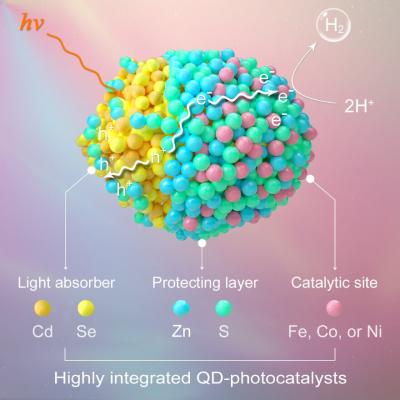
Very recently, Chinese researchers had achieved site- and spatial- selective integration of earth-abundant metal ions (e.g., Fe2+, Co2+, Ni2+) in semiconductor quantum dots (QDs) for efficient and robust photocatalytic H2 evolution from water.

This research, published online in Matter, was conducted by a research team led by Prof. WU Lizhu and Dr. LI Xubing from the Technical Institute of Physics and Chemistry (TIPC) of the Chinese Academy of Sciences.

Photosynthesis in nature provides a paradigm for the large-scale conversion of sunlight into chemical fuels. For example, hydrogenases in certain bacteria and algae catalyze the reversible reduction of protons to H2 with remarkable activity.

Inspired by natural photosynthesis, solar-driven H2 evolution from water is regarded as an ideal pathway to store solar energy in chemical bonds. In pursuing of highly efficient chemical transformation, QDs in conjunction with non-noble metal ions have appeared as the cutting-edge technology of H2 photogeneration.

This research successfully realized the cooperative and well-controlled loading of non-noble metal ions in QDs, thereby integrating light absorber, protecting layer and active site together in an ultra-small nanocrystal, which would show great potentials in fabricating artificial photosynthetic devices for scale-up solar-to-fuel conversion.

Time-resolved spectroscopic techniques and density functional theory calculations reveal the kinetics of interfacial charge transfer and the mechanism of H2 evolution at active species, which provides new guidance on the design of multifunctional photocatalysts for practical applications.

This work was supported by the Ministry of Science and Technology of China, the National Science Foundation of China, and the Strategic Priority Research Program of the Chinese Academy of Science.

###

Media Contact
HE Jianing
[email protected]

Related Journal Article

http://dx.doi.org/10.1016/j.matt.2020.06.022

Tags: Chemistry/Physics/Materials SciencesEnergy/Fuel (non-petroleum)Polymer Chemistry
Share12Tweet8Share2ShareShareShare2

Related Posts

Three-Year Campus Study Reveals How Bangkok’s Haze Season Seeps Into University Buildings

Three-Year Campus Study Reveals How Bangkok’s Haze Season Seeps Into University Buildings

September 26, 2026
Pulsed Nickel Coating on Titanium Delivers a Durable, pH-Universal Hydrogen Catalyst

Pulsed Nickel Coating on Titanium Delivers a Durable, pH-Universal Hydrogen Catalyst

September 26, 2026

Cow Dung Yields Fulvic Acid That Kills E. coli in Early Lab Tests

September 26, 2026

Century-Old Solvent Dichloromethane Emerges as Surprising Coupling Reagent for Amide Synthesis

September 26, 2026
Please login to join discussion

POPULAR NEWS

  • Overlapping Genes Evolve by Different Rules in Bacteria and Complex Life

    29 shares
    Share 12 Tweet 7
  • Laser-Dissected Proteomics Reveals Where Immunity Really Lives in Triple-Negative Breast Tumors

    29 shares
    Share 12 Tweet 7
  • Three-Year Campus Study Reveals How Bangkok’s Haze Season Seeps Into University Buildings

    29 shares
    Share 12 Tweet 7
  • Lockdowns Curbed Teen Drinking Worldwide, But a New Analysis Reveals Stark Regional Divides

    29 shares
    Share 12 Tweet 7

About

We bring you the latest biotechnology news from best research centers and universities around the world. Check our website.

Follow us

Recent News

Overlapping Genes Evolve by Different Rules in Bacteria and Complex Life

Laser-Dissected Proteomics Reveals Where Immunity Really Lives in Triple-Negative Breast Tumors

Three-Year Campus Study Reveals How Bangkok’s Haze Season Seeps Into University Buildings

Subscribe to Blog via Email

Enter your email address to subscribe to this blog and receive notifications of new posts by email.

Join 85 other subscribers
  • Contact Us

Bioengineer.org © Copyright 2023 All Rights Reserved.

Welcome Back!

Login to your account below

Forgotten Password?

Retrieve your password

Please enter your username or email address to reset your password.

Log In
No Result
View All Result
  • Homepages
    • Home Page 1
    • Home Page 2
  • News
  • National
  • Business
  • Health
  • Lifestyle
  • Science

Bioengineer.org © Copyright 2023 All Rights Reserved.