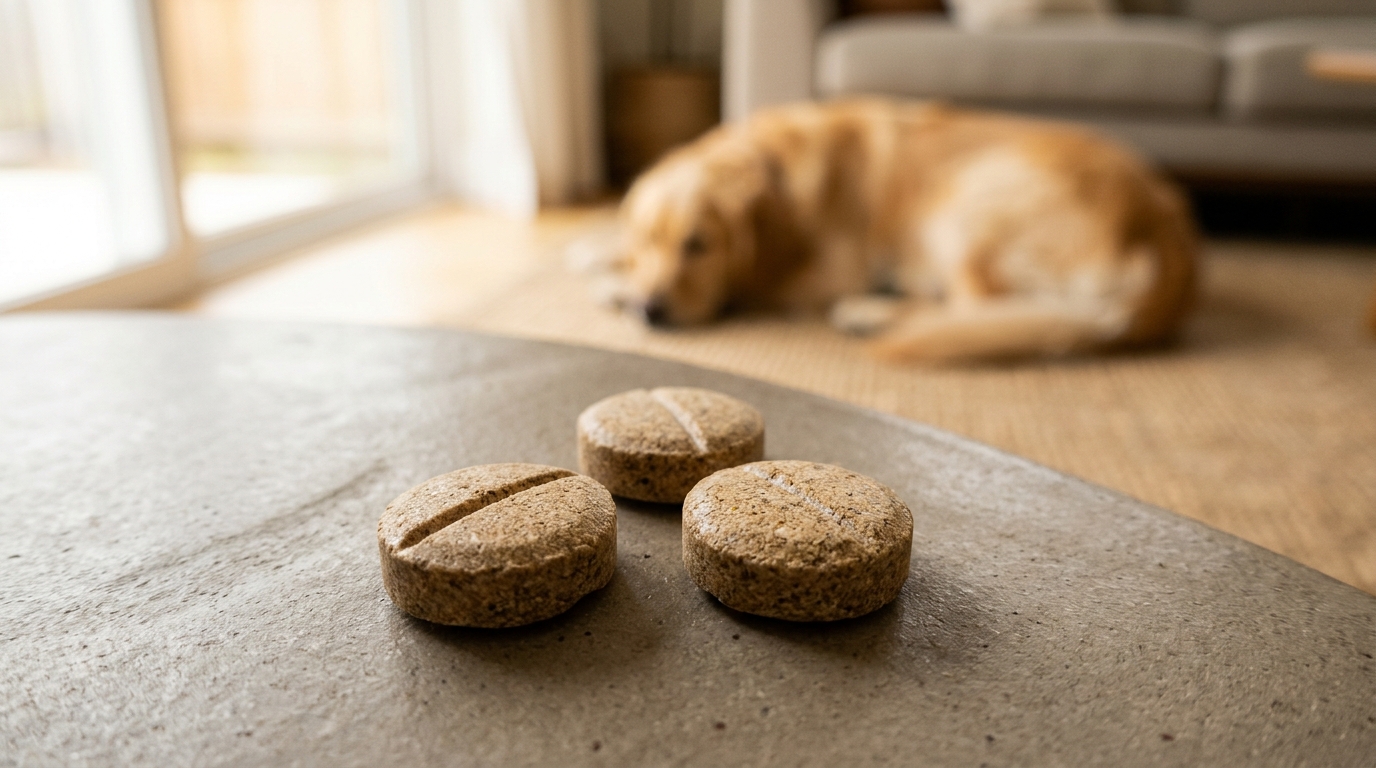
Analytical chemists have developed and validated an eco-efficient ultraviolet spectrophotometric procedure designed to quantify the non-steroidal anti-inflammatory drug carprofen in commercial chewable tablets intended for veterinary medicine. Carprofen, chemically designated as 2-(6-chloro-9H-carbazol-2-yl)propanoic acid, is widely administered in animal healthcare to manage post-surgical pain and chronic inflammation stemming from osteoarthritis, predominantly in canine patients. Although injectable solutions are formulated for both dogs and cats, chewable tablets are favored in canine therapy because of their exceptional ease of oral administration. Despite the widespread clinical use of this active pharmaceutical ingredient, existing analytical literature reveals a pronounced scarcity of quality control procedures that combine practical laboratory workflows with environmentally benign chemistry. By intentionally replacing hazardous organic solvents with ethanol and purified water, the newly developed assay establishes a stability-indicating ultraviolet protocol that satisfies the dual tenets of Green Analytical Chemistry and White Analytical Chemistry, delivering a reliable testing protocol suited for routine pharmaceutical manufacturing and regulatory quality verification.
The underlying motivation for modernizing carprofen testing stems from the heavy environmental and occupational burdens imposed by legacy analytical practices. A comprehensive literature survey evaluating physicochemical procedures published between 2015 and 2026 revealed that more than 71.42 percent of existing carprofen quantification methods depend on high-performance liquid chromatography, while only 14.28 percent make use of ultraviolet spectrophotometry. Furthermore, standard testing workflows frequently rely on hazardous diluents, with methanol appearing in over 85.71 percent of published protocols, acetonitrile in more than 42.86 percent, and glacial acetic acid in over 28.57 percent. Inhaled or ingested methanol exhibits severe biological toxicity through its metabolic breakdown into formaldehyde and formic acid, provoking systemic metabolic acidosis, severe organ damage, visual impairment, and central nervous system disruption. Acetonitrile similarly carries grave occupational dangers through its metabolic transformation into toxic cyanide, which impairs cellular respiration and triggers neurological symptoms including lethargy, vomiting, and seizures. By demonstrating that ethanol and purified water can replace toxic reagents, the research aligns pharmaceutical analysis with the United Nations Sustainable Development Goals.
To establish the physical basis of the assay, the investigators procured a reference standard of carprofen with an established purity of 99.70 percent alongside commercially sourced 25 milligram chewable tablets with an average tablet weight of 275.44 milligrams. The target drug shows low aqueous solubility and limited solubility in 2-propanol, but dissolves readily in methanol and exhibits high solubility in acetone. The study designed a stock preparation that powdered twenty whole tablets, extracted a portion equivalent to 2.0 milligrams of carprofen into ethanol inside a 25 milliliter volumetric flask, and applied ultrasonic agitation for two minutes before filling to volume to yield an initial concentration of 80 micrograms per milliliter. Working standard and sample solutions were subsequently prepared by transferring stock aliquots into 10 milliliter volumetric flasks and completing the volume with purified water, generating operational concentrations spanning 1.4 to 5.0 micrograms per milliliter. Transmittance measurements across thirty-three reference concentrations ranging between 0.2 and 20 micrograms per milliliter were assembled into a Ringbom curve at 238 nanometers to locate the linear operational zone.
The selectivity of the spectrophotometric technique was demonstrated by examining spectral overlaps between the standard analyte, commercial tablet extracts, blank diluent, and an excipient pool mirroring typical chewable formulations. This adjuvant mixture combined 71 percent lactose monohydrate, 10 percent corn starch, 5 percent microcrystalline cellulose, 5 percent colloidal silicon dioxide, 3 percent povidone, 3 percent magnesium stearate, and 3 percent artificial meat flavoring. Absorbance scans confirmed that the adjuvant matrix and the water-ethanol blank showed no background absorption at the operating wavelength of 238 nanometers, ensuring that spectral responses originated exclusively from the carprofen molecule. To verify whether the method could selectively quantify carprofen in the presence of decomposition products, stress studies exposed tablet samples to 1 M hydrochloric acid at 80 degrees Celsius, 0.1 M sodium hydroxide at 60 degrees Celsius, purified water at 60 degrees Celsius, and 254 nanometer ultraviolet irradiation at room temperature. The degradation products generated under these extreme stress exposures were not analytically isolated or structurally identified by the authors.
The chemical stress testing demonstrated distinct degradation patterns across exposure conditions while confirming analytical selectivity. Under neutral, alkaline, and acidic conditions, carprofen in chewable tablets exhibited less than 5 percent total degradation across heating periods extending to five and eight hours. The structural stability observed during basic hydrolysis reflects the inherent chemical resistance of the aromatic carboxylic functional group found in the carprofen core when subjected to moderately alkaline environments. Under acidic exposure, the minor decomposition observed was hypothesized to stem from solvent-mediated esterification between ethanol and the carboxylic moiety, although definitive identification was not performed. In sharp contrast, exposing the formulation to photolytic stress inside the 254 nanometer chamber for twenty-four hours induced 20.92 percent degradation, confirming the established photosensitivity of carprofen documented in previous literature.
Rigorous validation demonstrated exceptional linear regression, experimental precision, and recovery accuracy across all testing tiers. The calibration line constructed across six standard levels—1.4, 2.0, 2.4, 3.0, 4.0, and 5.0 micrograms per milliliter—yielded a linear equation of y = 0.1757x + 0.0094 with a determination coefficient of 0.9997. Analysis of variance verified significant linear regression with a calculated F-statistic of 1400.28 against the critical table value of 4.75, while deviation from linearity remained non-significant at 0.38 compared to the 3.26 threshold at a 5 percent significance level. Residual analysis across eighteen measurements exhibited an entirely random distribution without systemic bias. Method precision, assessed at 3.0 micrograms per milliliter, generated relative standard deviations of 0.97 percent for intraday repeatability across six replicates, 2.12 percent for interday precision evaluated across twelve determinations on separate days, and 2.73 percent for interanalyst variability involving two independent operators, remaining comfortably below the 3 percent acceptance ceiling. Standard addition recovery experiments spanning 80, 100, and 120 percent spiking levels yielded a mean recovery of 99.34 percent, satisfying standard compendial criteria.
Method robustness was examined by systematically perturbing four independent operational parameters: the detection wavelength between 238 and 240 nanometers, quartz cuvette capacity between 1 and 4 milliliters, ethanol manufacturer brand between Halogenn and Êxodo Científica, and the inclusion versus omission of the initial ultrasonic water bath step. Variance comparison through Fisher F-tests confirmed equal variances between baseline and altered conditions, yielding calculated values of 1.00 for wavelength, 1.05 for ethanol manufacturer, 1.76 for cuvette capacity, and 1.81 for ultrasound, all residing well below the critical F-value of 19. Subsequent two-tailed Student t-tests demonstrated that minor variations in detection wavelength (t = 2.09), solvent supplier (t = 1.60), and cuvette volume (t = 1.05) exerted no statistically significant effect against the critical t-value of 2.78. Conversely, omitting the ultrasonic agitation step produced a calculated t-statistic of 3.53, exceeding the critical boundary. This finding indicates that ultrasonic cavitation for two minutes is an indispensable requirement during stock solution extraction to guarantee complete dissolution of carprofen from the chewable tablet matrix.
The practical utility of the validated method was verified through direct quantitative content analysis of commercial chewable tablets across three separate testing days in triplicate. The ultraviolet spectrophotometric assay registered an average carprofen content of 97.55 percent of declared label claim, which aligns with the official United States Pharmacopeia monograph specification requiring tablet potency to fall between 90 and 110 percent. When experimental results were statistically contrasted against an established carprofen assay from existing scientific literature, a Student t-test yielded an empirical t-value of 0.25, demonstrating no significant difference against the tabulated critical benchmark of 2.78 at the 5 percent significance level. Beyond providing numerical parity with reference techniques, the newly developed procedure delivers significant operational simplifications, reducing initial volumetric flask sizes from standard 100 milliliter vessels down to 25 milliliter containers. This vessel downsizing substantially curtails overall solvent consumption and waste generation during routine commercial batch release.
To provide a quantitative evaluation of environmental sustainability and operational efficiency, the analytical procedure was appraised using six independent green and white chemistry metrics: the National Environmental Methods Index, Eco-Scale Assessment, Analytical GREEnness metric, Carbon Footprint Reduction Index, Blue Applicability Grade Index, and the Click Analytical Chemistry Index. The National Environmental Methods Index displayed four completely green quadrants, confirming that ethanol is omitted from toxic chemical inventories and Environmental Protection Agency priority lists, operational pH stays safely between 2 and 12, and liquid effluent remains below the 50 milliliter threshold.
Further metric evaluations substantiated the balance between environmental responsibility and practical laboratory throughput. The Analytical GREEnness tool produced an overall score of 0.76, reflecting low sample mass, minimized solvent volumes, and the bio-based safety of ethanol, though the requirement for off-line manual benchtop transport prevented a higher rating under in-line monitoring criteria. The Carbon Footprint Reduction Index registered 85 points, credited to professional waste management ending in controlled high-temperature incineration, with score deductions caused by the non-reusable single-use status of the aqueous-ethanol diluent. The Blue Applicability Grade Index awarded 70 points for modest instrument energy demands, while penalizing manual sample dissolution and single-analyte throughput. The Click Analytical Chemistry Index scored the procedure at 74 points, highlighting rapid turnaround and low detection limits while noting the absence of full laboratory automation. In conclusion, this ultraviolet method offers a robust, validated, and eco-efficient alternative for routine veterinary pharmaceutical release, establishing that green solvents can successfully replace toxic mobile phases without compromising analytical precision.
Subject of Research: Eco-efficient ultraviolet spectrophotometric validation for quantifying carprofen in veterinary chewable tablets
Article Title: Development and validation of an eco-efficient UV spectrophotometric method for carprofen determination in chewable tablets
Article References: Alves, K. A., dos Santos Galvão, N. S., & Kogawa, A. C. (2026). Development and validation of an eco-efficient UV spectrophotometric method for carprofen determination in chewable tablets. Discover Chemistry, 3(1), Article 657. https://doi.org/10.1007/s44371-026-01092-8
Image Credits: AI Generated
DOI: 10.1007/s44371-026-01092-8
Keywords: Carprofen, Chewable Tablets, Veterinary Medicine, UV Spectrophotometry, Green Analytical Chemistry, White Analytical Chemistry, Analytical Validation, Eco-Scale Assessment, Analytical GREEnness Metric, Carbon Footprint Reduction Index, Blue Applicability Grade Index, Click Analytical Chemistry, Forced Degradation Testing, Drug Quality Control, Ethanol Diluent, Method Robustness
News Source: William Thompson. (November 29, 2026). Green Ultraviolet Spectrophotometric Method Accurately Quantifies Veterinary Carprofen in Chewable Tablets. Scienmag.