Credit: UT Health San Antonio
Scientists with the Greehey Children's Cancer Research Institute at UT Health San Antonio have discovered a surprising connection between a breast cancer protein, BRCA1, and a pediatric cancer called Ewing sarcoma.
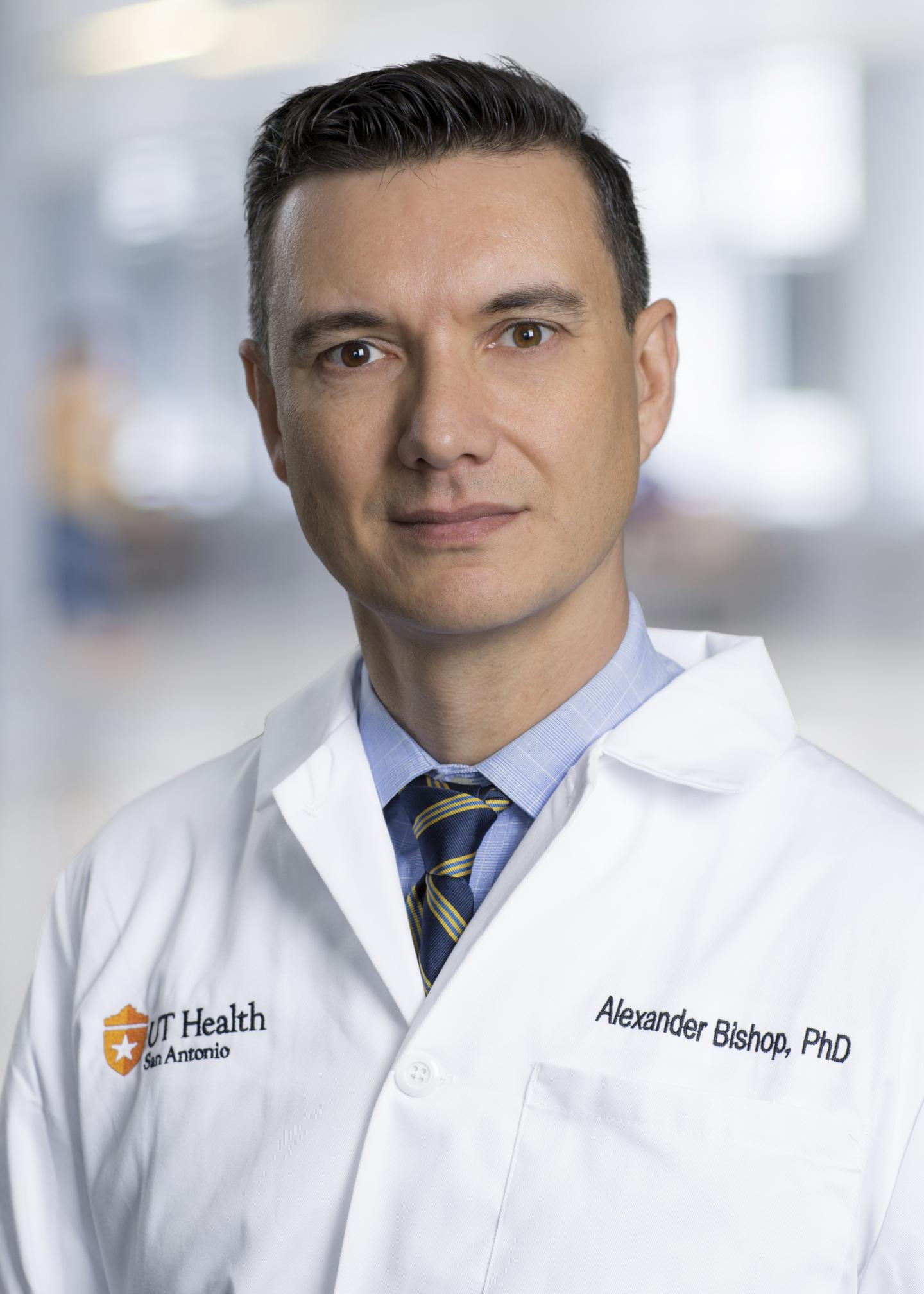
Their findings, reported March 7 in the journal Nature, reveal a completely new mechanism by which BRCA1 can be rendered dysfunctional. "The observations raise many new questions about both Ewing sarcoma and BRCA1 biology," said the study's senior author, Alexander J.R. Bishop, D.Phil., of UT Health San Antonio.
Ewing sarcoma is a pediatric bone and soft tissue cancer. The median age of Ewing sarcoma patients is 15 years, and more than half of patients are adolescents. "Our team worked to identify why Ewing sarcoma is usually sensitive to standard cancer drugs, with the hope of finding new targets for therapy and revealing new ways to treat the disease if it returns or does not respond to standard therapies," Dr. Bishop said.
Fused genes
Almost all Ewing sarcomas are caused by a rearrangement of two genes that are fused together. The resulting combination of the Ewing sarcoma protein, EWSR1, and another protein, usually FLI1, is called a "fusion oncogene." This bad actor promotes cancer.
The researchers reported in Nature that:
- The mutant protein produced by the fusion oncogene interferes with normal EWSR1 protein function. Because of this, the cancer's normal cell functions run unchecked.
- BRCA1, which repairs damaged DNA (genetic material) when those same cell functions shut off, cannot do this repair because the machinery keeps running.
"EWSR1 is like a train conductor who sees damage on the tracks ahead and stops the train," Dr. Bishop said. "BRCA1 is the repair crew who are passengers on the train and go fix the damage when the train stops. But now you've got this mutant bully, this fusion oncogene, who prevents the conductor from being able to stop the train and prevents the repair crew from getting off to work on the tracks."
###
Acknowledgments
Dr. Bishop joined UT Health San Antonio in 2005. He is an associate professor in the Department of Cell Systems & Anatomy within the Joe R. & Teresa Lozano Long School of Medicine. Concurrently he is a member of both the Greehey Children's Cancer Research Institute and the Mays Cancer Center, the newly named center at UT Health San Antonio MD Anderson Cancer Center.
This research is made possible by grants from the Max and Minnie Tomerlin Voelcker Fund, Hyundai Hope on Wheels, the National Cancer Institute and the Cancer Prevention & Research Institute of Texas.
The University of Texas Health Science Center at San Antonio, with missions of teaching, research and healing, is one of the country's leading health sciences universities and is now called UT Health San Antonio™. UT Health's schools of medicine, nursing, dentistry, health professions and graduate biomedical sciences have produced more than 33,000 alumni who are advancing their fields throughout the world. With seven campuses in San Antonio and Laredo, UT Health San Antonio has a FY 2018 revenue operating budget of $838.4 million and is the primary driver of its community's $37 billion biomedical and health care industry. For more information on the many ways "We make lives better®," visit http://www.uthscsa.edu.
Media Contact
Will Sansom
[email protected]
210-567-2579
@UTHealthSA
http://www.uthscsa.edu/hscnews
Original Source
https://news.uthscsa.edu/greehey-institute-team-finds-link-between-brca1-and-ewing-sarcoma/ http://dx.doi.org/10.1038/nature25748