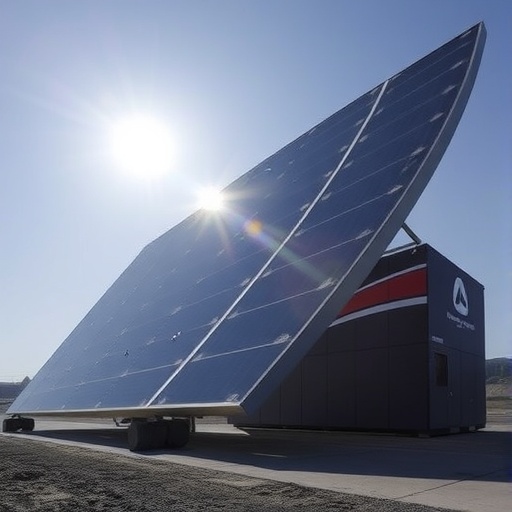
In an era where technological advancements are pushing the boundaries of what’s possible, the integration of cutting-edge materials into aerospace engineering is revealing unprecedented opportunities. Among these innovations, graphene—a material heralded for its extraordinary properties—has emerged as a vital component in the development of solar-photon sails. Researchers H. Liao, C. Shi, and X. Pan, along with their team, are drawing attention to a groundbreaking concept: the graphene solar-photon sail utilizing an Auger-like mechanism. This new technology aims to revolutionize space exploration and create artificial halo families around the Earth, marking a significant leap forward in our capabilities for interstellar travel.
Graphene, a single layer of carbon atoms arranged in a two-dimensional honeycomb lattice, is widely recognized for its remarkable strength, electrical conductivity, and thermal properties. These characteristics not only make graphene a fascinating subject of study but also provide a solid foundation for the development of advanced aerospace technologies. The recent advancements in synthesizing and manipulating graphene have led to its use in various applications, including flexible electronics, high-capacity batteries, and now, solar sails—one of the most promising innovations in space propulsion systems.
The concept of utilizing solar-photon sails for propulsion is rooted in the principles of physics, where light’s momentum can be harnessed to propel spacecraft. Unlike traditional propulsion systems, which rely heavily on fuel, solar sails utilize the pressure exerted by sunlight to facilitate movement. As the sail captures photons, the momentum transfer enables spacecraft to accelerate without the need for chemical propulsion. The incorporation of graphene into this system brings an additional advantage due to its ultra-lightweight nature and superior strength, enhancing the sail’s overall efficiency and performance.
At the center of this innovative design is the Auger-like mechanism, which references the physical process by which energy is transferred between particles without releasing photons. In the context of the graphene solar-photon sail, the Auger-like mechanism facilitates the efficient conversion of solar energy into kinetic energy, effectively amplifying the propulsion capabilities of the sail. This process is not only energy-efficient but also harnesses the natural abundance of sunlight, making it a sustainable option for deep-space exploration.
Moreover, the ability to create artificial halo families around Earth presents new opportunities for scientific research and satellite deployment. Current methods for maintaining objects in orbit often require significant resources and energy expenditure. The development of graphene solar-photon sails could simplify this process, granting scientists and engineers the ability to position satellites and other objects in specialized orbits with unprecedented precision, allowing for enhanced monitoring of Earth’s atmosphere and climate.
As we dive deeper into possibilities afforded by graphene solar-photon sails, the implications for space exploration become more pronounced. One of the most impactful applications lies in the potential for interplanetary missions. With the efficiency and power of a solar-photon sail, missions to Mars and beyond might be achieved more economically and feasibly than ever before. Consider astronauts traveling to distant worlds with the help of sails propelled by sunlight; such a prospect evokes excitement and inspiration for future generations.
In addition to furthering our reach in space, graphene solar-photon sails offer the promise of alleviating some of the environmental impacts associated with traditional space missions. The reliance on chemical fuels generates waste and emits pollutants into the atmosphere and beyond, directly affecting space debris problems. By employing sunlight as a power source, this innovative technology presents a cleaner alternative, potentially reducing humanity’s ecological footprint as we venture into the final frontier.
Furthermore, the exploration of gravitational fields around celestial bodies is enhanced through the strategic use of artificial halo families established by graphene solar-photon sails. These halos create stable zones that can serve as human outposts or observation stations for astrophysical research. The orbiting stations could offer continuous surveillance of cosmic phenomena—tracking asteroids, monitoring solar activity, and exploring the vast mysteries of dark matter and dark energy.
As with any novel technology, the development of graphene solar-photon sails will face its share of challenges, particularly in manufacturing techniques and real-world applications. Scaling the production of high-quality graphene while ensuring the integrity of its unique properties will require stringent research and development. Moreover, ensuring the resilience of the sails against space conditions such as radiation, micrometeoroids, and thermal fluctuations will necessitate comprehensive testing and innovation.
With the projected publication of Liao, Shi, and Pan’s research article in 2025, the scientific community looks forward to gaining valuable insight into the methodologies and findings of their work. This study has the potential to ignite further research avenues and collaborations across disciplines, paving the way for advancements not only in aerospace engineering but also in materials science, physics, and environmental engineering.
In conclusion, the integration of graphene solar-photon sails powered by an Auger-like mechanism marks a transformative step in the quest for sustainable space propulsion. This innovation holds promise not merely for scientific endeavor but also for fostering a deeper engagement between humanity and the cosmos. As we stand on the brink of this new frontier, the possibilities are as endless as space itself.
By exploring the versatility of graphene and the implications of the Auger-like mechanism, researchers are not just enhancing our technological capabilities; they are redefining our relationship with space and paving the way for a more sustainable future. As we anticipate the publication of their findings, one can only imagine the profound effects this groundbreaking work will have on the fields of aerospace exploration and material sciences.
Subject of Research: Graphene solar-photon sail technology and Auger-like mechanisms for space exploration.
Article Title: Graphene solar-photon sail with Auger-like mechanism for sun-earth artificial halo family.
Article References:
Liao, H., Shi, C., Pan, X. et al. Graphene solar-photon sail with Auger-like mechanism for sun-earth artificial halo family. AS (2025). https://doi.org/10.1007/s42401-025-00427-0
Image Credits: AI Generated
DOI: 10.1007/s42401-025-00427-0
Keywords: Graphene, solar-photon sail, Auger-like mechanism, space exploration, sustainable propulsion, artificial halo family.
Tags: advanced materials in aerospaceadvancements in graphene synthesisartificial halo families around EarthAuger-like mechanism in space travelcutting-edge space propulsion systemsfuture of solar-powered spacecraftgraphene applications in space explorationgraphene solar sailsinnovative aerospace engineeringinterstellar travel innovationssolar-photon propulsion technologystrength and conductivity of graphene