• HOME
  • NEWS
  • EXPLORE
    • CAREER
      • Companies
      • Jobs
    • EVENTS
    • iGEM
      • News
      • Team
    • PHOTOS
    • VIDEO
    • WIKI
  • BLOG
  • COMMUNITY
    • FACEBOOK
    • INSTAGRAM
    • TWITTER
Saturday, February 7, 2026
BIOENGINEER.ORG
No Result
View All Result
  • Login
  • HOME
  • NEWS
  • EXPLORE
    • CAREER
      • Companies
      • Jobs
        • Lecturer
        • PhD Studentship
        • Postdoc
        • Research Assistant
    • EVENTS
    • iGEM
      • News
      • Team
    • PHOTOS
    • VIDEO
    • WIKI
  • BLOG
  • COMMUNITY
    • FACEBOOK
    • INSTAGRAM
    • TWITTER
  • HOME
  • NEWS
  • EXPLORE
    • CAREER
      • Companies
      • Jobs
        • Lecturer
        • PhD Studentship
        • Postdoc
        • Research Assistant
    • EVENTS
    • iGEM
      • News
      • Team
    • PHOTOS
    • VIDEO
    • WIKI
  • BLOG
  • COMMUNITY
    • FACEBOOK
    • INSTAGRAM
    • TWITTER
No Result
View All Result
Bioengineer.org
No Result
View All Result
Home NEWS Science News Chemistry

Graphene mapping 50 times faster

Bioengineer by Bioengineer
February 6, 2020
in Chemistry
Reading Time: 3 mins read
0
IMAGE
Share on FacebookShare on TwitterShare on LinkedinShare on RedditShare on Telegram

IMAGE

Credit: ©Science China Press


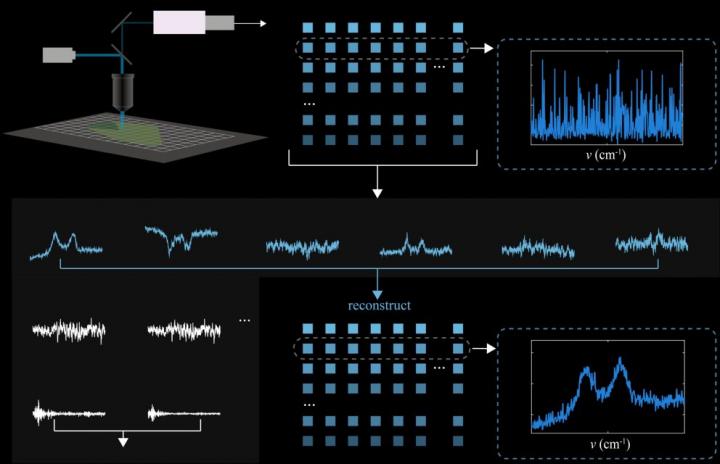
Graphene is always raising high expectations, as a strong, ultrathin, two-dimensional material that could also be the basis for new components in information technology. There is huge need for characterization of graphene devices. This can be done using Raman spectroscopy. Laser light is sent to the material sample, and scattered photons tell us about the rotations and vibrations of the molecules inside, and thus about the crystal structure. On average, only around 1 in 10 million photons is scattered in this way. This not only makes it hard to detect the right information, it is also very slow: it may take half a second to image one single pixel. The question is if Raman still remains the best option, or if there are better alternatives. UT researchers Sachin Nair and Jun Gao keep Raman spectroscopy as a starting point, but manage to improve the speed drastically: not by changing the technique itself, but by adding an algorithm.

Noise reduction

This algorithm is not unknown in the world of signal processing and it is called Principal Component Analysis. It is used to improve the signal-to-noise ratio. PCA determines the characteristics of noise and those of the ‘real’ signal. The larger the dataset, the more reliable this recognition is, and the clearer the actual signal can be distinguished. Apart from that, modern Raman instruments have a detector called electron-multiplying charge-coupled device (EMCCD) that improves the signal-to-noise-ratio. The net result of this work is that processing one pixel doesn’t take half a second, but only 10 milliseconds or less. Mapping a single sample doesn’t take hours anymore. An important feature for vulnerable materials like graphene oxide is that the intensity of the laser can be lowered two or three orders of magnitude. These are major steps ahead for getting a fast grip on the materials’ properties.

Multi-purpose

Except for graphene, the improved Raman technique can also be used for other two dimensional materials like germanene, silicene, molybdenum disulfide, tungsten disulfide and boron nitride. Use of the algorithm is not limited to Raman spectroscopy; techniques like Atomic Force Microscopy and other hyperspectral techniques could also benefit from it.

The research has been done in the group Physics of Complex Fluids of Prof Frieder Mugele, part of UT’s MESA+ Institute. The researchers collaborated with the Medical Cell BioPhysics group and the Physics of Interfaces and Nanomaterials group, both of the University of Twente as well.

###

See the article:

Sachin Nair, Jun Gao, Qirong Yao, Michael Duits, Cees Otto and Frieder Mugele

National Science Review, nwz177, https://doi.org/10.1093/nsr/nwz177

The National Science Review is the first comprehensive scholarly journal released in English in China that is aimed at linking the country’s rapidly advancing community of scientists with the global frontiers of science and technology. The journal also aims to shine a worldwide spotlight on scientific research advances across China.

Media Contact
Jun Gao
[email protected]

Related Journal Article

http://dx.doi.org/10.1093/nsr/nwz177

Tags: Chemistry/Physics/Materials Sciences
Share14Tweet8Share2ShareShareShare2

Related Posts

blank

Breakthrough in Environmental Cleanup: Scientists Develop Solar-Activated Biochar for Faster Remediation

February 7, 2026
blank

Cutting Costs: Making Hydrogen Fuel Cells More Affordable

February 6, 2026

Scientists Develop Hand-Held “Levitating” Time Crystals

February 6, 2026

Observing a Key Green-Energy Catalyst Dissolve Atom by Atom

February 6, 2026
Please login to join discussion

POPULAR NEWS

  • Robotic Ureteral Reconstruction: A Novel Approach

    Robotic Ureteral Reconstruction: A Novel Approach

    82 shares
    Share 33 Tweet 21
  • Digital Privacy: Health Data Control in Incarceration

    63 shares
    Share 25 Tweet 16
  • Study Reveals Lipid Accumulation in ME/CFS Cells

    57 shares
    Share 23 Tweet 14
  • Breakthrough in RNA Research Accelerates Medical Innovations Timeline

    53 shares
    Share 21 Tweet 13

About

We bring you the latest biotechnology news from best research centers and universities around the world. Check our website.

Follow us

Recent News

Decoding Prostate Cancer Origins via snFLARE-seq, mxFRIZNGRND

Digital Health Perspectives from Baltic Sea Experts

Florida Cane Toad: Complex Spread and Selective Evolution

Subscribe to Blog via Email

Enter your email address to subscribe to this blog and receive notifications of new posts by email.

Join 73 other subscribers
  • Contact Us

Bioengineer.org © Copyright 2023 All Rights Reserved.

Welcome Back!

Login to your account below

Forgotten Password?

Retrieve your password

Please enter your username or email address to reset your password.

Log In
No Result
View All Result
  • Homepages
    • Home Page 1
    • Home Page 2
  • News
  • National
  • Business
  • Health
  • Lifestyle
  • Science

Bioengineer.org © Copyright 2023 All Rights Reserved.