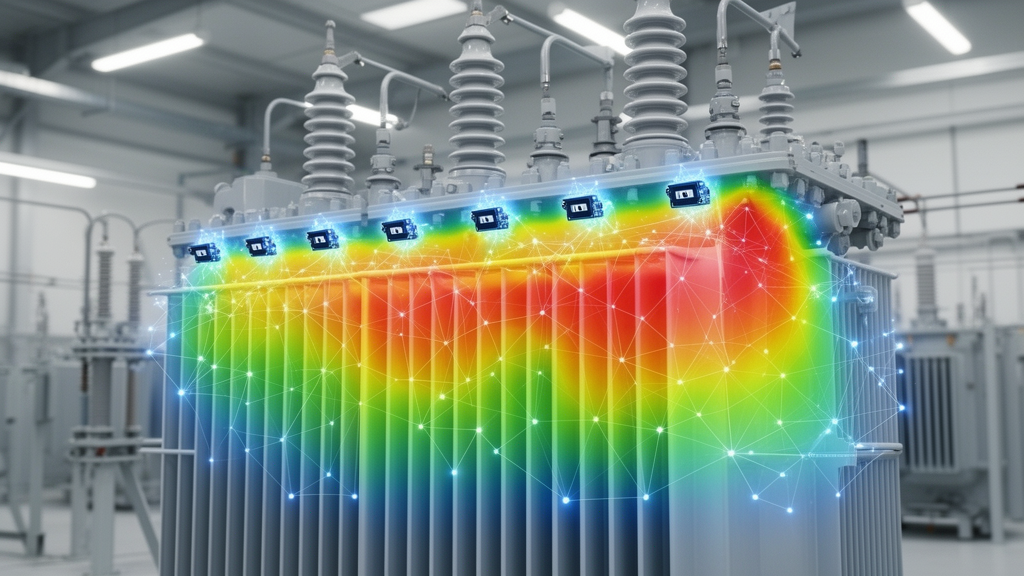
A research team has demonstrated a deep learning architecture that reconstructs transient thermal fields inside high-voltage electrical equipment in real time using measurements from only three external sensors. Described in the journal Digital Engineering, the framework pairs an Edge-Featured Graph Isomorphism Network with Gated Recurrent Units to infer internal temperature states across complex three-dimensional geometries. Operating on simulated ultra-high voltage gas-insulated transmission lines, the Sparse-Driven Spatio-Temporal Graph Neural Network achieved an overall root mean square error of 0.036 degrees Celsius and kept worst-case node errors below 0.08 degrees Celsius across thousands of mesh points. The model executes single-step predictions in 10.93 milliseconds on a graphics processing unit, compressing inference latency compared to numerical solvers. By embedding discretized physical laws into graph connections, the approach provides an engineering pathway for thermal monitoring where internal sensor placement is impossible.
Constructing operational digital twins for energy infrastructure has long faced an efficiency-fidelity-interpretability trilemma. Traditional physics-driven numerical approaches, including the finite element method and finite volume method, solve partial differential equations to deliver rigorous, interpretable descriptions of physical field evolution. However, their computational cost remains prohibitive for real-time monitoring, as a single transient simulation requires tens of minutes to several hours on central processing units. Conversely, pure data-driven neural networks offer millisecond inference speeds but operate as opaque black boxes that lack physical interpretability and suffer from severe generalization deficits in sparsely sensed regions. Standard deep networks struggle to extrapolate accurately across areas distant from sparse sensors. Existing hybrid surrogates that blend physics with machine learning have largely remained confined to simplified geometries or steady-state scenarios, leaving sparse-to-dense transient field reconstruction on unstructured three-dimensional meshes an unresolved engineering challenge.
This technological bottleneck is especially acute in ultra-high voltage gas-insulated transmission lines, which operate under extreme voltages, strong electromagnetic fields, and elevated temperatures. Within these enclosed systems, internal conductors and insulating spacers experience intense thermal stress, yet direct monitoring is precluded by the harsh environment and dielectric safety requirements. Operators must rely on sparse temperature sensors affixed to the accessible outer metal enclosure. Conventional inversion methods relying on empirical formulas exhibit significant temporal lag and low precision, while high-fidelity multi-physics simulations cannot keep pace with real-time operational shifts. Because equipment lifespan depends on identifying localized hotspots along internal conductor-insulator interfaces, monitoring systems require an architecture capable of mapping sparse boundary readings to dense internal physical states without sacrificing physical consistency or computational speed.
To bridge the divide between sparse observations and full-field digital twins, the researchers developed the Sparse-Driven Spatio-Temporal Graph Neural Network around finite element mesh topology. Rather than treating physical fields as Euclidean grids or independent point series, the architecture converts the three-dimensional computational mesh into an undirected graph where surface nodes serve as vertices and mesh element connectivity defines graph edges. For the single-insulator geometry studied, 2810 computational mesh vertices were directly mapped to graph nodes, while only three nodes on the outer enclosure provided active sensor inputs. Crucially, the researchers incorporated four-dimensional edge feature vectors containing normalized Euclidean distances and three-dimensional unit direction vectors. The normalized distance parameter explicitly represents local thermal resistance scales, reflecting the physical principle that shorter distances enable stronger heat flux, while the unit direction vector captures directional anisotropy in heat conduction, embedding physical inductive biases directly into the network architecture.
The core computational pipeline couples spatial graph convolutions with recurrent temporal tracking in a unified framework. In the spatial dimension, the Edge-Featured Graph Isomorphism Network performs message-passing operations that mirror the discretized heat diffusion equation. Central node representations correspond to thermal inertia, neighboring feature aggregations capture heat flux contributions, and edge projections modulate signals according to physical distance and direction. Node representations are projected to a 128-dimensional hidden space before entering the graph convolution layers. To track temporal evolution and account for thermal inertia, the resulting spatial representations across historical observation windows are processed through Gated Recurrent Units. Using an optimal sliding window of six historical time steps spanning sixty seconds of operational data, the gating mechanisms within the recurrent units selectively preserve thermal history, allowing the network to distinguish instantaneous electrical load shifts from gradual heat accumulation before a linear output layer decodes full-field temperatures.
To train and validate the framework, the investigators generated a comprehensive multi-physics dataset modeling an ultra-high voltage gas-insulated transmission line section equipped with a three-post epoxy insulator. Using the finite element solver COMSOL Multiphysics, they executed twelve-hour transient simulations coupling solid heat conduction, conductor Joule heating, external natural convection, surface thermal radiation, and non-isothermal sulfur hexafluoride gas flow across approximately 110,000 mesh elements. The simulation campaign examined four electrical load levels ranging from 6000 to 6400 amperes alongside eleven ambient temperature conditions spanning 20 to 40 degrees Celsius in two-degree increments. Conventional finite element simulations required approximately 78 minutes, or 4712 seconds, to resolve each 45,151-second transient operational scenario. Graph node coordinates and transient temperature fields were aligned using a bidirectional KD-tree algorithm, with three virtual sensors positioned on the outer enclosure surface at the structural contact points of the three insulator support pillars.
Across validation testing on unseen operational scenarios, the spatio-temporal model demonstrated high fidelity in reconstructing internal temperature distributions. The system achieved an overall root mean square error of 0.05 degrees Celsius on representative test snapshots, with maximum spatial deviations strictly bounded within plus or minus 0.27 degrees Celsius. Visual comparisons among the finite element ground truth, predicted fields, and spatial residual distributions confirmed that the network accurately localized high-temperature hotspots near internal conductors while preserving smooth gradients in low-flux zones. Across all 2810 evaluation nodes, the worst-case node maintained a root mean square error of 0.0794 degrees Celsius and a coefficient of determination of 0.9988. Errors were distributed uniformly across the structural geometry rather than concentrating along complex material interfaces or sensor blind zones, demonstrating that the network avoided localized divergence even in areas farthest from physical sensors.
Systematic ablation experiments confirmed that accurate transient thermal reconstruction strictly requires simultaneous spatial coupling, geometric edge encoding, and temporal memory. Evaluating a spatial-only architecture by removing the recurrent temporal units caused catastrophic failure, producing static outputs that yielded an overall root mean square error of 26.19 degrees Celsius and a negative coefficient of determination of minus 37.42. Conversely, a temporal-only model that processed each node as an isolated time series without spatial convolutions plateaued at an overall error of 0.45 degrees Celsius, with worst-case node errors reaching 1.265 degrees Celsius. In areas experiencing dense heat flux, the temporal-only model exhibited systematic mean-reverting errors exceeding 5 degrees Celsius, overestimating temperatures during initial warming phases and underestimating steady-state levels. Furthermore, stripping geometric distance and direction attributes from graph connections caused overall error to surge to 2.413 degrees Celsius, proving that topological adjacency alone cannot substitute for explicit physical resistance metrics.
The investigation also evaluated how strategies for handling unobserved sensory nodes influence reconstruction accuracy. The authors compared baseline zero-filling and minus-one filling against input-level gating with binary observation masks and trainable parameter embeddings. Complex missing-value methods offered no performance advantages over straightforward numerical filling; input-level gating achieved an overall error of 0.0632 degrees Celsius and learnable embeddings reached 0.0546 degrees Celsius, both trailing zero-filling at 0.0361 degrees Celsius. Physical regularization from graph topology and metric edge features dominated inference, rendering the model insensitive to input placeholder choices. In contrast, replacing the summation aggregation of the graph isomorphism network with dynamic attention mechanisms in an alternative architecture degraded overall error to 4.06 degrees Celsius, as three sensors could not supply sufficient supervisory signals to train attention weights across tens of thousands of edges. Traditional inverse distance weighting combined with recurrent units likewise failed, yielding an error of 8.77 degrees Celsius due to its inability to capture material boundaries.
Sensitivity analyses further confirmed that the proposed network maintains robust stability under engineering uncertainties, including sensor sparsity, physical placement tolerances, and stochastic initialization. Incrementally varying the number of surface sensors from one to nine demonstrated that overall reconstruction errors remained between 0.0563 and 0.1356 degrees Celsius. Even with a single surface sensor on the outer enclosure, the model achieved an overall root mean square error of approximately 0.116 degrees Celsius. Simulating installation inaccuracies by randomly shifting sensor positions between one and three centimeters along the casing resulted in absolute performance deviations below 0.03 degrees Celsius, well within standard measurement tolerances. Across five random initialization seeds, the model converged consistently, yielding an average overall error of 0.0933 degrees Celsius with a standard deviation of 0.0412 degrees Celsius. When evaluated on a complex multi-component assembly encompassing 4347 nodes across an epoxy insulator and aluminum alloy conductor, the network achieved an overall error of 0.0363 degrees Celsius, demonstrating generalization across distinct material regions with sharp conductivity contrasts.
In computational efficiency assessments, the deep learning model achieved substantial acceleration over numerical solvers, reducing per-step inference latency to 10.93 milliseconds on an NVIDIA RTX 4090 D graphics processor compared to the multi-second time steps required by finite element calculations on a 28-core central processing unit. This performance represents a 9.5-fold acceleration for retrospective offline analysis and an improvement of one to two orders of magnitude for online transient monitoring. Despite these results, the authors emphasized key limitations in their study. Because the network was trained exclusively on synthetic simulations, a simulation-to-reality gap may arise from factors such as contact thermal resistance, material aging, and environmental sensor noise. Furthermore, algorithmic optimization of sensor placement and dynamic model updating were not examined. Future research directions include deploying the architecture on a physical transmission line test platform, developing continuous learning routines for online adaptation, and establishing mathematical frameworks to jointly optimize sensor numbers and placement layouts.
Subject of Research: Transient thermal field reconstruction for digital twins of electrical equipment using spatio-temporal graph neural networks.
Article Title: Sparse-Driven Spatio-Temporal Graph Neural Networks for high-fidelity real-time thermal field reconstruction in digital twins
Article References: Luo, L., Qin, W., Yu, W., Li, C., He, J., & Zhang, H. (2027). Sparse-Driven Spatio-Temporal Graph Neural Networks for high-fidelity real-time thermal field reconstruction in digital twins. Digital Engineering, 13, Article 100152. https://doi.org/10.1016/j.dte.2026.100152
Image Credits: AI Generated
DOI: 10.1016/j.dte.2026.100152
Keywords: digital twins, graph neural networks, spatio-temporal modeling, thermal field reconstruction, gas-insulated transmission lines, ultra-high voltage, finite element method, GINE, gated recurrent units, sparse sensing, heat diffusion, thermal management, surrogate modeling, computational heat transfer, edge feature engineering, power equipment monitoring, unstructured meshes
News Source: Cassandra Pierce. (November 26, 2026). Graph Neural Networks Reconstruct High Voltage Equipment Temperatures from Sparse Surface Sensors. Scienmag.