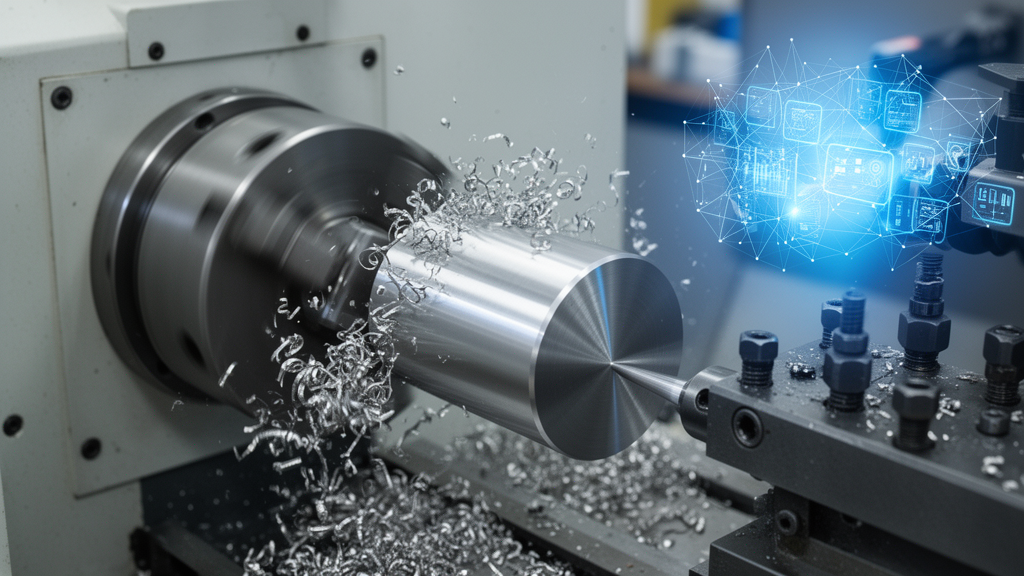
A hybrid modeling framework integrating physics-informed graph neural networks with evolutionary optimization has successfully balanced machining precision, tool forces, and direct operational carbon emissions in titanium alloy turning operations. Researchers Mingming Wu and Mingyu Lu developed the computational architecture to address the intricate multi-physics interactions inherent in cryogenic minimal quantity lubrication, a clean manufacturing approach that pairs liquid nitrogen jet cooling with micro-liter lubricant delivery. Unlike conventional manufacturing models that treat environmental impact as a passive secondary consequence of electrical energy consumption, the research explicitly establishes a dedicated carbon efficiency metric as an independent optimization target co-evaluated with finished workpiece surface roughness and cutting force. Evaluated on titanium alloy workpieces under controlled turning conditions, the graph-based framework captured coupled thermal, mechanical, and fluid interactions across cutting interfaces, demonstrating that systematic data-driven modeling can accurately reconcile conflicting operational objectives that historically required costly trial-and-error physical experimentation.
The industrial context surrounding modern manufacturing underscores an urgent requirement for rigorous carbon accounting alongside mechanical productivity. Machining processes account for more than fifteen percent of total industrial energy consumption globally, with turning operations alone responsible for over thirty percent of that mechanical share. Traditional machining processes have historically depended upon extensive flooding with conventional cutting fluids to suppress high cutting temperatures and extend cutting tool endurance. However, conventional wet cutting consumes vast chemical resources and creates severe chemical pollution and disposal hazards, while dry cutting alternatives accelerate abrasive tool wear and drive up operational electrical power consumption due to extreme friction and heat generation. Cryogenic minimal quantity lubrication technology has emerged as a promising sustainable pathway by discharging targeted liquid nitrogen jets to induce rapid localized cooling while atomizing minute quantities of lubricant to preserve interfacial lubricity. Despite these operational merits, industrial deployment has remained impeded because intense low-temperature cooling and micro-droplet film formation create complex thermodynamic trade-offs that conventional empirical methods cannot reliably balance.
To establish a quantifiable environmental benchmark for process optimization, the researchers formulated the carbon efficiency ratio as an explicit mathematical objective defined as equivalent carbon dioxide emissions generated per unit of material removal volume. The physical accounting boundary of this carbon metric is intentionally confined to the direct machining stage, incorporating instantaneous cutting spindle energy consumption, auxiliary pump electrical power utilized for micro-lubricant delivery, and the proportional liquefaction energy required to prepare the liquid nitrogen allocated to the active cutting duration. Upstream supply chain emissions, including raw metal extraction and carbide tool manufacturing, as well as downstream component disposal and waste management phases, were excluded from the computational boundary because the optimization targets immediate, unit-process operational decisions rather than broad corporate lifecycle assessments. To allow the model to adapt dynamically to diverse regional electrical grids without altering the underlying mechanical cutting physics, the carbon efficiency formulation incorporates a regional electricity grid emission coefficient, calibrated in this investigation to East China’s 2023 grid carbon intensity of 0.581 kilograms of carbon dioxide per kilowatt-hour.
Transforming the complex mechanical interactions of the cutting zone into computable structured topology required constructing a heterogeneous tri-partite industrial graph representing tool, workpiece, and coolant systems. The graph node configuration comprises three distinct subsets: tool nodes encoding Rockwell hardness between 58 and 62 HRC along with coating properties and nose radius; workpiece nodes capturing Ti-6Al-4V alloy thermal conductivity and yield strength; and coolant nodes defining liquid nitrogen jet velocity between 15 and 30 meters per second alongside lubricant viscosity and nozzle spray angles. Each physical node is characterized by an eight-dimensional normalized attribute embedding vector. Spatial and thermal relational edges connect adjacent nodes whenever their Euclidean distance within the cutting zone remains below five millimeters or their interfacial temperature gradient exceeds fifty Kelvin, generating a sparse binary adjacency matrix with approximately twelve percent connection density. Edge weights are further modulated by a directional coolant influence factor ranging between 0.3 and 0.8 determined by nozzle impingement geometry, providing a structured topological map of cutting interactions.
Rather than relying purely on black-box deep learning or computationally prohibitive finite element solvers, the architecture embeds governing physical principles directly into its feature constraints and graph inductive biases. The physical prior layer incorporates three fundamental analytical formulations: a cutting zone total heat flux density equation accounting for shear strain plastic work, frictional contact dissipation, and turbulent convective heat transfer; a liquid nitrogen jet heat transfer equation featuring a dedicated phase-change source term that models rapid vaporization heat absorption; and a micro-liquid film lubrication dynamics equation that tracks hydrodynamic lubricant film thickness against thermal viscosity decay and nitrogen vaporization mass loss. Instead of solving these differential equations sequentially, key field variables including shear stress distributions, interfacial temperature gradients, and liquid film thicknesses are mapped onto node and edge features within the industrial graph. Through message-passing convolution layers, the graph neural network learns the implicit non-linear coupling between thermal dissipation, mechanical cutting resistance, and fluid transport directly from experimental data.
The core predictive engine processes the industrial graph through a multi-head graph attention convolution architecture paired with residual gated updates, a multi-scale feature pyramid, and specialized objective decoupling heads. The multi-head attention mechanism deploys four parallel projection heads with sixteen-dimensional key vectors to extract relational feature correlations across microscopic and mesoscopic cutting scales, while gated linear units and layer normalization prevent gradient degradation during backpropagation. To resolve inherent multi-objective trade-offs, the decoupling head applies specialized task weights to the shared representations: surface roughness receives a weight of 0.02, main cutting force receives a weight of 0.07, and carbon efficiency receives a weight of 0.91. These weights directly reflect target prediction uncertainty, where the carbon metric demonstrates an exceptionally tight standard deviation of 0.025, compared to 0.08 for surface roughness and 18.5 for cutting force. This dynamic weighting strategy intentionally allocates predictive resources toward the most stable and reliable operational indicators.
Global exploration of the Pareto-optimal parameter space is conducted via an improved differential evolution algorithm featuring an adaptive dynamic scaling factor and a strict hierarchical constraint-dominated mechanism. To prevent catastrophic mechanical failure during physical implementation, candidate parameter sets must satisfy three rigid process safety boundaries prior to evaluating objective trade-offs: cutting tool temperature must not exceed 600 degrees Celsius to prevent thermal degradation and oxidation of the tool’s TiAlN coating; the lubricant film thickness ratio must equal or exceed 3.0 to maintain full fluid-film elastohydrodynamic lubrication and prevent abrasive tool-chip asperity contact; and cutting speed must remain within safe machine boundaries between 80 and 160 meters per minute. When any candidate parameter combination breaches these boundaries, a heavy penalty multiplier of one thousand scales the violation degree, forcing the optimization algorithm to discard infeasible operational states before ranking feasible solutions across normalized surface finish, cutting force, and carbon efficiency objectives.
Empirical calibration and validation relied upon a systematic orthogonal turning experiment conducted on Ti-6Al-4V titanium alloy across twenty-seven distinct parameter combinations encompassing cutting speed, feed rate, depth of cut, and cooling modes including dry cutting, conventional micro-lubrication, and cryogenic liquid nitrogen delivery. With each operational condition tested across three independent runs, eighty-one initial datasets were generated, capturing white-light interferometry surface roughness, dynamometer cutting forces, calibrated coolant flow rates, and infrared thermal imaging. Applying a three-sigma statistical filter identified and removed two anomalous outliers representing 2.5 percent of samples, leaving seventy-nine validated observational records. The dataset was partitioned through stratified random sampling based on cooling method into a training split of fifty-six samples and a test split of twenty-three samples. Model training executed on an NVIDIA RTX 3090 graphics processing unit under five-fold stratified cross-validation, averaging 42.3 minutes of training time per fold while achieving a rapid inference latency of 11.8 milliseconds per parameter configuration.
Ablation experiments confirmed that the proposed graph architecture substantially outperforms traditional empirical estimation models and standard machine learning baselines across all target metrics. Surface roughness predictions, which spanned true values between 0.35 and 0.65 micrometers, achieved a root mean square error of 0.097 micrometers with an average prediction error of 6.7 percent under the full graph model, contrasting sharply with an 18.3 percent error and 0.125 root mean square error observed for empirical baselines. Cutting force predictions across actual loads of 160 to 250 Newtons reached a root mean square error of 21.3 Newtons and an average error of 5.3 percent, outperforming the baseline error of 14.2 percent. Carbon efficiency predictions across the 0.12 to 0.15 grams of carbon dioxide per cubic millimeter range recorded a root mean square error of 0.028 and an average error of only 4.6 percent, compared to 12.8 percent baseline deviation. Systematic component decomposition demonstrated that the deep fusion module provided the largest isolated contribution to accuracy at 3.9 percent, followed by the graph convolutional layer at 3.5 percent, multi-head attention at 3.1 percent, and residual connections at 2.4 percent.
Multi-objective optimization verification demonstrated pronounced operational improvements when compared directly against conventional empirical parameter selection and radial basis function support vector machines. On the independent testing dataset, the proposed framework achieved a 15.1 percent improvement in finished surface roughness, lowering mean values from 0.58 to 0.50 micrometers, alongside a 9.4 percent reduction in resultant cutting force from 242 to 219 Newtons. Operational carbon efficiency improved by 10.5 percent, descending from 0.157 to 0.141 grams of carbon dioxide per cubic millimeter of removed material. Furthermore, overall machining energy consumption dropped by 13.9 percent from 8.7 to 7.6 kilojoules, while per-piece processing time decreased by 10.4 percent from 12.5 to 11.2 minutes. Under the identified Pareto-optimal operating setting of 120 meters per minute cutting speed, 0.12 millimeters per revolution feed rate, 1.0 millimeter cutting depth, and 25 meters per second liquid nitrogen flow, direct cutting energy accounted for 78 percent of the carbon efficiency ratio, liquid nitrogen preparation represented 19 percent, and lubricant pump electricity constituted the remaining 3 percent.
Despite these demonstrable gains in cutting performance and emission tracking, the researchers emphasized clear methodological and experimental boundaries governing the current findings. The graph topological definitions, physical priors, and edge thermal thresholds were calibrated specifically for Ti-6Al-4V turning kinematics and thermal properties, meaning their quantitative predictive validity cannot be assumed for disparate materials such as aluminum alloys, nickel-based superalloys, or fiber-reinforced composites without formal recalibration. Additionally, the industrial graph maintains a static topology during execution and does not currently track dynamic process perturbations, such as progressive cutting tool flank wear, chip accumulation, or high-frequency machine tool spindle vibration. Furthermore, the operational carbon efficiency boundary remains strictly confined to direct machining and immediate coolant preparation power, omitting broad lifecycle phases such as liquid nitrogen storage facility construction, cutting tool re-grinding, and lubricant chemical disposal, which preliminary assessments indicate would increase absolute carbon emissions by fifteen to twenty percent. Future investigations aim to incorporate adaptive sensor-driven graph updates and extend multi-objective relational modeling to complex five-axis milling and grinding operations.
Subject of Research: Physics-informed graph neural network optimization for low-carbon cryogenic minimal quantity lubrication machining
Article Title: Multi-objective graph neural network alternative modeling for low-temperature minimal lubrication towards near-zero carbon emissions
Article References: Wu, M., & Lu, M. (2026). Multi-objective graph neural network alternative modeling for low-temperature minimal lubrication towards near-zero carbon emissions. Systems and Soft Computing, 9, Article 200692. https://doi.org/10.1016/j.sasc.2026.200692
Image Credits: AI Generated
DOI: 10.1016/j.sasc.2026.200692
Keywords: cryogenic minimal quantity lubrication, graph neural networks, multi-objective optimization, carbon efficiency ratio, titanium alloy turning, differential evolution, sustainable manufacturing, Ti-6Al-4V machining, physics-informed machine learning, surface roughness prediction, cutting force modeling, liquid nitrogen cooling, machining carbon footprint, industrial graph structure, green machining processes, tool wear prevention
News Source: Cassandra Pierce. (November 26, 2026). Graph Neural Network Optimizes Titanium Turning to Cut Machining Carbon Emissions. Scienmag.