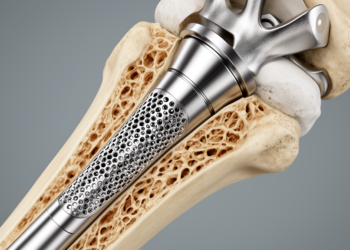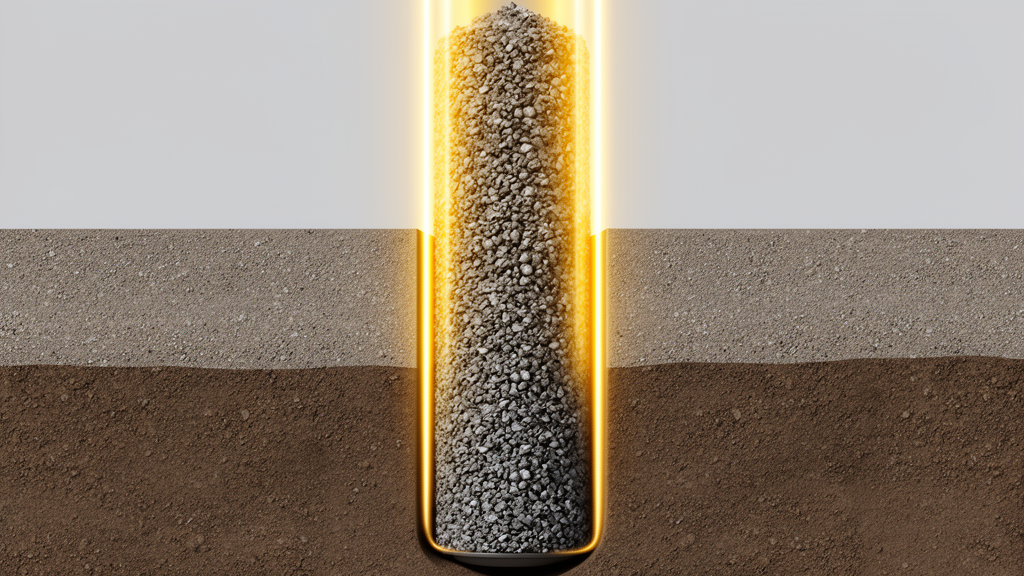
Granular compaction piles transfer structural loads predominantly through skin friction mobilized along their uppermost sections rather than through toe resistance, with maximum lateral bulging occurring at depths governed directly by the stiffness of surrounding ground strata. According to field static pile load tests and three-dimensional finite element simulations conducted by researchers Yushik Han and Yongkyu Choi, external compressive loads applied to granular compaction piles are absorbed almost entirely by shaft resistance within a depth equivalent to 1.0 times the pile diameter. At the pile base, remaining axial forces drop to near zero, demonstrating that end-bearing capacity is scarcely activated when compacted crushed stone columns deform under axial pressure in soft cohesive soils.
The investigation evaluates granular compaction piles as an engineering alternative to traditional sand compaction pile methods, which face increasing ecological and financial constraints stemming from natural sand depletion. Granular compaction piles replace diminishing natural sand aggregate with materials such as crushed stone or recycled concrete, building upon historical ground improvement techniques that originated with stone columns developed in France during the 1830s. While granular columns have long served to accelerate consolidation, mitigate settlement, and enhance bearing resistance in loose cohesionless deposits and soft clays, practical understanding of their local deformation patterns, stress dissipation mechanics, and bulging behavior across stratified ground profiles has remained limited, particularly when comparing uniform cylindrical piles against tapered configurations.
To capture realistic soil-structure interactions under diverse geological conditions, the researchers executed comprehensive field static loading programs across two distinct sites designated as Site A and Site B. At Site A, standard penetration testing identified an extremely soft clay layer classified as CH mixed with silt that extended to a depth of 15.5 meters, exhibiting susceptibility to self-weight penetration and an N-value of zero. This upper weak layer was underlain by a 2-meter-thick gravelly sand deposit featuring an average penetration resistance N-value of 39 before reaching weathered soil. Site B presented a different geological sequence, comprising an initial 1-meter surface landfill composed of silty sand mixed with clay, followed by a 12.5-meter soft CH clay deposit with an average N-value of 3, which rested upon weathered rock having an N-value exceeding 50 and underlying soft rock.
The experimental setup evaluated both uniform-diameter and tapered granular compaction piles installed as isolated single piles and as four-pile group configurations. At Site A, uniform piles were constructed with a constant diameter of 0.7 meters and a total embedded length of 18 meters, whereas tapered columns featured an upper segment diameter of 0.8 meters extending 8 meters deep and a lower segment diameter of 0.6 meters continuing for 10 meters. At Site B, uniform piles measured 0.7 meters in diameter across a length of 12.5 meters, while tapered geometries possessed an upper diameter of 0.8 meters along a 5.5-meter depth and a reduced base diameter of 0.6 meters along the remaining 7 meters. In both settings, tapered geometries were produced by regulating the discharge volume of crushed stone through controlled withdrawal and re-intrusion cycles of the vibro-hammer casing.
Static load testing was executed in accordance with ASTM D1143-81 specifications, combining slow standard continuous loading sequences with cyclic load increments using a reaction anchor framework. The testing assembly utilized ground anchors installed at designated radial offsets from the test piles, linked to a overhead reaction steel cross-beam. Hydraulic jacks positioned between the reaction beam and pile head plates exerted controlled downward vertical thrust while anchor assemblies provided the balancing upward reaction resistance. Pile head settlements were continuously logged across every loading stage to establish load-settlement curves and assess yield bearing thresholds across both single and group pile arrangements.
The field load testing revealed that single uniform piles and single tapered piles yielded at virtually identical vertical load levels at both testing locations. However, when arranged into four-pile clusters, pile geometry and surrounding stratum stiffness produced divergent load responses. At Site A, the tapered group exhibited an ultimate yield bearing capacity 1.2 times greater than that of the uniform pile group. Furthermore, group interaction effects multiplied bearing performance substantially at Site A, where the uniform group achieved 4.0 times the capacity of an individual uniform pile, and the tapered group reached 5.0 times the single tapered pile benchmark due to confinement provided by adjacent columns. In contrast, Site B generated a more modest group multiplier of 2.2 for group piles over single columns, a reduction attributed to the mechanical influence of the surface landfill layer.
To evaluate internal stress transfers and lateral deformations that cannot be measured directly during field load tests, the authors developed three-dimensional finite element models using the GTS NX software package. The numerical meshes adopted model dimensions scaled to pile length L, locating lateral vertical boundaries at a distance L and the fixed base at a depth of 2L to eliminate artificial boundary restrictions, with mesh grading clustered tightly near the pile-soil interface. Both the granular pile material and surrounding clay strata were modeled via elasto-plastic Mohr-Coulomb formulations, with mechanical parameters derived through back-analysis of field load-settlement measurements. Shared nodes were implemented along pile-soil boundaries to capture continuous displacement and stress transmission without assuming artificial interface separation.
Numerical calculations verified that vertical load distribution is heavily governed by the area replacement ratio and the relative rigidity between compacted stone aggregate and adjoining soil strata. In the upper ground layer, replacement ratios of 27 percent for uniform piles and 35 percent for tapered geometries were analyzed. Because compacted stone piles exhibit higher elastic modulus and structural rigidity relative to soft clay, the piles attract a disproportionately higher share of external stress as the upper replacement ratio expands. Conversely, in profiles where surrounding soils possess greater intrinsic stiffness, differential settlement between the column and the ground diminishes, enabling the surrounding ground mass to support a larger proportion of the applied surface load and reducing pile stress concentration.
Axial load distribution profiles plotted along the pile depth revealed an abrupt decrease in vertical compressive force immediately below the ground surface. For both uniform and tapered piles across Site A and Site B, the vertical load within the pile diminished rapidly within a depth equal to approximately 1.0 times the column diameter. At the pile toes, residual compressive force converged close to zero, demonstrating that granular compaction piles function almost purely as friction-based elements in soft clays. Unit skin friction calculated from load distribution gradients showed peak values reaching 60 to 100 kilopascals at Site A near a shallow depth of 0.25 times the pile diameter, while Site B exhibited maximum upper skin friction values ranging between 110 and 220 kilopascals in the fill and upper clay layers.
Analysis of relative lateral expansion displacement confirmed that bulging failure is governed by the confining resistance of surrounding ground strata, behaving in accordance with cavity expansion principles. In the very soft clay at Site A, where low shear strength provided minimal lateral confinement, applied vertical stress concentrated near the surface, causing the pile to bulge outwards at a shallow depth of approximately 1.5 times the pile diameter. In the stiffer clay stratum at Site B, increased passive resistance and shear strength enabled vertical stresses to propagate deeper into the ground, shifting the maximum lateral bulging zone downward to depths between 2.5 and 4.0 times the pile diameter and distributing lateral deformation across a broader subsoil zone.
Subject of Research: Load transfer mechanisms and bulging deformation behavior in uniform and tapered granular compaction piles
Article Title: Analysis of load transfer and deformation behavior in granular compaction piles
Article References: Han, Y., & Choi, Y. (2026). Analysis of load transfer and deformation behavior in granular compaction piles. International Journal of Geo-Engineering, 17(1), Article 11. https://doi.org/10.1186/s40703-026-00266-8
Image Credits: AI Generated
DOI: 10.1186/s40703-026-00266-8
Keywords: granular compaction piles, sand compaction pile alternative, soft ground improvement, bulging failure, shaft friction, axial load transfer, static pile load test, tapered granular compaction piles, finite element analysis, GTS NX, soil stiffness, group pile effect, Mohr-Coulomb model, crushed stone columns, cavity expansion theory, geotechnical engineering, skin friction mobilization
News Source: Denise Maddox. (November 21, 2026). Granular Compaction Piles Transfer Axial Load Primarily Through Upper Shaft Friction. Scienmag.