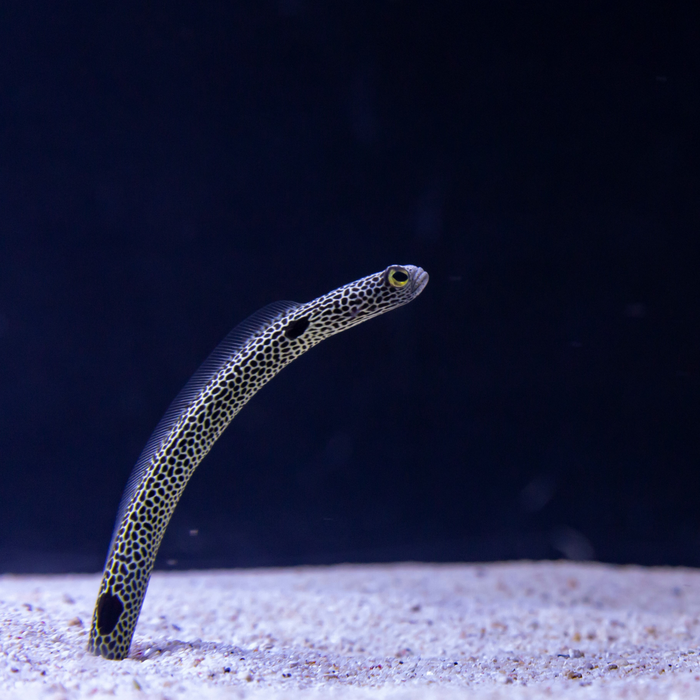
Garden eels are the ultimate homebodies. Instead of swimming freely in the ocean, these eels anchor themselves into burrows in the sandy seabed, which they almost never leave. Their colonies, which are typically found on the outskirts of tropical coral reels, can be made up of thousands of eels, which from a distance resemble a garden of seagrass as the eels bob and wave. Their heads, complete with a pouting mouth and cute cartoon eyes, face against the flow of the current as they strike at tiny animals called zooplankton that drift past.
Credit: OIST
Garden eels are the ultimate homebodies. Instead of swimming freely in the ocean, these eels anchor themselves into burrows in the sandy seabed, which they almost never leave. Their colonies, which are typically found on the outskirts of tropical coral reels, can be made up of thousands of eels, which from a distance resemble a garden of seagrass as the eels bob and wave. Their heads, complete with a pouting mouth and cute cartoon eyes, face against the flow of the current as they strike at tiny animals called zooplankton that drift past.
Currently, scientists know relatively little about these unique creatures, and how their behavior, like how they feed, changes with environmental conditions. Most marine research has focused on the more common feeding strategies of free-swimming fish, and the shyness of garden eels, who hide when predators (or scuba divers) pass by, makes their study even more challenging.
Now, for the first time, marine researchers at the Okinawa Institute of Science and Technology Graduate University (OIST) have looked at the feeding behavior of garden eels in an experimental lab setting. Their findings, published in the Journal of Experimental Biology, reveal how garden eels make use of their burrows, and change their movement and posture, in response to strong currents, allowing them to feed in a wider range of flow speeds compared to many free-swimming fish.
“Free-swimming fish can shelter from currents by hiding in cracks and crevices in the reef,” said Kota Ishikawa, first author and PhD student in OIST’s Marine Biophysics Unit. “But garden eels are stuck in a more exposed area, with only their own burrows for shelter, so they’ve had to develop their own unique strategies for dealing with strong currents.”
In the lab, the scientists recreated typical conditions by custom-making a flume with a sandy bottom. Inside the flume was a spot to place a portable burrow, with each burrow housing a single spotted garden eel, Heteroconger hassi, a species commonly found in Okinawa.
In the experiments, the researchers added zooplankton to the water and used cameras – two to the side and one above – to capture the motion of the garden eel as it fed at four different flow rates: 0.1, 0.15, 0.2 and 0.25 m/s.
The footage captured by the cameras was then used to train a deep learning program to recognize and track the eye and uppermost black patch on their body. From this tracked data, the researchers then digitally reconstructed and analyzed the 3D movement and posture of each eel.
As the current increased, the 3D tracking showed that the garden eels retreated farther into their burrows and focused their strikes on zooplankton that passed closer by.
“This is a really important adaptation, as faster currents require more energy to move in,” said Ishikawa.
After each trial finished, the scientists counted the remaining zooplankton to work out how many the eel had managed to catch and eat. They found that as the current increased in speed up to 0.2 m/s, the slow retreat into burrows didn’t stop the eels from feeding at a rapid pace. The reason for this, explained Ishikawa, is that despite limiting their feeding area, faster currents meant that more zooplankton drifted past in the given amount of time, offsetting the behavior change. The shorter strike distance also meant that the eels were more likely to successfully catch the zooplankton.
At higher flows, the eels also adopted a curved posture, in contrast to the straighter posture seen at slower flows. This, coupled with reducing the amount of their body exposed to the current, enabled the eels to reduce the amount of drag on their body by around 57%, conserving energy.
However, even for garden eels, some currents are simply too strong. Once the flow rate reached 0.25 m/s, the garden eels retreated completely into their burrows and did not feed at all.
Overall, the researchers found that the feeding rate of the garden eels hit its peak at just under 0.2 m/s. Free-swimming, plankton-eating fish typically have a peak feeding rate at around 0.15 m/s, showing that garden eels are adapted to feed at a wider range of flow speeds than free-swimming reef fish .
“We can see that their unique strategy of retreating into the burrows and reducing their strike distance really pays off when dealing with strong currents,” said Ishikawa.
For garden eels at least, it seems that staying at home is best.
Journal
Journal of Experimental Biology
DOI
10.1242/jeb.243655
Method of Research
Experimental study
Subject of Research
Animals
Article Title
RESEARCH ARTICLE| 22 APRIL 2022 Effects of prey density and flow speed on plankton feeding by garden eels: a flume study
Article Publication Date
22-Apr-2022
COI Statement
The authors declare no competing or financial interests.