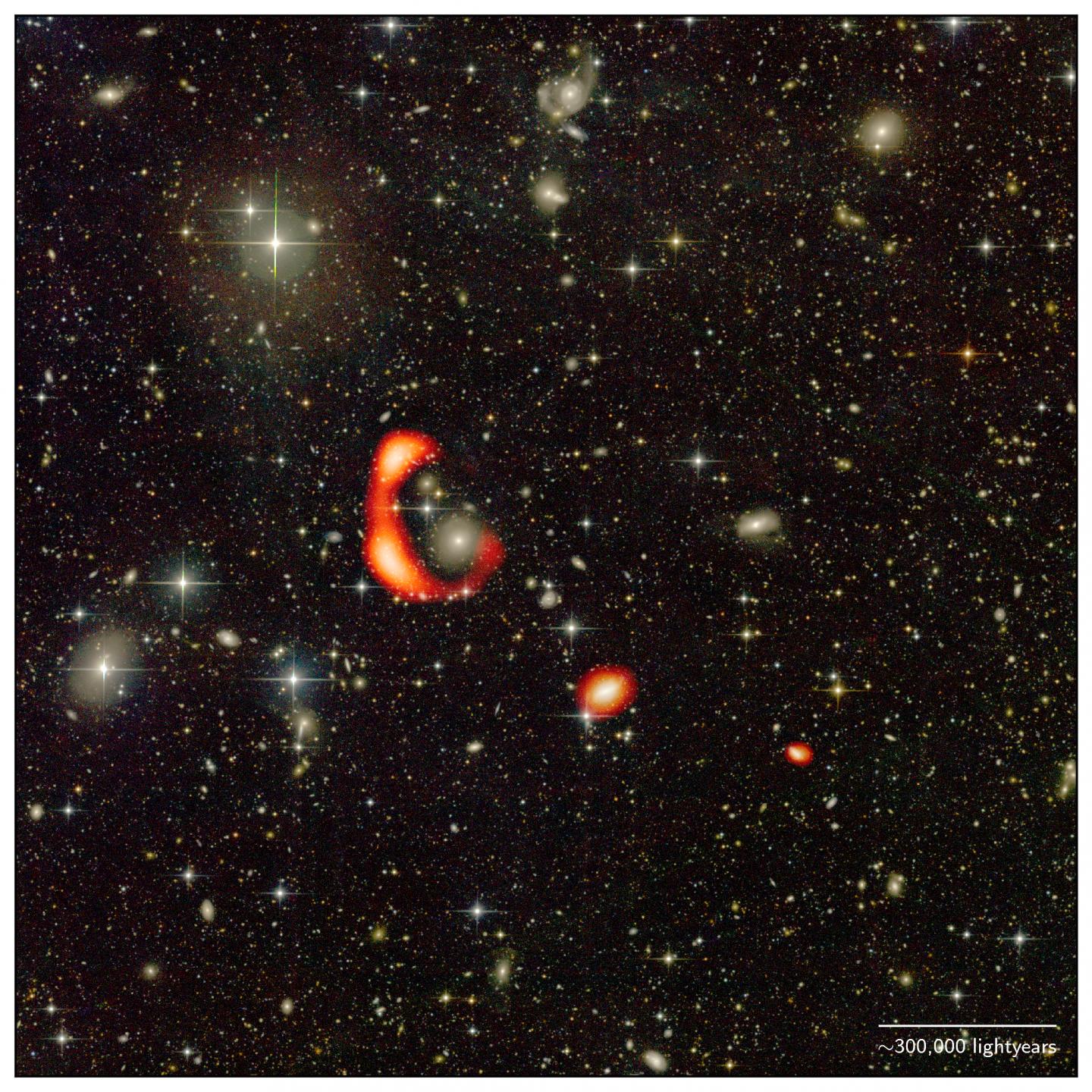
Credit: O. Bait (NCRA-TIFR/GMRT), Duc (ObAS/CFHT)
A team of astronomers at the National Centre for Radio Astrophysics (NCRA) in Pune, India have discovered a mysterious ring of hydrogen gas around a distant galaxy, using the Giant Metrewave Radio Telescope (GMRT). The ring is much bigger than the galaxy it surrounds and has a diameter of about 380,000 light-years (about 4 times that of our Milky Way).
The galaxy (named AGC 203001), is located about 260 million light-years away from us. There is only one other such known system with such a large neutral hydrogen ring. The origin and formation of such rings is still a matter of debate among astrophysicists.
Neutral hydrogen emits radio waves at a wavelength of about 21cm. This radiation from neutral hydrogen atoms has allowed radio astronomers to map the amount and distribution of neutral hydrogen gas in our Milky Way galaxy and in other galaxies in the Universe. Typically, large reservoirs of neutral hydrogen gas are found in galaxies which are actively forming new stars. However, despite showing no signs of active star formation the galaxy AGC 203001 was known to have large amounts of hydrogen, although its exact distribution was not known. The unusual nature of this galaxy motivated astronomers in NCRA to use the GMRT to conduct high-resolution radio observation of this galaxy to find out where in the galaxy this gas lies.
The GMRT observations revealed that the neutral hydrogen is distributed in the form of a large off-centered ring extending much beyond the optical extent of this galaxy. More puzzlingly, the astronomers found that the existing optical images of the ring showed no sign of it containing stars. In collaboration with two French astronomers, Pierre-Alain Duc and Jean-Charles Cuillandre, the NCRA team obtained a very sensitive optical image of this system using the Canada-France-Hawaii-Telescope (CFHT) in Hawaii, USA. However, even these images do not show any sign of starlight associated with the hydrogen ring.
There is no clear answer today as to what could lead to the formation of such large, starless rings of hydrogen. Conventionally, galaxy-galaxy collisions were thought to lead to the formation of such off-centered rings around galaxies. However, such rings also generally contain stars. This is contrary to what is found in this ring. Figuring out how this ring was formed remains a challenge to astronomers.
Encouraged by this discovery, the team is now conducting a large survey to map the neutral hydrogen around several more similar galaxies. If some of them also show rings like this, it should help us to better understand the formation mechanism behind such rare rings.
This work was led by Omkar Bait, a doctoral student at NCRA working under the supervision of Yogesh Wadadekar. This work forms a part of Omkar’s doctoral thesis. Sushma Kurapati, who is another doctoral student at NCRA also played a role in the radio observations. Other expert scientists who contributed include, Pierre-Alain Duc (Universite de Strasbourg, Strasbourg, France), Jean-Charles Cuillandre (PSL University, Paris, France), Peter Kamphuis (Ruhr University, Bochum, Germany) and Sudhanshu Barway (Indian Institute of Astrophysics, Bengaluru, India).
###
(Acknowledgments: GMRT is run by the National Centre for Radio Astrophysics of the Tata Institute of Fundamental Research. Based on observations obtained with MegaPrime/MegaCam, a joint project of CFHT and CEA/DAPNIA, at the Canada-France-Hawaii Telescope (CFHT) which is operated by the National Research Council (NRC) of Canada, the Institut National des Sciences de l’Univers of the Centre National de la Recherche Scientifique of France, and the University of Hawaii.)
Media Contact
Yogesh Wadadekar
[email protected]
91-202-571-9238
Related Journal Article
http://dx.