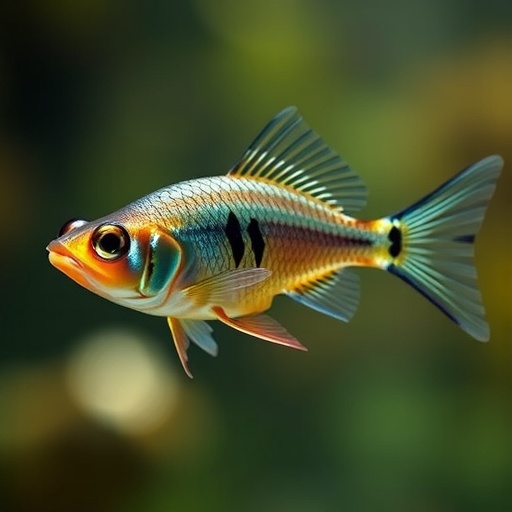
In a groundbreaking study, researchers have unveiled significant insights into the intricate relationship between glucocorticoid receptor expression and visual lateralization in zebrafish. This research, conducted by a team led by Rovegno, Frigato, Dalla Valle, and their colleagues, shines a spotlight on how hormonal variations might influence cognitive and behavioral patterns in these fascinating aquatic organisms. Interestingly, these findings not only enhance our understanding of zebrafish behavior but may also have broader implications for understanding stress responses across vertebrates.
Glucocorticoids, commonly known as stress hormones, play a pivotal role in regulating a wide array of physiological processes. They are known to influence behavior, cognition, and even social dynamics. The expression of glucocorticoid receptors is crucial for the organism’s ability to respond to stress. Recent studies suggest that individual differences in glucocorticoid receptor expression might correlate closely with varying cognitive styles, particularly in how different species process sensory information. The zebrafish, an increasingly popular model organism in behavioral studies, offers a unique lens through which to explore these relationships.
Visual lateralization refers to the tendency for one hemisphere of the brain to dominate processing visual stimuli over the other. This phenomenon, observed across various species, can affect how animals perceive their environment, respond to predators, and interact with conspecifics. In the case of zebrafish, understanding visual lateralization is particularly crucial as it may provide insights into their behavioral ecology, including mate selection and social interactions. The asynchronous development of brain regions may lead to divergent behavioral outcomes among individuals.
The research team conducted a comprehensive analysis of glucocorticoid receptor expression in conjunction with behavioral assays that assessed the visual lateralization of zebrafish. They found a clear link between the levels of glucocorticoid receptors and the extent of visual lateralization exhibited by the subjects. This relationship suggests that individual differences in stress hormone receptor availability may shape how zebrafish process visual information, leading to variations in phenotypic traits.
One of the study’s notable methodologies involved the use of both behavioral and molecular techniques to draw connections between glucocorticoid signaling and visual processing. By employing advanced imaging and genetic analyses, the researchers could assess how variations in glucocorticoid receptor expression might manifest behaviorally. This integrative approach adds a layer of robustness to their findings, making the case for a biochemical basis for behavioral diversity in zebrafish.
Additionally, the implications of this research extend beyond the laboratory. The findings may have significant ramifications for the fields of neuroscience and evolutionary biology. By revealing how hormonal variations can influence cognitive abilities, this study opens avenues for exploring the evolution of stress response systems in relation to environmental challenges. For instance, an understanding of these mechanisms may help explain why certain populations of zebrafish may thrive in contrasting ecological niches, depending on their hormonal profiles.
The researchers also highlighted how this work could enhance conservation efforts by providing a deeper understanding of how environmental stressors may affect behavioral traits in fish populations. Understanding individual differences in stress responses could inform management strategies aimed at preserving biodiversity and promoting healthy ecosystems. Given the threats posed by climate change and habitat destruction, insights like these will be increasingly vital for the conservation community.
The study controls for various confounding factors, ensuring that the observed relationships are robust and reliable. Various environmental aspects, such as temperature and population density, were carefully monitored to establish a clear connection between glucocorticoid receptor expression and individual behavioral outcomes. This level of rigor ensures that the findings stand up to scrutiny and can serve as a foundational model for future research.
Furthermore, the work raises intriguing questions about the interplay between genetics and environment in shaping behavior. While glucocorticoid receptor expression can certainly vary due to genetic differences, environmental factors such as stress exposure and social dynamics may also play significant roles. Understanding this interaction could lead to new insights in fields ranging from behavioral ecology to evolutionary genetics.
The publication of these findings in a renowned journal highlights the study’s significance within the scientific community. Articles like this contribute to an ongoing dialogue about the importance of integrating behavioral and molecular approaches in ecological research. The study serves as a reminder of how much we still have to learn about the underlying mechanisms that drive animal behavior and the intricate balance of hormonal systems in shaping life history strategies.
In conclusion, the research team led by Rovegno and Frigato has successfully illuminated the complex relationship between glucocorticoid receptor expression and visual lateralization in zebrafish. Their findings underscore the critical interplay between hormones and behavior, presenting a nuanced understanding of how aquatic organisms adapt to their environments. As we continue to unravel the mysteries of animal behavior, studies like these will undoubtedly pave the way for new discoveries that could change our perspective on the biological sciences.
The importance of such research cannot be overstated, particularly as the world faces an array of environmental stressors that threaten biodiversity. Understanding how individual differences in stress hormone responses influence behavior provides a vital tool for scientists and conservationists alike. The future of ecological research hinges on a multi-disciplinary approach, hybridizing behavioral observations with molecular insights to foster a more comprehensive understanding of life on Earth.
As the field of animal behavior continues to evolve, it is clear that studies focusing on model organisms like zebrafish will remain pivotal to advancing our understanding of the biological underpinnings of behavior. This research not only deepens our knowledge of zebrafish but also offers valuable frameworks for further exploration in other species, widening the scope of inquiry in behavioral science. The road ahead is filled with potential, and the implications of this study are poised to resonate within various scientific disciplines for years to come.
Subject of Research: The relationship between glucocorticoid receptor expression and visual lateralization in zebrafish.
Article Title: Correction: Expression of glucocorticoid-receptor covaries with individual differences in visual lateralisation in zebrafish.
Article References:
Rovegno, E., Frigato, E., Dalla Valle, L. et al. Correction: Expression of glucocorticoid-receptor covaries with individual differences in visual lateralisation in zebrafish.
Anim Cogn 28, 70 (2025). https://doi.org/10.1007/s10071-025-01987-6
Image Credits: AI Generated
DOI: 10.1007/s10071-025-01987-6
Keywords: glucocorticoids, zebrafish, visual lateralization, behavior, stress response, receptor expression, cognitive diversity.
Tags: aquatic organisms and cognitionbrain hemisphere dominance in visual processingglucocorticoid receptor expressionglucocorticoids and social dynamicshormonal influence on animal behaviorimplications for vertebrate stress responseindividual differences in stress responsesensory processing in zebrafishstress hormone effects on cognitionvisual lateralization in vertebrateszebrafish as model organismszebrafish behavioral studies