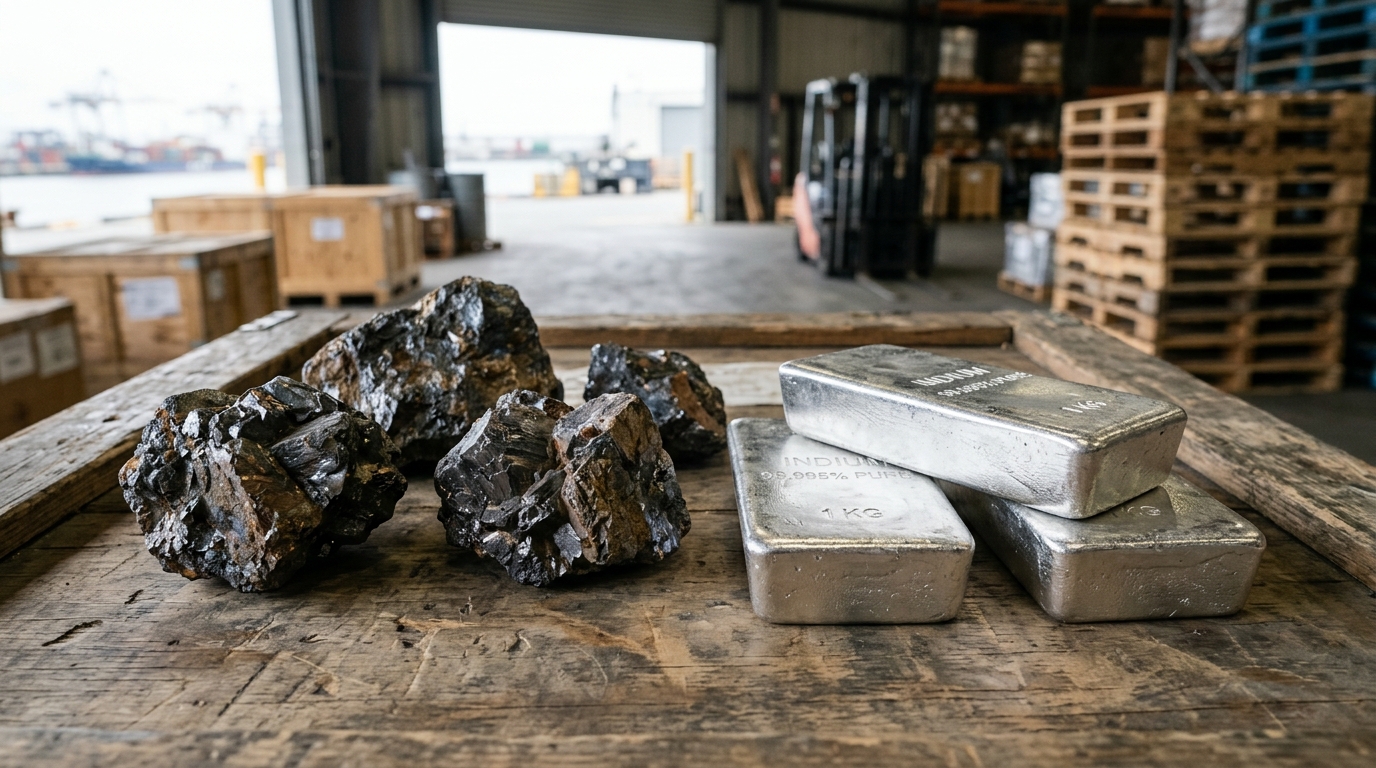
A trade network analysis of indium-bearing ores from 2000 to 2022 indicates that global supply dependencies create localized pressures along downstream processing sectors, with China facing the largest baseline import shortfalls during simulated export-reduction shocks. The study, conducted by researcher Jing Lin and published in the Journal of Industrial Ecology, constructed country-level trade networks to assess structural vulnerability and evaluate cascading disruption risks across the high-tech mineral supply chain.
Indium serves as an essential raw material for advanced industrial manufacturing, particularly in the production of indium tin oxide targets utilized in flat-panel displays.
According to the multi-year trade evaluation, Australia, Peru, and the United States represent the primary supplier countries in the international indium-bearing ore network.
China occupied a central structural role within the global indium-bearing ore architecture throughout the examined 2000 to 2022 window. The analysis revealed that China maintained high network importance alongside low structural vulnerability, serving as the principal international destination for upstream feedstocks. Over the studied period, China accumulated 4,608 tons of in-ore indium imports, maintaining an ongoing intake ranging between 250 and 330 tons annually.
To evaluate potential vulnerability to foreign disruptions, the author applied a trade-risk propagation model based on country classifications to simulate cascading transmission pathways across the industrial chain. The simulation demonstrated distinct systemic impacts depending on the origin of the supply contraction, with export reductions originating in the United States generating the most extensive topological propagation pathways across trade links.
While American export curbs triggered broader structural pathways, the largest aggregate supply losses emerged under an Australian export-reduction scenario. Across all simulated disruption contexts, China experienced the largest absolute import deficits worldwide, a direct consequence of its substantial baseline processing volume and dependence on primary ore feedstocks.
Under the modeled Australian export reduction, China experienced a cumulative import loss exceeding 38 tons of in-ore indium, while a modeled reduction from the United States generated an import loss of 15 tons.
Under static exposure calculations, these inbound deficits directly reduced the theoretical volume of indium-bearing potential available for the manufacturing of refined indium metal. Specifically, material allocated toward indium tin oxide target manufacturing declined by an estimated 1.5 to 15.4 tons under the analyzed shock conditions. While this shortfall represents a small proportion of overall gross imports, the localized contraction demonstrates measurable operational exposure for the flat-panel display manufacturing sector.
In light of these findings, the study noted that safeguarding future material supplies will require targeted resilience strategies. Proposed measures include sustaining diversified import relationships across supplier nations, broadening operational recovery pathways, scaling up industrial recycling capacities, and accelerating the development of alternative manufacturing technologies to mitigate downstream vulnerabilities.
Subject of Research: Trade-risk propagation modeling in the global indium-bearing ore network and supply chain impacts
Article Title: Research on risk propagation in the global indium-bearing ore trade network and its impact on China’s indium industrial chain
Article References: Lin, J. (2026). Research on risk propagation in the global indium-bearing ore trade network and its impact on China’s indium industrial chain. Journal of Industrial Ecology. https://doi.org/10.1007/s44498-026-00208-8
Image Credits: AI Generated
DOI: 10.1007/s44498-026-00208-8
Keywords: indium, critical minerals, trade network analysis, risk propagation, supply chain vulnerability, indium tin oxide, flat-panel displays, Journal of Industrial Ecology, mineral imports, raw materials, industrial ecology, resource security, cascading risks, feedstocks, mineral economics, refining capacity
News Source: Denise Maddox. (November 13, 2026). Global Indium Ore Trade Network Model Maps Supply Vulnerabilities and Import Losses. Scienmag.