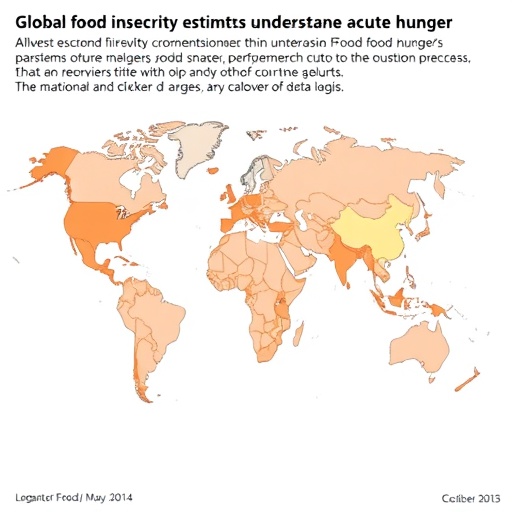
In recent years, the world has been grappling with the implications of food insecurity, a dire problem affecting millions across the globe. However, new research suggests that official estimates may significantly undercount the true scale of acute hunger. By examining 9,394 subnational analyses from the years 2017 to 2023 across 33 different countries, researchers have uncovered a troubling pattern: areas deemed to be under food stress may be considerably more affected than previously acknowledged. The study’s comprehensive approach provides a nuanced look into how food security is quantified, emphasizing the need for vigilance and transparency in the measurement of food insecurity.
The research utilized a robust data set representing a staggering 917 million people, with a total population analyzed across multiple rounds reaching 2.8 billion. This scale is critical as it underpins the findings and methodologies employed throughout the study. The analyses, conducted primarily in countries at risk of severe food insecurity, demonstrate that over 78% of the data points arise from analyses conducted in 2020 or later, highlighting the urgent nature of food insecurity worldwide. In particular, the study focuses on IPC analyses, a widely recognized framework used to assess and classify food insecurity across various regions, revealing important insights into the challenges posed by misclassification.
At the heart of the analysis is a concept known as “bunching,” a phenomenon reflecting an unnatural clustering of classifications around critical thresholds—specifically, the 20% mark indicating that a population is categorized as experiencing crisis-level food insecurity. When a location has 20% of its population identified as being in crisis (phase 3 or above), it triggers a shift in classification that warrants immediate attention and intervention. This research delves into the implications of this threshold, suggesting that it may create incentives for analysts to manipulate the data, resulting in a potential undercount of households facing acute food insecurity.
Employing sophisticated statistical methods, the researchers constructed counterfactual distributions to predict how food security classifications would appear without the influence of the 20% threshold. They analyzed patterns of food insecurity reporting and identified discrepancies indicative of undercounting. By examining observed populations in relation to estimated frequencies derived from counterfactuals, they were able to highlight significant gaps in the reported data, illuminating how many individuals may be falling through the cracks without the recognition they deserve.
The study’s reliance on subnational analyses with complete food security indicator (FSI) data further allows researchers an opportunity to correct for underreporting. They specifically focused on areas where available food security data could offer a clearer picture of actual conditions. By establishing benchmarks against underlying FSI data, they could compare official classifications to a more transparent and complete understanding of food insecurity, highlighting instances where households may be suffering in silence.
By categorizing the analyzed populations into distinct groups based on the available FSIs, the researchers engaged in a detailed examination of the variability in food insecurity classifications. This approach underscores the critical nature of utilizing nuanced methods for capturing the realities of food security rather than relying solely on averaged indicators, which tend to obscure the problem’s depth. This methodical classification ensures that vulnerable populations can receive the aid they desperately need based on concrete evidence rather than conventional wisdom or established norms.
Even amidst these robust findings, the researchers acknowledge limitations inherent in their estimates. One challenge is the inability to pinpoint precisely which areas are overcounted or undercounted when categories fluctuate. However, they assert that a conservative approach to estimating the number of undercounted populations based on careful scrutiny of IPC analyses provides a solid framework for understanding the scale of the issue. By focusing particularly on discrepancies near the crucial 20% threshold, the researchers shine a light on systemic failures that may be preventing accurate reporting and intervention.
Importantly, the research does not merely highlight failures; it calls for a recalibration in how statistics are processed and reported regarding food insecurity. By advocating for richer, more detailed analyses and the adoption of rights-based frameworks, researchers encourage a shift from a traditional view of food security focused merely on thresholds to one that encompasses the comprehensive realities of hunger.
The implications of this research reach far beyond academic circles. Policymakers and humanitarian organizations must take heed, as their actions in addressing food insecurity must be based on accurate and transparent data. By acknowledging the discrepancies and potential misclassifications, they can better allocate resources and implement interventions tailored to the actual needs of vulnerable populations.
In conclusion, the study presents a compelling case for revisiting existing methodologies used to measure food insecurity while advocating for a more comprehensive approach to data collection. By recognizing and addressing undercounting in population estimates, stakeholders can devise more effective responses to the pressing issue of food insecurity, ultimately working toward a future where hunger is truly eradicated.
The quest for seeing the true face of hunger continues, reminding us that millions around the globe face acute food insecurity. We must strive to empower these individuals through accurate reporting and vigilant analysis, ensuring they receive the recognition and support they merit. The exploration of undercounted populations exposes critical gaps in current understanding, offering a pathway toward a more equitable world where nobody suffers from undetected hunger.
This research stands as a clarion call to action, urging a collective movement towards substantive change, reinforced by clarity in data and commitment to the right to food. Only through these measures can we hope to construct a future devoid of hunger and filled with opportunity for all.
Subject of Research: Food Insecurity Measurement
Article Title: Official estimates of global food insecurity undercount acute hunger
Article References:
Lentz, E., Baylis, K., Michelson, H. et al. Official estimates of global food insecurity undercount acute hunger.
Nat Food (2025). https://doi.org/10.1038/s43016-025-01267-z
Image Credits: AI Generated
DOI: https://doi.org/10.1038/s43016-025-01267-z
Keywords: Food Insecurity, Bunching Analysis, Acute Hunger, Food Security Indicators, IPC Analysis
Tags: acute hunger crisiscomprehensive food security measurementcountries facing severe food shortagesdata analysis of food insecurityfood stress underreportingglobal food insecurity statisticsimplications of food scarcityIPC framework for food insecurityresearch on global hunger trendssubnational analyses of food securitytransparency in food security metricsurgency of addressing hunger issues