


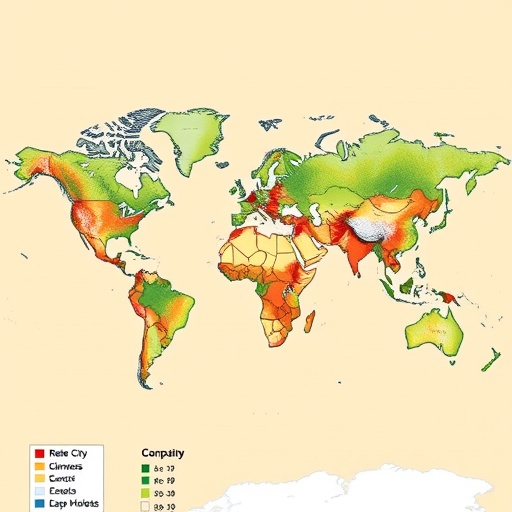
In the global push to stem climate change, cities have emerged as pivotal players, spearheading efforts to cut household and energy-related greenhouse gas emissions. However, an increasingly urgent but overlooked challenge lies in addressing emissions generated by the sprawling construction sector. Despite cities’ prominent role in shaping sustainability policies, comprehensive data quantifying the carbon footprint of urban construction—and frameworks for mitigating it—have remained elusive. A groundbreaking study spanning over 1,000 cities worldwide now shines a critical light on this silent yet substantial source of climate emissions, revealing both its scale and the radical transformations required to keep planetary warming within safe limits.
Researchers have meticulously calculated construction consumption emissions in cities encompassing every inhabited continent, uncovering a striking global convergence in per capita emissions. The data suggests that the average city dweller today is indirectly responsible for approximately one to three metric tons of carbon dioxide equivalents (tCO₂e) annually through construction activities alone. This figure, seemingly modest in isolation, becomes alarming when scaled across entire urban populations and projected forward against international climate targets, particularly the goal of limiting warming to below two degrees Celsius. At current emission rates, city-level construction could consume the lion’s share—or even exceed—the allowable carbon budget dedicated to this sector as early as 2030.
The implications of these findings signal an unprecedented challenge for urban planners, policymakers, and the construction industry. Current practices and technologies, largely entrenched in traditional resource-intensive methodologies, are fundamentally misaligned with the urgent need for deep decarbonization. The study’s authors argue for ambitious reductions, estimating that construction-related emissions within cities must be driven down to less than 10% of present-day levels within the next two to four decades. Achieving such a goal necessitates not only technological breakthroughs in low-carbon materials and building methods but also a wholesale reimagination of how cities grow and develop.
One of the pivotal insights gleaned from the research is the limited awareness and strategic focus cities have traditionally placed on construction emissions. While energy use and urban transportation have dominated emissions reduction agendas, construction’s environmental footprint has lingered in the shadows, partly due to its complex supply chains and diffuse sources. This new global inventory provides an empirical foundation on which cities can anchor their mitigation commitments, shifting construction into the mainstream of urban climate strategies.
The researchers designed an accessible digital dashboard, allowing city stakeholders to explore their own construction carbon footprints and compare them against climate-aligned pathways. This tool empowers decision-makers with actionable intelligence, enabling the integration of emissions reductions into development plans and infrastructure investments. The open dashboard represents a pioneering step toward democratizing climate data and fostering accountability across diverse urban contexts, from rapidly expanding megacities to mature industrial hubs.
Among the technical challenges highlighted is the embedded carbon in construction materials, such as cement, steel, and glass—the production of which has historically been energy-intensive and heavily reliant on fossil fuels. Innovations in alternative materials, circular economy principles emphasizing reuse and recycling, and advances in modular and prefabricated construction offer promising avenues for lowering the sector’s carbon intensity. Yet, these technological shifts must be complemented by policy frameworks encouraging sustainable construction procurement, urban densification, and adaptive reuse of existing buildings.
Moreover, the study underscores the temporal urgency of action. The carbon budgets compatible with the 2 °C target are dauntingly finite, and delays in emission reductions will rapidly erode the remaining allowable emissions. This places enormous pressure on cities to implement ambitious policies today rather than defer changes until later. There is a growing consensus that transformative policies, including mandates for embodied carbon disclosure and stringent procurement standards, must become normative to catalyze systemic change.
Economic dimensions also permeate the discourse on construction emissions. While construction is a major source of urban employment, its fossil fuel dependence presents a risk of stranded assets and costly retrofitting if climate policies intensify abruptly. Accordingly, the research advocates for strategic alignment of economic incentives with sustainability goals, promoting innovation clusters, workforce retraining, and integration of climate risk into financial planning linked to urban development.
Despite the daunting magnitude of the climate challenge embodied in urban construction, the study’s authors offer a cautiously optimistic vision. The trajectory of construction emissions is not fixed, but malleable through concerted governance innovation, cross-sector collaboration, and investment in green technologies. The research insists that cities can reconcile economic growth and climate stewardship but only through unprecedented levels of ambition and coordination.
The global scope of the study enriches its insights, revealing heterogeneity in construction emissions pathways across diverse urban typologies and development stages. Rapidly urbanizing cities in the Global South confront a dual challenge: meeting housing and infrastructure demands while preventing carbon lock-in from high-emission construction methods. Developed cities, conversely, have opportunities to lead by example through retrofitting and pioneering circular economy models. This duality underscores that solutions must be context-specific yet informed by universal sustainability imperatives.
As climate impacts intensify worldwide, the spotlight on construction emissions compels a paradigm shift in conceiving urban futures. Building design, material sourcing, waste management, and even urban form—all traditionally siloed domains—must intertwine within integrated climate action frameworks. The research marks a decisive step towards making the invisible visible—turning construction emissions from a neglected blind spot into a central target of urban climate resilience planning.
This seminal contribution invites a reexamination of prevailing narratives around urban sustainability. It clearly demonstrates that without confronting the carbon embedded in the very fabric of cities, broader climate commitments risk being undermined. The study’s combination of empirical data, forward-looking carbon budgets, and digital tools equips city leaders with the insights necessary to pioneer responsible urban development in the climate era.
Ultimately, the research delivers a stark message: current construction emissions trajectories are incompatible with limiting warming to 2 °C. Immediate, scalable, and equitable interventions are imperative to avoid exhausting the carbon budget in the next decade. By embracing innovative technologies, policy reforms, and new governance models, cities can harness construction as a powerful lever for climate action and sustainable development.
As the urban century unfolds, the construction sector’s climate limits emerge as a defining frontier. This work provides the blueprint and wake-up call for cities to lead with determination, engineering a transition to low-carbon construction that secures a viable future for coming generations. The open-access dashboard stands ready to empower stakeholders worldwide, transforming climate ambition into tangible, measurable progress in the built environment. The task is massive, but so too is the potential for urban leadership in the climate fight.
Subject of Research:
Climate impact assessment and carbon budgeting of urban construction emissions across over 1,000 cities globally.
Article Title:
The climate limits of construction in over 1,000 cities
Article References:
Rankin, K.H., Cabrera Serrenho, A., Bachmann, C. et al. The climate limits of construction in over 1,000 cities. Nat Cities (2026). https://doi.org/10.1038/s44284-025-00379-8
Image Credits: AI Generated
DOI: https://doi.org/10.1038/s44284-025-00379-8
Tags: carbon dioxide equivalents from constructioncarbon footprint of urban constructionclimate change and urbanizationconstruction sector emissionsglobal city climate boundariesgreenhouse gas emissions in citiesinternational climate targets for citiesmitigating construction emissionsper capita emissions in citiesradical transformations for climate sustainabilitysustainability policies in urban areasurban population carbon impact



