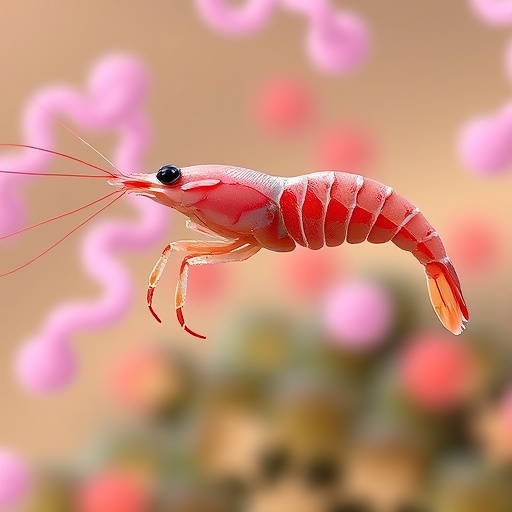
In the expansive and seemingly unbounded marine realm, the processes driving species divergence pose one of the most intricate puzzles for evolutionary biologists. Unlike terrestrial environments where physical barriers such as mountains and rivers delineate species ranges, marine species often exhibit widespread dispersal capabilities, making it challenging to pinpoint the mechanisms behind population differentiation. A groundbreaking study published in Heredity by Teles et al. illuminates this conundrum by revealing complex genomic patterns underlying divergence in the pink shrimp, Farfantepenaeus brasiliensis, across its Western Atlantic habitat.
Utilizing cutting-edge genomic techniques, the researchers applied ddRAD sequencing in tandem with mitochondrial DNA analyses to unravel the population structure of this commercially and ecologically significant crustacean. By sampling four geographically distinct regions — Florida in the USA, Northeastern Brazil, Eastern Brazil, and Southeastern Brazil — they achieved comprehensive coverage of the species’ entire distribution. The study aimed to test whether oceanographic features, particularly the famed Amazon–Orinoco Plume, act as semi-permeable barriers influencing genetic differentiation despite the species’ high dispersal potential.
Strikingly, the analysis exposed two genetically distinct clusters that correspond to northern and southern population groups. The northern group, encompassing Florida and Northeastern Brazil samples, exhibited notably higher levels of genetic diversity compared to their southern counterparts collected from Eastern and Southeastern Brazil. This bifurcation occurs despite an absence of strict physical barriers, suggesting that factors beyond mere geography sculpt the population structure.
One critical insight derived from demographic modeling revealed that these divergence events likely initiated approximately two million years ago, coinciding with climatic fluctuations during the Pleistocene epoch. The temporal scale points to allopatric divergence fuelled by historical isolation, followed by secondary contact where gene flow resumed but remained asymmetric and limited. Instead of complete reproductive isolation, the populations exhibit a classic divergence-with-gene-flow scenario, wherein enough genetic separation is maintained to promote distinct evolutionary trajectories while allowing intermittent interbreeding.
Ecologically, the Amazon–Orinoco Plume emerges as a fundamental oceanographic feature influencing these dynamics. The plume, a massive freshwater outflow rich in sediments and nutrients extending from northern South America, creates unique salinity gradients and turbidity barriers that affect larval dispersal and survival. Such semi-permeable barriers impede but do not entirely block larval exchange, facilitating a balance between connectivity and isolation. This oceanographic complexity underlines how ecological differentiation paired with environmental discontinuities can drive speciation even in high-mobility marine species.
Complementing the genomic insights, mitochondrial DNA analyses and species delimitation algorithms robustly supported the taxonomic distinctness of the northern and southern populations. The authors propose that these clusters might represent cryptic species, a revelation with profound implications for biodiversity assessments, fisheries management, and conservation policies. Recognizing genetically discrete units enhances management precision, ensuring sustainable exploitation and protection aligned with evolutionary and ecological realities.
Intriguingly, the study also identifies signs of recent demographic shifts, including expansions and contractions linked to climate cycles. Both populations experienced expansion post-Last Glacial Maximum, roughly 20,000 years ago, reflecting habitat suitability improvements as ice sheets receded and oceanic conditions stabilized. More concerning is evidence of recent population declines, especially in the southern group, which may reflect anthropogenic pressures such as overfishing, habitat degradation, and climate change. These trends warrant urgent attention to safeguard the species’ long-term viability.
The implications of this research transcend the pink shrimp and extend to broader marine biodiversity paradigms. It challenges the traditional notion that marine species with high dispersal abilities are genetically homogenous across broad ranges. Instead, it affirms that subtle environmental factors and historical demographic processes can foster significant genomic divergence that may underpin speciation events. Studies like this reshape our comprehension of marine evolutionary biology, signaling the need for nuanced frameworks accommodating gene flow and environmental heterogeneity.
From a methodological perspective, the integration of high-resolution genomic data with sophisticated demographic modeling exemplifies the future of marine population genetics. Techniques such as ddRAD sequencing enable fine-scale detection of genetic structure that conventional markers often miss. This precision is vital for uncovering ‘cryptic’ diversity that might be invisible to classic taxonomy based solely on morphology. The study thus sets a gold standard for investigating population connectivity in other elusive or economically vital marine taxa.
The dichotomy discovered between northern and southern Farfantepenaeus brasiliensis populations also raises questions about the evolutionary pressures shaping these groups. Differences in genetic diversity hint at varied evolutionary histories, possibly linked to distinct ecological niches or historical population sizes. The northern cluster maintains greater heterozygosity, indicating larger effective population sizes and potentially higher resilience. Conversely, the southern cluster’s reduced diversity and evidence of recent decline signal vulnerability, emphasizing the need for geographically tailored management strategies.
Moreover, the influential role of the Amazon–Orinoco Plume as a partial barrier reinforces the importance of integrating physical oceanography with evolutionary biology. Understanding oceanographic features such as currents, salinity gradients, and freshwater outflows provides crucial context for interpreting gene flow patterns. These insights transcend the pink shrimp case, highlighting how dynamic environmental forces sculpt marine biodiversity mosaics across the globe.
As fisheries worldwide grapple with sustainability challenges, this research signals a pivotal direction. Conservation efforts must acknowledge hidden genetic subdivisions to avoid the pitfalls of managing species as monolithic units. Genetic data can guide the designation of management units, inform breeding stock selections, and support ecosystem-based approaches that preserve evolutionary potential. In the face of accelerating climate change and habitat alteration, adaptive management informed by contemporary evolutionary science becomes indispensable.
In summary, the study by Teles and colleagues offers a compelling narrative of marine divergence driven by a nuanced interplay between gene flow, historic isolation, and ecological barriers. It underscores that speciation in the ocean is neither a purely physical nor a simplistic process but a layered dynamic shaped by genetic, environmental, and demographic factors. This work enriches our understanding of marine evolution and provides a practical framework for enhancing biodiversity management in a changing world.
Looking ahead, further research could explore how ecological differences between these populations influence phenotype, behavior, and reproductive isolation mechanisms. Additionally, assessing how contemporary oceanographic changes may alter gene flow patterns would deepen our grasp of species resilience. Ultimately, this study opens avenues to redefine marine biodiversity conservation in multidimensional genetic and ecological landscapes.
The revelations from this investigation redefine our comprehension of marine species complexity, offering a window into the evolutionary tapestry woven beneath the waves. Pink shrimp, long a staple in commercial fisheries, now present a fascinating case of cryptic divergence and ongoing genomic interplay. Integrating such knowledge promises to revolutionize marine biodiversity stewardship, aligning industry, science, and conservation in a shared quest to sustain the ocean’s living treasures.
Subject of Research: Genomic structure and demographic history of the pink shrimp Farfantepenaeus brasiliensis across the Western Atlantic.
Article Title: Genomic evidence of divergence-with-gene-flow in the pink shrimp Farfantepenaeus brasiliensis.
Article References:
Teles, J.N., Peres, P.A., Bracken-Grissom, H. et al. Genomic evidence of divergence-with-gene-flow in the pink shrimp Farfantepenaeus brasiliensis. Heredity 134, 705–717 (2025). https://doi.org/10.1038/s41437-025-00811-8
Image Credits: AI Generated
DOI: 27 November 2025
Keywords: marine divergence, population genomics, pink shrimp, Farfantepenaeus brasiliensis, gene flow, cryptic species, marine biodiversity, oceanographic barriers, Amazon–Orinoco Plume, demographic history, high dispersal species, population structure, evolutionary biology, conservation genetics
Tags: Amazon-Orinoco Plume impact on geneticsddRAD sequencing in marine biologyecological significance of pink shrimpevolutionary biology of marine speciesFarfantepenaeus brasiliensis genetic studygene flow in marine speciesgenetic diversity in shrimp populationsgenomic evidence in crustaceansmitochondrial DNA analysis in shrimpoceanographic barriers to gene flowpink shrimp population differentiationpopulation structure of marine organisms