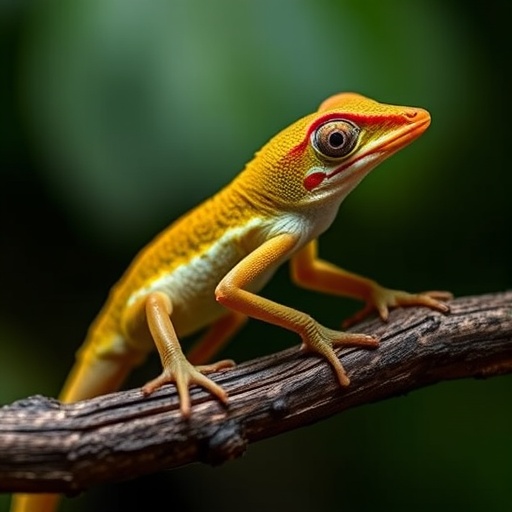
In the dazzling realm of animal communication, color often reigns supreme as a potent signal used to convey information to conspecifics and interspecific rivals alike. From the iridescent feathers of birds to the vibrant scales of fish, the vivid hues displayed are not merely aesthetic but deeply entrenched in the evolutionary history of these species. Yet, despite the prominence of colorful traits in the natural world, the precise genetic underpinnings of these signals frequently remain elusive. A recent groundbreaking study delves into this enigma, focusing on a striking example of morphological polymorphism found in a little-known yet fascinating reptile: the slender anole, Anolis apletophallus.
Male slender anoles boast a distinctive throat fan called a dewlap, which they extend during social interactions. This dewlap is not only a key player in mating and territorial displays but also exhibits a remarkable polymorphism. Specifically, some male slender anoles bear a uniformly orange dewlap—a phenotype dubbed the “solid” morph—while others display a predominantly white dewlap punctuated by a basal orange spot, referred to as the “bicolor” morph. This visually arresting color variation has long intrigued biologists, but until now, the genetic mechanisms orchestrating such differences had remained largely speculative.
The new study leverages an impressive dataset stemming from 99 controlled crosses among individuals sourced from both monomorphic populations—where only one dewlap morph is present—and polymorphic populations, characterized by the coexistence of both morphs. These breeding experiments provided a rich framework to assess the patterns of inheritance governing the dewlap polymorphism. The results, as revealed through meticulous Mendelian genetic analyses, articulate a straightforward but captivating story: the dewlap color morphs are controlled by a single autosomal locus, with the allele dictating the solid orange phenotype being dominant over the allele responsible for the bicolor pattern.
Unraveling the genetic architecture of the dewlap polymorphism took a significant leap forward with the incorporation of pooled population sequencing (Pool-seq)—a high-throughput approach that sequences the combined DNA of multiple individuals to detect allele frequency differences associated with particular traits. Through rigorous outlier analysis, the researchers pinpointed a genomic region exhibiting a pronounced correlation with dewlap phenotype. Embedded within this region, a promising candidate gene emerged: the transcription factor known as single-minded 1, or SIM1.
Transcription factors such as SIM1 play critical regulatory roles in gene expression networks, driving diverse developmental and physiological processes. The identification of SIM1 as a candidate gene linked to dewlap coloration signals a potential regulatory cascade that underlies the pigmentation patterns observed in these lizards. This discovery opens avenues for further functional studies to determine how variations in SIM1 expression or function might lead to the distinct morphs, possibly by influencing pigment synthesis, distribution, or scale development in the dewlap region.
The significance of this work extends beyond deciphering the trait itself. Color polymorphisms are often emblematic of adaptive radiation and ecological divergence—phenomena that have propelled the astounding diversity within Anolis lizards globally. By elucidating the genetic basis of the dewlap polymorphism, scientists gain a window into how simple genetic changes can translate into the phenotypic diversity that fuels species interactions, mate choice, and ultimately evolutionary trajectories.
While numerous studies have dissected the ecological and behavioral significance of dewlap displays, the genetic insight provided by this research fills a critical gap in our understanding. It highlights how combining classical breeding experiments with cutting-edge genomic tools can yield powerful resolutions to longstanding questions in evolutionary biology. Moreover, the clear Mendelian inheritance pattern simplifies genetic modeling, enabling researchers to predict how dewlap morph frequencies might fluctuate under different environmental or selective pressures.
The focus on the slender anole as a model organism is particularly apt, given the genus Anolis‘s role as a premier system for studying evolution, speciation, and adaptation. The genus’ rich phenotypic variety coupled with widespread geographic distribution makes it an ideal candidate for investigating the genetic underpinnings of morphological traits. This study leverages this unique system adeptly, pairing field observations with laboratory analyses that bridge ecological context and molecular mechanisms.
Furthermore, the discovery pertaining to SIM1 adds to the growing body of evidence that variation in transcription factors often drives phenotypic polymorphisms across taxa. Such genes frequently act as “genetic switches,” capable of modulating complex traits through alterations in regulatory networks rather than changes in structural proteins alone. This regulatory model provides an elegant explanation for the existence of discrete, heritable morphs, as opposed to continuous variation, by channeling developmental processes into distinct phenotypic endpoints.
The implications of this research might also ripple into conservation biology. Understanding the genetic basis of traits involved in signaling and mate choice can inform management efforts, particularly when polymorphisms contribute to reproductive isolation or local adaptation. The slender anole’s dewlap polymorphism could serve as a marker for population structure or adaptive potential, offering clues about the resilience and evolutionary flexibility of populations subjected to environmental change.
Moreover, the methodologies utilized—such as the combination of crossbreeding experiments and Pool-seq genomic scans—represent a promising blueprint for studying similar traits in other species. Many organisms exhibit color polymorphisms crucial to their ecology and evolution, yet their genetic bases remain obscure. Applying this integrative approach broadly could accelerate discoveries and enhance comparative evolutionary biology.
In sum, this research marks an elegant intersection of genetics, ecology, and evolutionary biology, revealing how a simple genetic locus orchestrates a vivid signal that mediates complex social interactions. As we deepen our grasp of the molecular choreography behind colorful traits, we unveil the genetic narratives that have shaped the living world’s diversity and splendor. The slender anole’s colorful dewlap is not just a visual delight—it is a genetic storybook of adaptation, dominance, and the power of a single gene to emblazon an evolutionary masterpiece.
The next steps beckon functional validation experiments to examine SIM1‘s role more directly, such as gene expression profiling during dewlap development or gene-editing approaches to manipulate the candidate locus. Such studies would cement the causal relationship and elucidate downstream genetic pathways. Additionally, exploring potential ecological or behavioral advantages of each morph would enrich our understanding of the selective forces maintaining this polymorphism.
Ultimately, this research enriches our appreciation of the genetic artistry underlying animal signals and underscores the enduring importance of integrative approaches in decoding nature’s complexity. In a world where biodiversity faces mounting challenges, uncovering the genes that craft its tapestry is both a scientific imperative and a source of endless wonder.
Subject of Research: Genetic basis of dewlap color polymorphism in the slender anole (Anolis apletophallus)
Article Title: The genetic basis of a colorful signal: the polymorphic dewlap of the slender anole (Anolis apletophallus)
Article References:
Pirani, R.M., Arias, C.F., Curlis, J.D. et al. The genetic basis of a colorful signal: the polymorphic dewlap of the slender anole (Anolis apletophallus). Heredity (2025). https://doi.org/10.1038/s41437-025-00763-z
Image Credits: AI Generated
DOI: https://doi.org/10.1038/s41437-025-00763-z
Tags: animal color signalinganimal communication through colorcolorful dewlap communicationconspecific interactions in natureevolutionary biology of color traitsgenetic mechanisms of color variationmating displays in anolesmorphological polymorphism in reptilesorange and bicolor dewlap phenotypesphenotypic diversity in anolesslender anole geneticsterritorial displays in reptiles