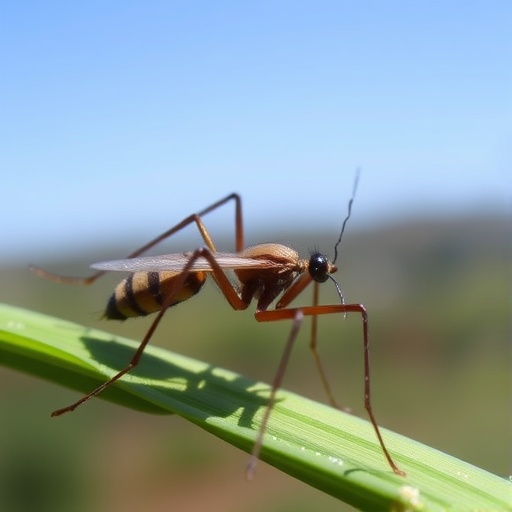
In the ever-evolving world of genetics, a groundbreaking study is shedding light on the complex dynamics of the Aedes aegypti mosquito populations in California. This research, led by a team of scientists that includes Campos, Lee, and Brisco, dives deep into the genetics behind range expansion and admixture of these prominent mosquito species, which are notorious for transmitting diseases like dengue fever, Zika virus, and chikungunya. The results of this study are expected to have significant implications for public health strategies as well as our understanding of ecological impacts.
Aedes aegypti, recognized for their distinct white markings on their legs and lyre-shaped pattern on their thorax, are primarily tropical and subtropical mosquitoes, but their presence is expanding into new territories, including parts of California. The researchers in this recent study focused on understanding the genetic factors driving the migration patterns and hybridization within Aedes aegypti populations. By employing advanced genomic techniques, the study unveils crucial insights into how these species are adapting to their changing environments.
In California, the shift in climate and urbanization has opened new habitats for Aedes aegypti. This adaptation is not merely a matter of survival but suggests a complex interplay of genetic variations within these mosquito populations. The research team has meticulously mapped genetic markers that distinguish various populations of Aedes aegypti across geographic regions. These markers are vital for understanding how genetic diversity contributes to both the resilience and vulnerability of these mosquito populations.
Admixture, a process where individuals from different populations interbreed, is a key concept in this study. The researchers found significant evidence of admixture among Aedes aegypti populations in California. This hybridization can lead to increased genetic variability, which may enhance the mosquitoes’ ability to adapt to new environmental challenges and control measures. It’s a double-edged sword; while it may bolster the species’ adaptive capacity, it may also complicate efforts to manage and eradicate these disease vectors.
The study utilized genomic sequencing technologies, allowing researchers to delve into the genetic architecture of the populations. This technology is groundbreaking, as it provides high-resolution data on the genetic makeup of Aedes aegypti, enabling scientists to track changes over time. The insights gained from this genetic analysis can inform ongoing monitoring efforts and could lead to more effective pest control strategies in the future.
Understanding the genetic framework of Aedes aegypti is not just a technical endeavor; it holds significant practical implications. Public health policy makers can leverage these findings to develop targeted control measures, especially in regions that are witnessing the incursion of these disease-carrying mosquitoes. Identifying genetically distinct populations can help in crafting tailored strategies, ensuring interventions are both effective and efficient.
Additionally, the implications of this research resonate far beyond California. The genetic insights obtained can serve as a model for studying similar patterns in Aedes aegypti populations around the globe. As climate change continues to dictate shifts in biodiversity, the management of mosquito populations will be vital in safeguarding public health in many countries. This research underlines the necessity of cross-border collaborations among scientists studying vector genetics.
Moreover, the role of environmental factors in genetic adaptations cannot be overstated. Changes in land use, urban development, and climate variations are all contributing to the shifting patterns of mosquito populations. By understanding these correlations, researchers can predict future trends, which is essential for proactive public health planning and response.
As scientists work to piece together the puzzle of Aedes aegypti’s genetics, broader questions about biodiversity and ecosystem health emerge. The findings not only reflect the resilience of these species but also highlight the fragility of ecosystems in the face of rapid environmental changes. It becomes increasingly clear that the interconnections within ecosystems must be acknowledged and considered in conservation and management efforts.
The groundwork laid by this study sets the stage for future research initiatives. Scientists can now explore questions regarding the potential for these hybrid populations to carry different disease vectors or exhibit varying resistance to insecticides. Such studies will be integral in refining our approaches to vector control and disease prevention.
In summary, the research spearheaded by Campos and colleagues provides a stunning view into the genetic landscape of Aedes aegypti in California. The implications of their findings are profound, offering pathways not only for understanding mosquito population dynamics but also for enhancing public health strategies to combat mosquito-borne diseases. As researchers continue to unravel the genetic intricacies of these vectors, the insights gained will undoubtedly become indispensable tools in the ongoing battle against infectious diseases.
Without a doubt, the study reflects an essential stride toward bettering our response to the challenges presented by Aedes aegypti, especially in a time when global interconnectedness increases the risks associated with disease transmission. As the fight against mosquito-borne diseases rages on, the integration of cutting-edge genomic research with public health strategies will be paramount in shaping a healthier future.
In conclusion, the research elucidates how genetic factors are deeply intertwined with ecological adaptations and public health concerns. As the scientific community delves deeper into this critical area, continual discovery and innovation will be necessary to keep pace with the evolving threats posed by vector populations such as Aedes aegypti.
Subject of Research: Genetics of range expansion and admixture of Aedes aegypti populations in California.
Article Title: Genetics of range expansion and admixture of Aedes aegypti populations in California.
Article References:
Campos, M., Lee, Y., Brisco, K. et al. Genetics of range expansion and admixture of Aedes aegypti populations in California. BMC Genomics (2025). https://doi.org/10.1186/s12864-025-12443-7
Image Credits: AI Generated
DOI: 10.1186/s12864-025-12443-7
Keywords: Aedes aegypti, genetics, range expansion, admixture, public health, disease transmission, genomics, hybridization, vector control.
Tags: advanced genomic techniques in entomologyAedes aegypti mosquito geneticsCalifornia mosquito population dynamicsclimate change and mosquito adaptationdengue fever and Zika virus vectorsdisease transmission by Aedes aegyptiecological impacts of mosquito migrationgenetic diversity in Aedes aegyptimosquito hybridization in Californiapublic health implications of mosquito researchrange expansion of Aedes aegyptiurbanization effects on mosquito populations