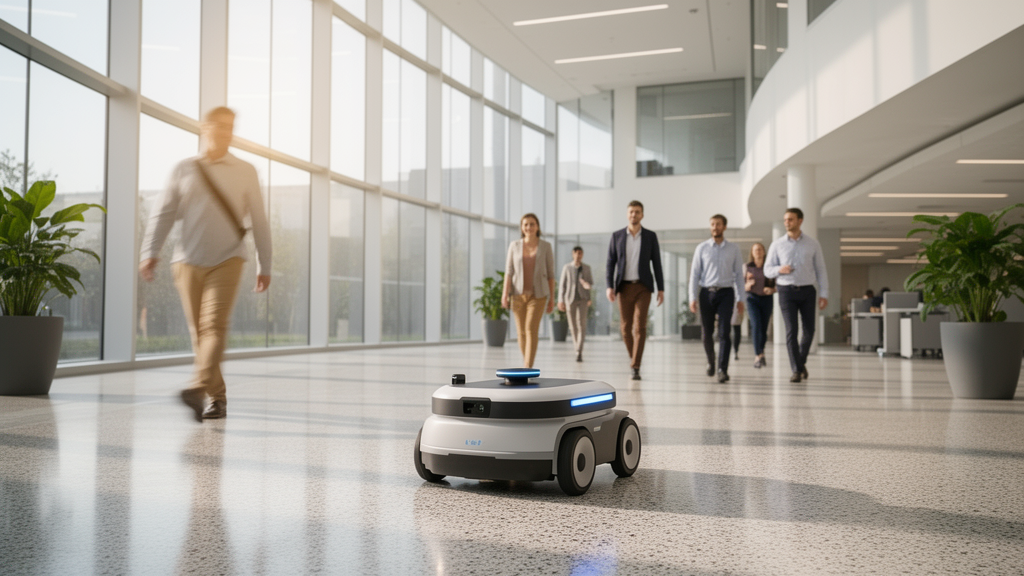
Robotics researchers have developed a situation-dependent motion generation framework based on a deep generative architecture that simultaneously plans local movements and forecasts forthcoming environmental changes in human-shared indoor environments. In daily unstructured settings, mobile robots often struggle to navigate effectively alongside people, frequently experiencing unrecoverable stalls or exhibiting rigid mechanical actions that degrade human-robot coexistence. Developing conventional navigation policies requires hand-crafted rules or exhaustive enumerations of potential spatial scenarios, which quickly becomes impractical in busy public spaces. To address these operational constraints, the investigation introduces a generative world model utilizing a variational autoencoder with arbitrary conditioning, known as VAEAC, to model continuous sequences of sensory observations and robotic actions. Published as a proof-of-concept study in Artificial Life and Robotics, the system replicates the human capacity to read environmental affordances and proactively anticipate potential futures, drawing upon past teleoperated experiences to generate context-sensitive mobile behaviors without pre-programmed cost maps.
The underlying conceptual foundation of the framework treats local planning as an affordance-driven perception-action loop rather than a rigid target-tracking problem. While conventional autonomous mobile robot navigation relies on a global planner to map waypoints across coordinate spaces through simultaneous localization and mapping, local planners must rapidly dictate short-term adjustments to immediate obstacles. Human movement in dynamic social environments relies on continuously updating cognitive processes informed by environmental cues, such as judging whether a walking pedestrian intends to cross a corridor or clear a pathway. The research team sought to transfer these spontaneous human capabilities into robotic local planning policies by jointly capturing multimodal temporal data. By modeling both the perceptual stream of future scenes and the corresponding movement actions within a single generative framework, the system enables an agent to explore compact indoor spaces, preserve temporal coherence across planned trajectories, and eliminate repetitive, low-efficiency behaviors that typically cause robots to get stuck.
To capture realistic demonstration data across varied social and architectural settings, the authors engineered a specialized detachable recording apparatus termed the Box PC. This compact modular unit integrates an Intel N100 mini PC, a fisheye camera providing an expansive optical field of view of nearly 180 degrees, and a sixteen-channel UMA-16 v2 microphone array. The device was installed on two distinct mobile platforms: an avatar robot configured with a display screen showing an operator face to simulate virtual meetings, and a rover platform outfitted with a communication robot bearing an anime-style facial interface. Human operators steered the platforms using a Joy-Con handheld controller while monitoring real-time first-person-view video streams transmitted directly from the onboard fisheye camera. As teleoperators navigated through real-world office suites, corridors, and simulated residential living rooms, the system systematically logged wheel encoder odometry as agent action records alongside synchronous video and multichannel audio streams across ten hours of exploratory operation.
The resulting ten-hour multimodal dataset formed the basis for training the predictive neural architecture, focusing specifically on visual observations and relative wheel movement actions. Visual streams consisting of 512 by 512 RGB fisheye frames were first unwarped to correct latitude distortion and subsequently resized to 256 by 256 pixels. To enhance generalizability across visually diverse environments, the frames were preprocessed through MaskDINO, a detection transformer framework pre-trained on the ADE20K and COCO datasets. MaskDINO simplified dense pixel data into segmented categorical channels, which were converted into one-hot encoded feature maps representing five explicit semantic classifications: ceilings, walls, floors, human occupants, and unrecognized obstacles. The semantic channels were downsampled to 64 by 64 arrays and temporally concatenated with the corresponding linear and angular odometry velocities. This semantic abstraction permitted the core generative network to focus on structural object relationships and dynamic affordances rather than superficial pixel-level lighting variations.
At the center of the computational framework is the VAEAC model, which formulates future prediction and action decision-making as an arbitrary data imputation task. Unlike traditional generative world models that enforce rigid splits between input condition variables and target output generations, the VAEAC architecture dynamically adjusts binary conditioning masks to infer any missing segment of the temporal sequence. The network architecture incorporates separate proposal, prior, and generative networks. The proposal network accesses the complete sixteen-timestep sequences of video frames and motion parameters during training, while the prior network processes masked sequences where eight timesteps are exposed and eight future timesteps are concealed. A MobileNet convolutional backbone processes the semantic observation frames to preserve spatial and temporal representations, and a three-layer multilayer perceptron encodes the linear and angular motion actions. Latent representations from both modalities undergo late fusion, after which a modified MobileNet decoder reconstructs future semantic intensity maps while an asymmetric multilayer perceptron decoder predicts forthcoming action vectors.
The entire pipeline was optimized end-to-end on a single GeForce RTX 3090 graphics processing unit across sixty training epochs using the Adam optimizer set to a learning rate of 5 multiplied by 10 to the power of negative 5. The multi-objective loss function balances mean squared error reconstruction terms for the unobserved video intensity maps and action trajectories against the Kullback-Leibler divergence between the prior and proposal latent distributions. Furthermore, specific mathematical regularizers were integrated into the variational lower bound to constrain the mean and standard deviation of the approximate prior distribution, avoiding numerical instability. In deployment on physical robots, the proposal network is omitted because future data cannot be accessed in real time; the robot relies exclusively on the trained prior network to sample latent variables from historical eight-timestep buffers, simultaneously predicting environmental changes and selecting immediate motor velocities.
Initial quantitative evaluations verified the statistical quality and fidelity of the model’s generated environmental predictions against real-world observations using Manhattan distance metrics across semantic channels. By computing the Manhattan distance between 350 ground-truth real-world data samples and sets of 50 randomly sampled real observations or 50 model-generated future predictions, the researchers assessed the alignment of the learned output distributions. The generated semantic samples demonstrated systematically lower Manhattan distance values than randomly selected real-world baselines. This confirmed that the network generated structured environmental transitions conditioned directly on immediate historical context rather than merely computing dataset-wide averages or producing unconstrained random outputs. The temporal coherence of the generated outputs demonstrated that predicted spatial layouts evolved smoothly in correspondence with the simultaneous motor commands, validating the internal consistency of the world action model.
Physical robotic experiments were subsequently conducted in a compact indoor testing arena measuring approximately 30 square meters filled with varied physical obstacles, evaluating collision avoidance across three distinct navigation strategies. The model-based walk was compared against two negative control baselines: a dummy walk, where the robot drove straight along an initial heading until encountering a barrier, and a random walk, where heading angles and step distances were drawn randomly from Gaussian distributions. An automated emergency stop protocol served as an objective safety threshold, triggering whenever the platform approached an imminent collision and forcing it to reverse and select a new heading. Across ten independent five-minute exploration trials per condition, the dummy walk triggered an average of 39.75 emergency stops, and the random walk triggered 36.8 safety interventions. In contrast, the model-based policy reduced the mean collision count to 28.5. When treating consecutive rapid contact events within a brief window as single incidents, the model-based walk logged 12.3 collisions compared to 20.4 for the dummy walk and 18.4 for the random walk.
The investigative team also examined autonomous spatial exploration across the same testing environment by overlaying a virtual coordinate grid with 0.1-meter spacing, recording points within 0.5 meters of the mobile platform as explored space. Over the five-minute trials, the teleoperated human expert driving the platform served as a positive control, achieving a peak spatial coverage of 92 percent within the limits imposed by inaccessible room contours and platform geometry. Among the autonomous operational modes, the model-based framework consistently achieved the highest coverage rate at each recorded timestep, navigating through open corridors and circumventing clusters of obstacles. Rather than wandering aimlessly or vibrating back and forth within confined corners, the model leveraged environmental affordances learned from human demonstrations to seek viable pathways into previously unvisited areas.
Beyond static obstacle navigation, the framework was tested in dynamic human interaction scenarios where an approaching pedestrian walked directly toward the robot along a narrow indoor pathway. The system continuously evaluated the probability of human presence by computing the ratio between the predicted intensity of human pixels and the predicted intensity of the surrounding floor plane across three distinct operational phases: prior to avoidance, at the onset of avoidance, and while passing by. The computed human presence probability increased steadily as the robot drew near the walking person and decreased smoothly as the robot steered clear and bypassed them. Instead of executing sharp stops or mechanical jerky pivots, the vehicle imitated natural deceleration patterns extracted from human teleoperation, slowing down smoothly and yielding right-of-way. In an unexpected blocking scenario where a pedestrian deliberately stepped into the robot’s predicted path, the model demonstrated operational robustness by updating its multimodal forecast and executing an alternative evasive maneuver.
Despite these encouraging validation results, the authors outlined key technical boundaries inherent in their current proof-of-concept implementation. Because the VAEAC architecture produces categorical intensity maps rather than high-resolution RGB imagery, fine-grained visual details, such as human facial cues, subtle hand gestures, and body gaze directions, are not currently incorporated into the decision pipeline. Furthermore, the variance across generated futures remains relatively restricted, causing the current model to predict primarily the single most probable trajectory rather than imagining multiple divergent outcomes. To build upon this foundation, future iterations aim to investigate diffusion transformer architectures, scale the training corpus with wearable sensor recordings, and integrate richer multimodal perception to allow mobile robots to anticipate complex human intentions in dense social environments.
Subject of Research: Generative world model for situation-dependent robot motion and dynamic human avoidance
Article Title: A situation-dependent motion generation framework using a generative model of motion and observation
Article References: Xu, C., Okadome, Y., Ishiguro, H., & Nakamura, Y. (2026). A situation-dependent motion generation framework using a generative model of motion and observation. Artificial Life and Robotics. https://doi.org/10.1007/s10015-026-01159-w
Image Credits: AI Generated
DOI: 10.1007/s10015-026-01159-w
Keywords: mobile robots, generative models, variational autoencoder with arbitrary conditioning, human-robot interaction, local motion planning, affordance-driven behaviors, semantic segmentation, MaskDINO, collision avoidance, autonomous exploration, teleoperation, world action models, odometry, indoor navigation, multimodal machine learning, Manhattan distance
News Source: Denise Maddox. (November 24, 2026). Generative World Model Enables Mobile Robots to Predict Scenes and Navigate Around Humans. Scienmag.