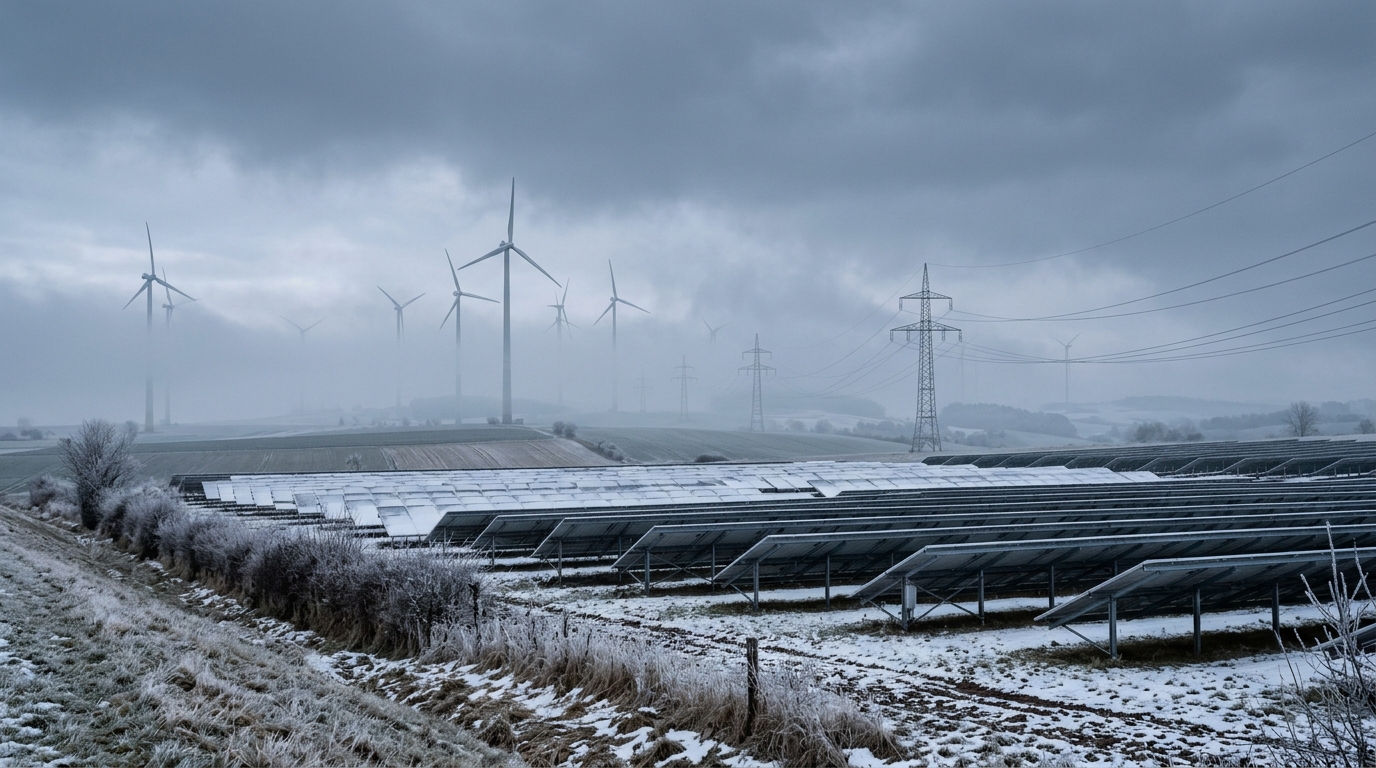
Advanced generative artificial intelligence models applied to global climate projections indicate that Germany is unlikely to face an increase in the frequency or duration of renewable energy droughts over the coming decades. According to an extensive investigation published in Environmental Data Science, periods of compound low wind and solar electricity production, widely known as Dunkelflaute events, are projected to remain remarkably stable across the twenty-first century under both optimistic low-emission and high-emission trajectories. By adapting a generative spatiotemporal downscaling framework based on score-based diffusion modeling and flow matching, researchers mapped coarse climate simulations from the Coupled Model Intercomparison Project Phase 6 onto high-resolution atmospheric fields. The downscaled simulations reveal that the ensemble mean frequency of Dunkelflaute occurrences remains level at approximately two to three events per year through 2100. This primary finding suggests that the meteorological hazard underlying these severe generation lulls will not inherently intensify as global temperatures rise, providing a crucial atmospheric baseline for long-term power system planning.
The stability of the electricity grid has emerged as an urgent priority as Europe accelerates its transition toward decarbonized power systems. In 2023, renewable generation supplied 44.7 percent of total electricity across the European Union and reached 62.7 percent in Germany, where onshore and offshore wind contributed 31.5 percent and solar photovoltaics accounted for 13.8 percent. However, this deep reliance on weather-dependent resources makes the transmission system exceptionally vulnerable to meteorological fluctuations. Dark doldrums, or Dunkelflaute episodes, occur primarily during winter months when persistent high-pressure atmospheric systems bring stagnant air, dense cloud cover, and short daylight hours, concurrently depressing wind turbine output and solar irradiance.
Anticipating the future behavior of these combined renewable droughts has long posed a severe computational and methodological challenge for atmospheric scientists and energy engineers. Future climate simulations coordinated by the Coupled Model Intercomparison Project Phase 6 provide multi-model projections running to the end of the century, but their native horizontal grid spacing of approximately 100 kilometers is far too coarse to resolve localized boundary-layer dynamics, complex topography, coastal gradients, and rapid diurnal cycles. Historically, climate researchers have refined global outputs using dynamical downscaling, in which regional climate models such as those within the EURO-CORDEX initiative simulate fine-scale physics at horizontal resolutions between 12 and 50 kilometers. While regional models have been coupled with energy datasets like the Copernicus Pan-European Climate Database, different global and regional model pairings often produce conflicting local trends under identical radiative forcing, especially in complex terrain and coastal transition zones. Furthermore, dynamic regional climate modeling demands immense supercomputing resources, restricting energy assessments to limited deterministic model combinations that frequently supply only monthly or aggregated spatial outputs rather than the continuous, sub-daily spatiotemporal sequences required for infrastructure modeling.
To overcome the computational expense of dynamic climate models and the physical oversimplifications of conventional statistical downscaling, the authors adapted the Generative Spatiotemporal Downscaling framework originally formulated around score-based diffusion models. While traditional statistical regression methods struggle to capture the complex spatial and temporal correlations governing multivariate atmospheric states, generative models learn implicit probability distributions from observed data and draw physically consistent high-resolution samples. The researchers refined this approach by shifting from standard diffusion equations to a Flow Matching objective with linear probability paths, which substantially stabilizes model training and improves sampling efficiency. In addition, the authors addressed a key structural limitation of purely unconditional generative downscaling by incorporating learned temporal conditioning embeddings directly during training. By supplying the hour of the day at six-hourly increments and the calendar month, the neural architecture explicitly internalizes the diurnal solar cycle and broader seasonal dynamics, ensuring that generated local realizations remain physically aligned with astronomical forcing even when conditioned on time-aggregated macroscale climate inputs.
The training and validation of the generative framework relied on the European Centre for Medium-Range Weather Forecasts ERA5 reanalysis dataset from 1979 through 2024, evaluated at a spatial resolution of 0.25 degrees and a six-hourly temporal resolution. To project future atmospheric behavior, the team selected five Earth System Models from the CMIP6 archive: MPI-ESM1-2-HR, GFDL-ESM4, IPSL-CM6A-LR, MIROC6, and CANESM5. These specific global models were selected to span a wide range of equilibrium climate sensitivities under two benchmark Shared Socioeconomic Pathways: the intermediate, optimistic low-emission SSP2-4.5 pathway and the unmitigated, fossil-fueled high-emission SSP5-8.5 pathway. To resolve systematic discrepancies, the authors implemented a rigorous two-stage quantile mapping bias correction procedure. In the first stage, raw CMIP6 large-scale predictor fields were corrected against coarsened ERA5 fields to eliminate foundational climate model errors. In the second stage, the downscaled high-resolution outputs were bias-corrected against full-resolution ERA5 observations, a step that proved essential for eliminating distortions caused by daily-mean wind velocity inputs, which otherwise compress sub-daily variability and artificially bias simulated surface wind distributions toward zero.
To translate atmospheric fields into energy metrics, the study simulated local power outputs using a customized configuration of the open-source atlite Python modeling library. For onshore and offshore wind energy, horizontal wind vector components at 10 meters were extrapolated upward to hub height using standard logarithmic wind profiles based on surface roughness parameters derived from ERA5. Onshore generation was modeled around the power curve of a Vestas V112 3-megawatt turbine, while offshore production was represented using a 5-megawatt National Renewable Energy Laboratory reference turbine. For solar photovoltaic generation, downward surface solar radiation was separated into direct and diffuse components via the Erbs decomposition model, which integrates surface 2-meter air temperature and solar zenith angles calculated across each grid cell. Power generation was then evaluated for fixed-tilt solar panels oriented directly south at an azimuth of 180 degrees and tilted at an inclination of 35 degrees. Regional capacity factors, defined as the ratio of generated power to maximum theoretical output, were calculated across the German landmass and combined using the national generation capacity shares measured in 2024, comprising 57.7 percent solar photovoltaics across 99.3 gigawatts, 36.9 percent onshore wind across 63.5 gigawatts, and 5.4 percent offshore wind across 9.2 gigawatts.
In establishing their analytical benchmark, the authors adopted an empirical, supply-based formulation of renewable droughts rather than a meteorological circulation index or a demand-coupled shortfall model. Following established literature, a Dunkelflaute event was operationalized as any period during which the nationwide 48-hour rolling average combined capacity factor fell below a threshold of 0.06, or 6 percent of nominal rated capacity. Under this definition, consecutive sub-threshold periods are merged into single continuous events indexed to their onset date. An analysis of the historical ERA5 baseline between 1979 and 2024 revealed that while individual wind and solar resources display distinct opposing annual regimes—wind yields peaking during winter and solar generation dominating summer months—the combined capacity factor remains relatively constant across the seasons. Nonetheless, Dunkelflaute events occur almost exclusively during the winter window from November to January. Because solar capacity factors drop near zero during winter due to short daylight duration and shallow atmospheric sun angles, solar panels cannot compensate for calm surface conditions, creating deep low-tail capacity factor distributions that drive compound generation droughts.
Rigorous validation against historical observations demonstrated that high-resolution spatiotemporal downscaling is indispensable for reproducing compound generation statistics. Uncorrected or coarse models systematically underestimated capacity factors in specific regions, such as northeastern Germany, which led to an artificial overestimation of Dunkelflaute events. Probabilistic calibration confirmed that the generative flow matching model produced well-calibrated distributions with only a slight tendency toward underdispersion. When assessing historical CMIP6 runs against ERA5 reanalysis across the 1980 to 2014 baseline using 10-year rolling windows, the bias-corrected downscaling faithfully captured multi-decadal trends. Over this historical timeframe, German onshore wind capacity factors experienced a mild two-percentage-point decrease between 1998 and 2010 alongside declining decadal standard deviations, whereas offshore wind capacity factors remained stable. Solar capacity factors exhibited a gradual increase of 0.5 percentage points with rising interannual variability. On a spatial level, pixel-by-pixel comparisons confirmed that onshore mainland wind errors remained under 1 percent, with minor deviations confined to coastal zones and the Baltic Sea where coarse global models inherently struggle with land-sea landcover boundaries.
When examining future climate projections out to 2100, the downscaled simulations demonstrated that neither the overall frequency nor the duration of Dunkelflaute events will undergo significant shifts. Across the historical verification period of 1980 to 2014, neither observational ERA5 data nor any individual CMIP6 model displayed a statistically significant trend at the 0.05 alpha level, with the ensemble mean closely tracking historical event counts from 2000 onward. In the future projections spanning 2020 through 2100 under the optimistic low-emission SSP2-4.5 scenario, individual models remained in tight consensus until roughly 2080, after which inter-model spread expanded: MPI-ESM1-2-HR, IPSL-CM6A-LR, and CANESM5 projected mild increases in annual event counts, whereas GFDL-ESM4 and MIROC6 indicated modest decreases. Under the high-emission SSP5-8.5 scenario, the multi-model ensemble mean remained exceptionally stable, averaging between two and three discrete Dunkelflaute events per year without significant upward or downward drift. Furthermore, probability density functions representing event durations revealed that the distribution of single-day and multi-day generation droughts remained virtually identical between historical records and twenty-first-century projections.
Although the national ensemble average shows long-term macroscale stability, high-resolution spatial mapping revealed localized geographic variations in the frequency of prolonged low-generation conditions. Examining 48-hour periods where combined capacity factors dropped below 6 percent during the sensitive November through February generation window between 2020 and 2050, researchers observed nuanced sub-national shifts. The historical baseline illustrates a distinct spatial gradient, with low-generation hours concentrated along a southwest-to-northeast axis and across upland regions. Under future warming scenarios, downscaled ensemble means project a noticeable decline in event frequency within the Hessian region of central Germany, driven primarily by localized enhancements in projected wind capacity factors. Similarly, a modest decrease in low-capacity-factor occurrences was identified in northeastern Germany near the Polish border, attributed to minor shifts in solar irradiance. In contrast, parts of eastern Germany and adjacent regions may experience slight reductions in mean wind velocity, while southwestern Germany is projected to see subtle improvements in wind resource reliability, highlighting subtle regional dynamics that may inform the spatial siting of future generation assets over 20- to 30-year operational lifetimes.
The study authors emphasized several critical physical and systemic caveats that must frame the interpretation of their findings. First, while localized wind biases over complex topography such as the Alps were identified in the downscaled fields, these high-altitude discrepancies have negligible practical relevance because commercial wind turbines are rarely deployed on alpine peaks. Second, while broad European climate projections suggest that near-surface wind speeds across central Europe could decline by 5 to 15 percent under SSP2-4.5 and up to 20 percent under SSP5-8.5, downscaled analyses specific to Germany indicate that mean wind speeds will experience only minor adjustments. The authors noted that potential changes in extreme, multi-day atmospheric blocking or intensified winter storms remain uncertain and warrant dedicated investigation. Most importantly, the researchers underscored that their analysis evaluated purely weather-induced generation potential under a fixed 2024 capacity layout, rather than total grid reliability. Incorporating high-resolution generative weather realizations into whole-system dispatch models like PyPSA represents the vital next step in stress-testing European grid resilience under a changing climate.
Subject of Research: Generative deep learning projection of future Dunkelflaute and renewable energy drought risks in Germany
Article Title: Assessing the risk of future Dunkelflaute events for Germany using generative deep learning
Article References: Strnad, F., Schmidt, J., Mockert, F., Hennig, P., & Ludwig, N. (2026). Assessing the risk of future Dunkelflaute events for Germany using generative deep learning. Environmental Data Science, 5, Article e11. https://doi.org/10.1017/eds.2026.10038
Image Credits: AI Generated
Keywords: Dunkelflaute, Generative Deep Learning, Climate Downscaling, CMIP6, ERA5 Reanalysis, Renewable Energy, Wind Energy, Solar Photovoltaics, Grid Stability, Capacity Factors, Flow Matching, Energy Transition, Climate Projections, Atmospheric Modeling, Germany Energy Grid, Diffusion Models, Quantile Mapping
News Source: Blake Davidson. (November 23, 2026). Generative Deep Learning Projects Stable Future Dunkelflaute Risks for German Renewable Grid. Scienmag.