Credit: ©Science China Press
Cancer is deadly, but available cancer treatment methods are quite limited. The use of therapeutic gas molecules such as H2, NO, CO and H2S for cancer treatment is promising owing to their unique properties for selectively killing cancer cells and protecting normal cells from damage from other traditional therapies. However, these gases and most of their prodrugs lack the abilities of active intratumoral accumulation and controlled gas release, causing limited therapeutic efficacy and potential side effects. The development of precision and intelligent gas delivery nanomedicines can maximize the profits of gas therapy by enhancing the bio-availability and bio-safety of therapeutic gases.
More and more gas-releasing nanomedicines are being developed by virtue of multifunctional nanoplatforms, making it ever-increasingly expectable to make breakthrough in cancer treatment. Even so, there are still many gaps between gas therapy and nanomedicines, needing to be filled.
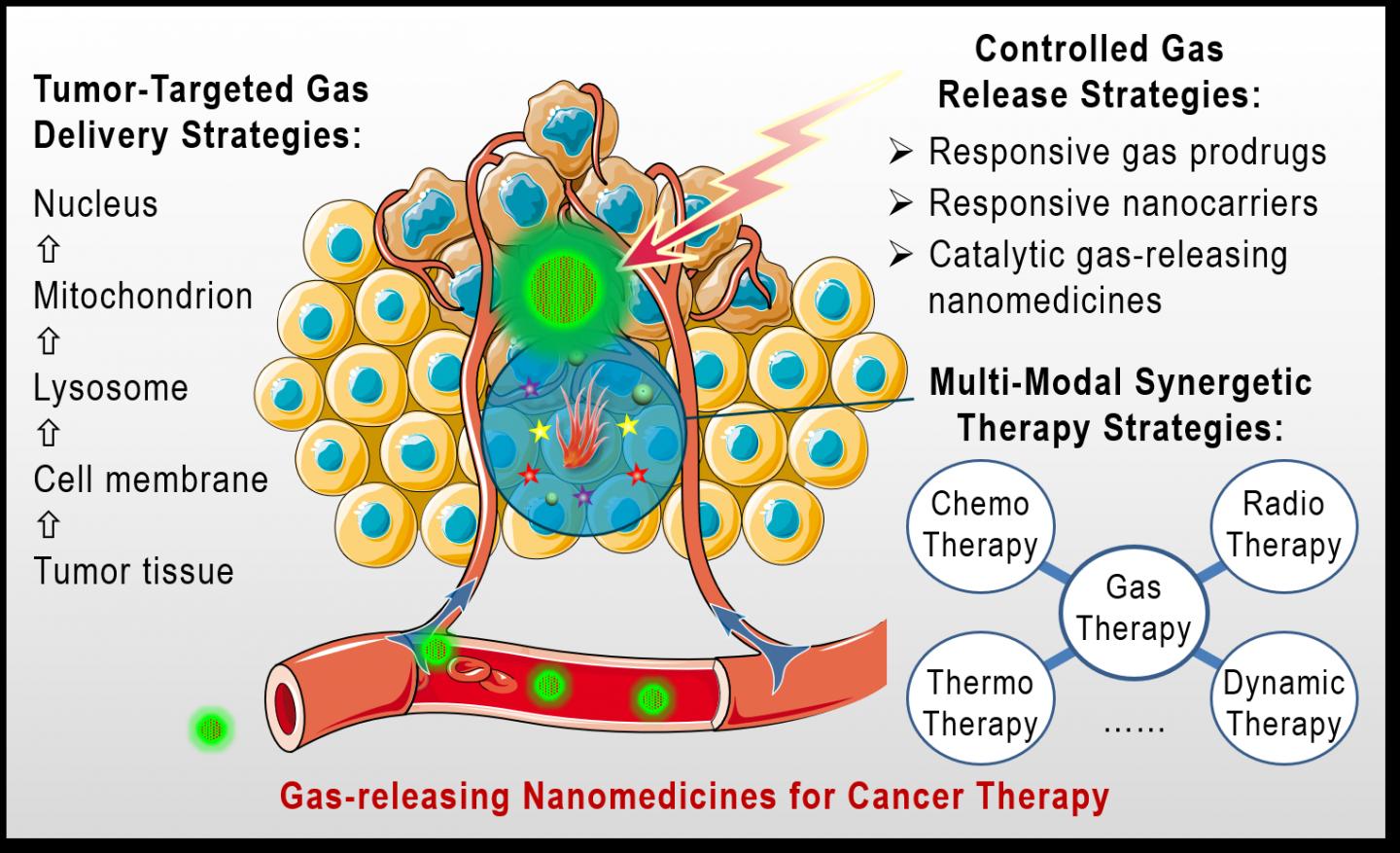
In a new overview published in the Beijing-based National Science Review, scientists at Shenzhen University, China propose a series of engineering strategies of advanced gas-releasing nanomedicines for augmented cancer therapy from four aspects, 1) stimuli-responsive strategies for controlled gas release, 2) catalytic strategies for controlled gas release, 3) tumor-targeted gas delivery strategies, 4) multi-model combination strategies based on gas therapy.
“This review systematically dissects the roles of carrier and gas prodrug within nanomedicine for stimuli-responsive gas release, catalytic gas generation routes, tumor-targeted gas delivery approaches and gas therapy-based combination methods, and also provides an insight into their engineering principles and working mechanisms, and correspondingly proposed a series of superior engineering strategies of nanomedicines for gas therapy of cancer to guide the future research.” Dr. Yingshuai Wang said “We believe this review could provide inspiration for constructing advanced gas-releasing nanomedicines.”
Moreover, they have also pointed out current issues and gaps in knowledge, and have envisaged current trends and future prospects of advanced nanomedicines for gas therapy of cancer in this review.
“There are many gaps intriguing me, such as high tissue penetration stimuli-responsive gas release, the local, endless and prodrug-free generation of gases by catalysis, and the super ability of assisting other almost all therapies.” Prof. Qianjun He adds “It is noticeable, in the recent fight of novel coronavirus pneumonia, hydrogen therapy is playing an vitally important role in assisting large numbers of patients to improve oxygen inhalation, relieve hypoxia, and scavenge inflammation. I hope our hydrogen-producing medicines would make bigger contribution to human being in the near future.”
###
This research received funding from National Natural Science Foundation of China, Shenzhen Basic Research Program, and Special Funds for the Development of Strategic Emerging Industries in Shenzhen.
See the article:
Yingshuai Wang, Tian Yang, and Qianjun He*
Strategies for engineering advanced nanomedicines for gas therapy of cancer
Natl Sci Rev https:/
The National Science Review is the first comprehensive scholarly journal released in English in China that is aimed at linking the country’s rapidly advancing community of scientists with the global frontiers of science and technology. The journal also aims to shine a worldwide spotlight on scientific research advances across China.
Media Contact
Qianjun He
[email protected]
Related Journal Article
http://dx.