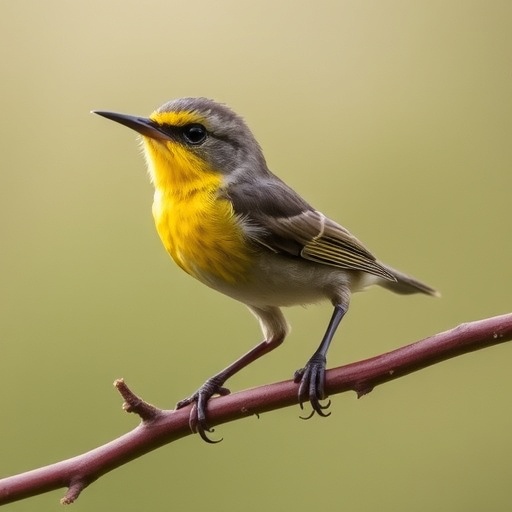
For decades, the scientific community has largely concentrated its studies of birdsong on male specimens, an approach that has left the vocal behaviors of female birds inadequately explored. This male-centric bias stems partly from historical assumptions that females play a passive role in sexual selection and partly from a predominant research focus on species from the Northern Hemisphere, where males tend to sing more frequently than females. This narrower scope has obscured understanding of the evolutionary and ecological nuances of female birdsong, particularly in tropical species, where emerging evidence indicates that female song is not only widespread but also likely serves diverse functions beyond those observed in males.
A groundbreaking study led by teams from the University of Vienna and Anglia Ruskin University has illuminated the vocal behaviors of female Galápagos yellow warblers (Setophaga petechia aureola), revealing that females sing regularly, though their song serves distinct purposes from those hypothesized for males. Situated on Floreana Island in the Galápagos archipelago, the research involved a combination of field observations and rigorous playback experiments designed to simulate territorial intrusions across both breeding and non-breeding seasons. These manipulations aimed to disentangle the functional motivations behind female song, an endeavor that ultimately challenged common paradigms in ornithology.
During their 2023 field expedition, researchers were intrigued to hear an unusual song not previously documented in scientific literature or regional ornithological guides. Initial assumptions identified this song as male, but further analysis demonstrated that it was indeed produced by females. This discovery prompted a comprehensive series of playback trials where recordings of male, female, and duetting vocalizations were broadcast to territorial pairs to elicit behavioral and vocal responses. Aggressive displays, song output, and territory retention over multiple years were meticulously recorded to assess potential correlations between song and territorial defense or intrasexual competition.
The classical hypotheses under scrutiny posited that female song might serve as a tool for intrasexual competition—essentially a mechanism allowing females to signal aggression towards same-sex rivals—or function in territorial defense, repelling intruders regardless of sex. Remarkably, the data collected refuted these expectations. Female warblers exhibited aggressive behaviors predominantly outside the breeding season, during which their singing was most frequently observed, yet singing was not synchronized with aggressive postures or behaviors. This dissociation starkly contrasts with males, whose vocalizations tightly correlate with territorial aggression, suggesting fundamental sex-based divergence in the role of song.
Intriguingly, female song seldom occurs in isolation. Rather, females often engage in duets with their male partners, typically responding to male-initiated vocalizations. This pattern intimates that female song may be more intricately linked to pair communication and maintenance than to territorial competition. The partners’ coordinated duetting could serve as a mechanism to reinforce pair bonds or synchronize reproductive and territorial activities, reflecting a communicative function distinct from male song’s overt territorial signaling.
The temporal patterning of female vocalizations further distinguishes their function. The predominance of female song during the non-breeding season, a period characterized by reduced territorial disputes yet heightened social interactions, invites speculation regarding alternative roles for singing. It is plausible that these vocal exchanges facilitate social cohesion between mates or within local populations, an area ripe for further neuroethological and behavioral investigations. Such findings underscore the necessity of integrating female vocal behaviors into broader models of avian communication evolution.
Historically underestimated, the complexity of female birdsong has profound implications for understanding sexual selection and social behavior in songbirds. By documenting female singing behavior in a species endemic to one of the world’s most iconic natural laboratories, this study enriches the discourse surrounding the evolution of vocal communication. It also serves as a corrective to the entrenched sex-biased focus that has limited behavioral ecology and evolutionary biology’s comprehension of female roles in acoustic signaling.
The study’s detailed elucidation of warbler song patterns hence contributes vital empirical data to the ongoing reevaluation of female song prevalence and function across avian taxa. Its methodological approach, combining long-term monitoring with sophisticated playback experiments, sets a new standard for field studies seeking to unravel the multifaceted roles of vocalizations in bird life history and social dynamics.
Emerging from this research is a broader recognition that female song in birds is far from rare or anomalous; rather, it is an integral component of avian acoustic repertoires, often specialized and adapted to fulfill specific communicative needs within the pair bond or wider social context. This realization challenges researchers to reconceptualize vocal behavior functions, incorporating female perspectives and behaviors as central elements rather than peripheral phenomena.
Moreover, the findings emphasize the importance of considering ecological context and seasonal variation when interpreting song function. Female Galápagos yellow warblers’ increased song activity during the non-breeding season suggests that vocal communication may shift priorities according to reproductive cycles and social demands, an insight that may apply broadly to other species with underexplored female vocalizations.
Ultimately, the researchers advocate for a paradigm shift in behavioral biology, urging that female song must be included to achieve a holistic and accurate portrait of avian communication systems. As this body of knowledge expands, it holds promise for unraveling the evolutionary pressures shaping complex vocal behaviors and fostering deeper appreciation for the nuanced social lives of birds worldwide.
This landmark study not only addresses historical research gaps but also opens new avenues for exploring the cognitive, evolutionary, and ecological dimensions of bird song. The call to action is clear: advancing ornithology requires embracing the full spectrum of vocal communication, centering female song as a fundamental component rather than a scientific afterthought.
Subject of Research: Vocal communication and behavioral ecology of female Galápagos yellow warblers (Setophaga petechia aureola).
Article Title: Solo songs, duets and territory defence across seasons in female Galápagos yellow warblers, Setophaga petechia aureola
News Publication Date: 17-Mar-2026
Web References: http://dx.doi.org/10.1016/j.anbehav.2026.123483
Image Credits: Çağlar Akçay
Keywords: Female birdsong, Galápagos yellow warbler, Setophaga petechia aureola, vocal communication, territorial defense, duetting behavior, intrasexual competition, avian behavior, evolutionary biology, songbird communication, behavioral ecology, paired vocal interaction