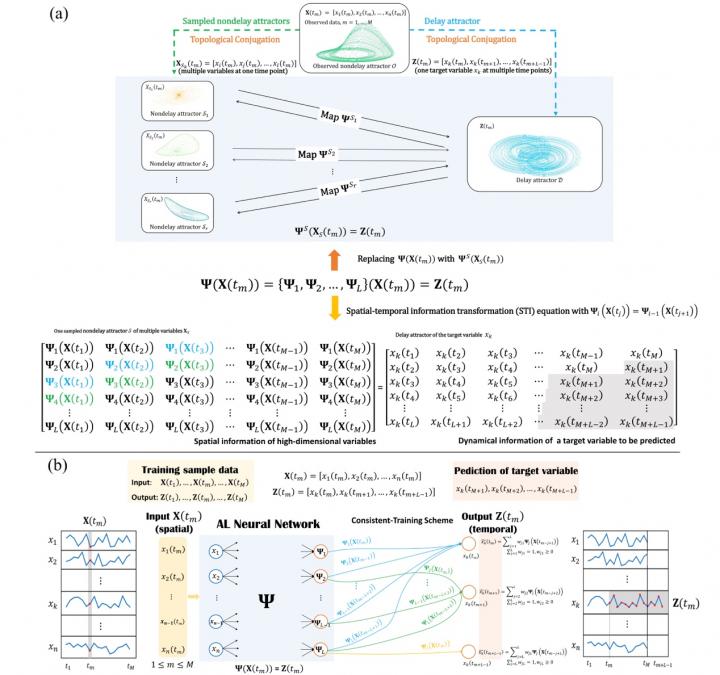
(a) The general principle of Anticipated Learning Machine (ALM). The observed attractor, a delay attractor and sampled nondelay attractors are all topologically conjugate with each other. Each sampled nondelay attractor…
view more
Making an accurate prediction based on observed data, in particular from short-term time series, is of much concern in various disciplines, arising from molecular biology, neuroscience, geoscience, economics to atmospheric sciences due to either data availability or time-variant non-stationarity. However, most of the existing methods require sufficiently long measurements of time series or a large number of samples, and there is no effective method available for the prediction only with short-term time-series because of lack of information.
To address this issue, Prof. CHEN Luonan (Institute of Biochemistry and Cell Biology, Chinese Academy of Sciences) with Dr. CHEN Chuan(Sun Yat-sen University), Prof. MA Huanfei (Soochow University) and Prof. AIHARA Kazuyuki (University of Tokyo) proposed a new dynamics-based data-driven method, Anticipated Learning Machine (ALM), for achieving precise future-state predictions based on short-term but high-dimensional data. Actually, the ALM is a multi-layered neural network, where high-dimensional variables are taken as input neurons (multiple variables but at a single time point) but a target variable is taken as output neurons (single variable but at multiple time points). In this way, ALM is able to transform the recent correlation/spatial information of high-dimensional variables to future dynamical/temporal information of any target variable, i.e. by spatial-temporal information transformation (STI) equations.
Specifically, ALM can be well trained to represent the randomly distributed embedding (RDE) map for STI equations by a large number of the generated training-samples with the Dropout scheme and the proposed consistent-training scheme, thus predicting the target variable in an accurate and robust manner even from short-term data. Extensive experiments on the short-term high-dimensional data from both synthetic and real-world systems demonstrated significantly superior performances of ALM over existing methods
Comparing with the traditional neural networks (or other machine learning approaches) which excavate the historical statistics of the original high-dimensional system and thus require a large number of samples, ALM efficiently and robustly reconstructs its dynamics even with a small number of samples by constraining to a low-dimension space which is actually an inherent property of such a dissipative system. Based on nonlinear dynamics to transform the spatial information of the all measured high-dimensional variables into the temporal evolution of the target variable by learning the STI equations, ALM open a new way for dynamics-based machine learning or “intelligent” anticipated learning.
“How to consider the strong nonlinearity or/and stochasticity of the dynamical systems also with the observed noisy data, and further how to make more in-depth theoretical analysis and further develop an appropriate framework taking these issues into consideration remain an open and interesting problem in future.” Stated by the authors.
###
This research received funding from National Natural Science Foundation of China, the Ministry of Science and Technology of China, and Japanese Research Grants.
See the article:
Chuan Chen, Rui Li, Lin Shu, Zhiyu He, Jining Wang, Chengming Zhang, Huanfei Ma, Kazuyuki Aihara and Luonan Chen.
Predicting future dynamics from short-term time series by anticipated learning machine.
Natl Sci Rev, doi: 10.1093/nsr/nwaa025
https:/
The National Science Review is the first comprehensive scholarly journal released in English in China that is aimed at linking the country’s rapidly advancing community of scientists with the global frontiers of science and technology. The journal also aims to shine a worldwide spotlight on scientific research advances across China.
Media Contact
Luonan Chen
[email protected]
Related Journal Article
http://dx.