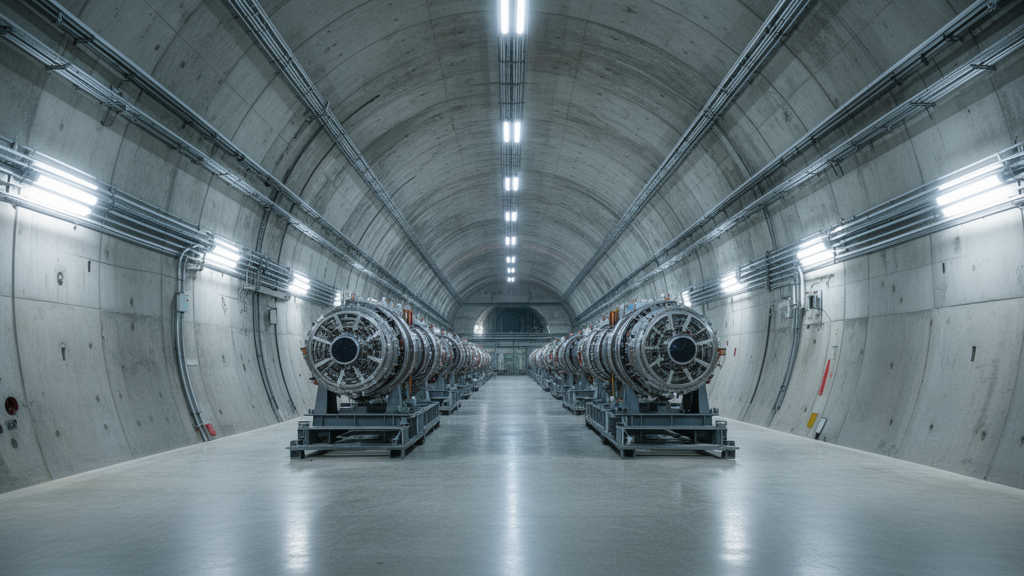
The Future Circular Collider integrated programme is conceived as a long-term, open, and internationally shared research infrastructure, according to a report published in EPJ Research Infrastructures by M. Benedikt and F. Zimmermann.
The programme combines a high-luminosity electron–positron collider, designated FCC-ee, with a subsequent energy-frontier proton–proton collider, designated FCC-hh, in a common 91-km-scale tunnel.
Beyond its physics case, the initiative is structured around specific research-infrastructure requirements, incorporating staged delivery and risk management across decades, broad user access, and sustainable operations supported by modern digital services.
Alignment with the FAIR data principles and interoperability with federated e-infrastructures, such as the European Open Science Cloud, provide a pragmatic route to maximise the reuse of data and software outputs across communities.
The brief report, authored by M. Benedikt and F. Zimmermann and published in EPJ Research Infrastructures, details how the Future Circular Collider integrated programme balances fundamental scientific research objectives with the complex practical demands of establishing an open, internationally shared facility. Rather than viewing the programme solely through the lens of its physics case, the authors emphasize an integrated operational strategy designed to ensure long-term viability across generations. Central to this vision is a sequential deployment pathway within a common 91-kilometer-scale tunnel. Under this framework, the high-luminosity electron–positron collider (FCC-ee) serves as the initial step, followed by an energy-frontier proton–proton collider (FCC-hh) that utilizes the same underground infrastructure.
To address the substantial operational challenges inherent in an infrastructure project designed to span multiple decades, the programme incorporates structured risk management and a staged delivery schedule. This comprehensive framework is structured to enable broad international user access, maintain administrative stability, and support sustainable operations through the integration of modern digital services across every phase of implementation.
In addition, modern data stewardship and technical interoperability represent foundational components of the overall research infrastructure requirements. By adhering closely to established FAIR data principles and ensuring seamless interoperability with federated electronic infrastructures such as the European Open Science Cloud, the programme establishes a clear, pragmatic route to maximize the cross-community reuse of both scientific data and related software outputs.
Subject of Research: Future Circular Collider research infrastructure
Article Title: Future Circular Collider Integrated Programme
Article References: Benedikt, M., & Zimmermann, F. (2026). Future Circular Collider Integrated Programme. EPJ Research Infrastructures, 10(1), Article 11. https://doi.org/10.1007/s41781-026-00162-x
Image Credits: AI Generated
DOI: 10.1007/s41781-026-00162-x
Keywords: Future Circular Collider, FCC-ee, FCC-hh, EPJ Research Infrastructures, research infrastructure, European Open Science Cloud, FAIR data principles, collider technology, Future, Circular, Collider, Integrated
News Source: Denise Maddox. (November 8, 2026). Future Circular Collider Outlines Staged Colliders for Shared Tunnel Infrastructure. Scienmag.