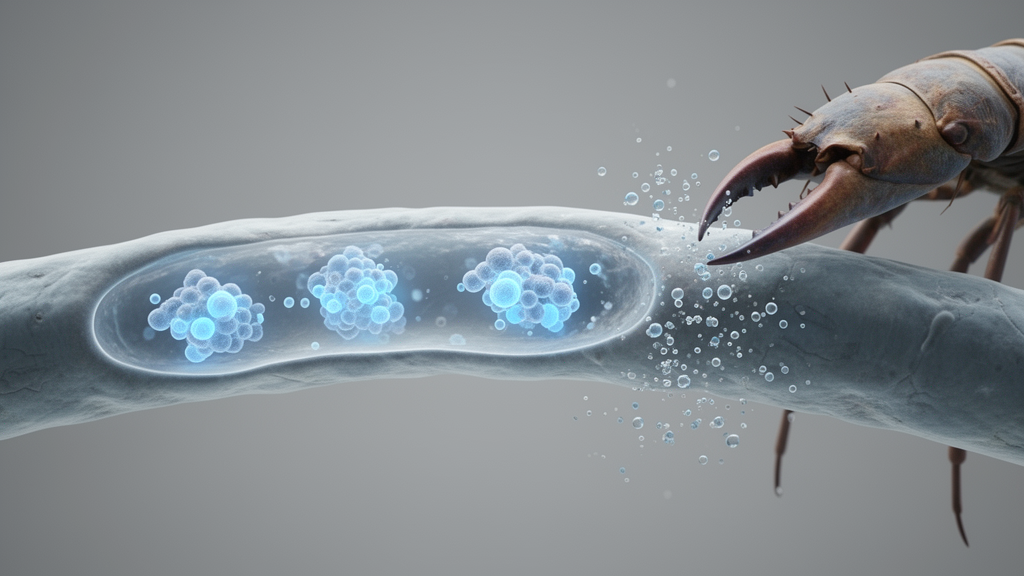
Biologists investigating the sensory and physiological survival strategies of filamentous fungi have identified that the eleven histidine kinase proteins in Neurospora crassa govern cellular adaptations, reproductive morphogenesis, and antioxidant biosynthesis when colonies face predation by the fungivorous arthropod Sinella curviseta. Filamentous fungi serve as critical agents for balancing environmental carbon fluxes and recycling organic nutrients across global ecosystems, while simultaneously acting as essential facultative or obligate food resources for diverse soil microarthropods. To survive constant grazing pressures without the capacity for physical locomotion, fungi have evolved intricate physiological and morphological response systems. While fungal two-component signaling cascades have previously been established as central coordinators of cellular responses to abiotic environmental stresses such as osmotic shifts, ambient light, fluctuating temperatures, and redox imbalances, this investigation directly tested how these sensory kinases participate in defense against biological predatory challenges.
The study focused on eleven specific histidine kinase genes identified across the Neurospora crassa genome, designated systematically as NCU09520, NCU02815, NCU07221, NCU01833, NCU04615, NCU04834, NCU05790, NCU02057, NCU01823, NCU00939, and NCU03164. Protein structural domain analyses utilizing the SMART database and Protein Blast confirmed that all eleven histidine kinase enzymes contain a conserved histidine kinase phosphoacceptor domain, known as HisKA, alongside conserved histidine kinase-like ATPase catalytic domains, designated HATPase_c. Furthermore, ten of the eleven sensor kinases harbor an associated CheY-homologous receiver domain, termed REC, with NCU09520 representing the lone exception lacking this specific domain. In addition, topological mapping revealed that the protein encoded by NCU04615 possesses an integral transmembrane region. These structural components enable histidine kinases to autophosphorylate conserved histidine residues upon detecting extracellular perturbations, subsequently relaying phosphoryl groups onto downstream response regulators or mitogen-activated protein kinase cascades.
To evaluate the specific functional contribution of every individual sensor kinase under controlled biotic stress, the researchers obtained verified deletion strains corresponding to each kinase gene from the Fungal Genetics Stock Center, utilizing the established 87-3 line as the baseline wild-type strain. The mutant series comprised delta-hk9, delta-os1, delta-hcp1, delta-nik2, delta-sln1, delta-phy1, delta-phy2, delta-luxq, delta-hk1, delta-dcc1, and delta-hk16. Experimental fungal colonies were established by inoculating one million conidia onto ninety-millimeter Petri dishes containing Vogel’s Minimal Medium supplemented with two percent sucrose and agar, followed by initial dark incubation at thirty degrees Celsius for seventy-two hours. Biological predation challenges were introduced by releasing approximately fifteen Sinella curviseta arthropods into each culture plate, while parallel plates maintained without arthropods served as environmental controls. All cultures were incubated in darkness at twenty-five degrees Celsius for an additional seventy-two hours before tissue harvesting, with each experimental condition evaluated across three independent biological replicates.
Quantification of asexual sporulation revealed that histidine kinases exert strong regulatory control over reproductive capacity both before and during predatory encounters. Under normal, unattacked growth conditions, the targeted deletion of any individual histidine kinase gene resulted in a reduction in conidial formation compared to the wild-type strain, with the most severe reproductive declines occurring within the delta-os1, delta-sln1, and delta-hk16 null mutants. When cultures were subsequently subjected to active grazing by Sinella curviseta, divergent developmental responses emerged across the mutant library. Conidial production increased significantly in both delta-sln1 and delta-os1 cultures under arthropod pressure, whereas conidia formation in the delta-hk16 mutant showed an opposite, marked decrease. These shifts demonstrate that specific sensory kinases modulate the fungus’s ability to rapidly generate reproductive dispersal structures when external grazing threatens mycelial integrity.
The experimental team further assessed the influence of histidine kinases and predatory stress on fungal sexual development by pairing opposite mating types on Crossing Medium under dark conditions at twenty-five degrees Celsius for thirty-two days. Wild-type and mutant strains entered the sexual cycle and produced perithecia fruiting bodies, but specific gene deletions led to pronounced morphological alterations in the perithecial beaks through which sexual ascospores are normally discharged into the environment. Fully formed, conventional beaks developed in the perithecia of delta-os1, delta-hcp1, delta-nik2, delta-phy2, delta-luxq, delta-hk1, delta-dcc1, and delta-hk16 mutants, whereas delta-sln1 and delta-phy1 crosses produced substantially fewer beaked structures. Strikingly, perithecia formed by the delta-hk9 mutant produced distinct double beaks. Across all tested strains, including wild-type Neurospora crassa, exposure to Sinella curviseta consistently triggered a reduction in the overall proportion of perithecia bearing projecting beaks, indicating a shared developmental shielding response that reduces ascospore exposure to predatory arthropods.
Because environmental and predatory insults frequently stimulate intracellular oxidative bursts, the authors examined reactive oxygen species dynamics within conidia using the transmembrane fluorescent probe 2’,7’-dichlorofluorescein diacetate. Using flow cytometry to measure fluorescence across fifty thousand conidia per sample, baseline and stress-induced oxidative states were quantified via spectral shifts. In the absence of arthropods, ten of the eleven kinase deletion mutants generated significantly higher basal reactive oxygen species levels than wild-type cells, whereas the delta-phy1 strain was the only deletion line exhibiting lower baseline values. Following eighteen hours of exposure to Sinella curviseta, reactive oxygen species levels rose dramatically across the fungal strains. This predator-induced oxidative surge was especially pronounced in delta-phy1, which registered an approximate one hundred twenty percent increase in reactive oxygen species, alongside an approximate sixty percent elevation in delta-hk9 and delta-nik2, an approximate thirty percent increase in wild-type, delta-os1, delta-sln1, delta-phy2, and delta-dcc1 strains, and an approximate twenty percent increase in delta-luxq.
The cellular accumulation of beta-glucan, a fundamental structural polysaccharide of the fungal cell wall known to possess free-radical scavenging properties, was also found to be heavily influenced by histidine kinase integrity and predator encounters. Following microwave-assisted extraction of combined conidial and mycelial tissues and spectrophotometric quantification, baseline beta-glucan levels in unattacked cultures were noticeably elevated in delta-hk9, delta-os1, delta-hcp1, delta-nik2, delta-sln1, delta-phy1, and delta-phy2 strains relative to wild-type controls, while remaining unchanged in delta-hk1, delta-dcc1, and delta-hk16. Under active Sinella curviseta feeding, beta-glucan concentrations in the wild-type and delta-hk16 strains remained steady, but increased significantly within delta-hk9, delta-os1, delta-sln1, delta-phy1, delta-phy2, delta-luxq, delta-hk1, and delta-dcc1 backgrounds. Conversely, beta-glucan accumulation dropped markedly in delta-hcp1 and delta-nik2 strains during arthropod attack, confirming that distinct kinase pathways steer cell wall polysaccharide fortification during predatory encounters.
Investigation of the imidazole-containing antioxidant metabolite ergothioneine, extracted from harvested biomass via ultrasonic disruption in water and analyzed by high-performance liquid chromatography with an amino-phase column at two hundred sixty nanometers, demonstrated coordinated metabolic control by histidine kinase networks. Under baseline culture conditions, deletion of hk9, hk1, or dcc1 caused significant declines in ergothioneine accumulation, while delta-phy1 and delta-hk16 mutants exhibited substantially elevated baseline concentrations compared to wild-type Neurospora crassa. When colonies were subjected to Sinella curviseta grazing, total ergothioneine content held constant in wild-type tissue, increased significantly in delta-hk1 and delta-dcc1 mutants, and declined sharply in delta-os1, delta-phy1, and delta-hk16 strains. These distinct shifts highlight the involvement of specific histidine kinases in either stimulating or repressing the synthesis of specialized free-radical scavenging betaine derivatives during biological stress.
Sterol membrane constituents, which preserve bilayer fluidity, permeability, and cellular resilience against oxidative membrane damage, also responded dynamically to kinase deletions and arthropod grazing. High-performance liquid chromatography analysis of freeze-dried biomass extracted with methanol revealed that basal ergosterol biosynthesis was uniquely enhanced by the deletion of nik2, but strongly inhibited by the loss of hk9, hcp1, or hk16, whereas other kinase knockouts showed minimal baseline differences compared to wild-type. Predation by Sinella curviseta stimulated substantial increases in total ergosterol synthesis across the wild-type strain and delta-hk9, delta-os1, delta-hcp1, delta-sln1, delta-phy1, delta-dcc1, and delta-hk16 mutants, while causing a pronounced reduction in delta-luxq. Concurrently, baseline accumulation of dehydroergosterol was elevated in delta-os1, delta-nik2, delta-sln1, and delta-hk1 strains, but depressed in delta-hk9, establishing that membrane sterol balances are directly coupled to two-component kinase signaling during arthropod feeding.
Detailed reverse-phase chromatographic profiling of carotenoid pigments further underscored how individual sensory kinases govern protective secondary metabolism in Neurospora crassa. Profiling of acetone-extracted tissues demonstrated that baseline lycopene concentrations were elevated in delta-hk9, delta-nik2, delta-phy1, delta-luxq, and delta-hk16 mutants, while reduced in delta-sln1, delta-phy2, and delta-hk1 backgrounds. Arthropod grazing triggered increased lycopene synthesis in wild-type colonies and in delta-hk9, delta-os1, delta-hcp1, delta-sln1, delta-phy2, and delta-dcc1 mutants, whereas levels fell in delta-nik2, delta-phy1, delta-luxq, delta-hk1, and delta-hk16. Gamma-carotene followed an analogous baseline pattern, showing heightened abundance in delta-hk9, delta-hcp1, delta-nik2, delta-phy1, and delta-luxq. Furthermore, while the deletion of hk1 suppressed 3,4-dehydrolycopene and neurosporaxanthin levels, knockouts of hk9, nik2, phy1, luxq, dcc1, and hk16 caused pronounced elevations in neurosporaxanthin accumulation, suggesting that several histidine kinases function as negative feedback regulators that constrain energetically demanding pigment biosynthesis under normal physiological conditions.
Collectively, the experimental findings establish that histidine kinases operate as central molecular regulators linking the perception of fungivorous arthropod attack to downstream developmental remodeling and antioxidant metabolite synthesis in Neurospora crassa. By governing reactive oxygen species production, altering asexual conidiation rates, modifying perithecial beak morphology to shield reproductive structures, and modulating defensive pools of beta-glucan, ergothioneine, sterols, and carotenoids, these two-component sensor proteins significantly enhance fungal adaptability in hostile ecological niches. The authors noted that fungal stress sensing relies on intricate phosphorylation relays that bridge two-component cascades to downstream mitogen-activated protein kinase pathways, emphasizing that future investigations must delineate the exact molecular mechanisms and phosphorylation cascades that coordinate these multifaceted adaptive responses when fungi encounter biological predators in soil communities.
Subject of Research: Fungal two-component histidine kinase signaling and adaptive metabolic defenses against fungivorous arthropods
Article Title: Adaptative responses of Neurospora crassa by histidine kinases upon the attack of the arthropod Sinella curviseta
Article References: Lu, T., Wang, X.-M., Chen, P.-X., Xi, J., Yang, H.-B., Zheng, W.-F., & Zhao, Y.-X. (2024). Adaptative responses of Neurospora crassa by histidine kinases upon the attack of the arthropod Sinella curviseta. Current Genetics, 70(1), Article 16. https://doi.org/10.1007/s00294-024-01302-9
Image Credits: AI Generated
DOI: 10.1007/s00294-024-01302-9
Keywords: Neurospora crassa, Sinella curviseta, histidine kinases, fungal ecology, reactive oxygen species, antioxidant metabolism, beta-glucan, ergothioneine, carotenoids, ergosterol, Adaptative, responses
News Source: Drew Townsend. (November 10, 2026). Fungal Histidine Kinases Regulate Development and Antioxidants During Arthropod Predator Attacks. Scienmag.