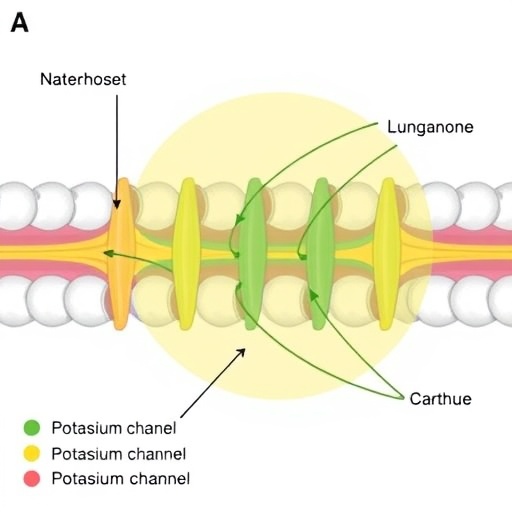
In a pioneering study that could reshape our understanding of certain neurological disorders, researchers from The University of Osaka have uncovered a profound connection between the functional state of potassium ion channels KCNQ2/3 and their precise localization within nerve cells. This discovery elucidates key aspects of the pathophysiology underlying epilepsy syndromes and opens promising avenues for targeted therapies aimed at restoring neuronal stability.
Potassium channels of the KCNQ family play a fundamental role in the regulation of neural excitability by controlling the flow of potassium ions across the plasma membrane. These channels help maintain the resting membrane potential and govern the firing threshold of neurons. Particularly, the heteromeric KCNQ2/3 channels are critical for damping excitatory impulses in the brain. Loss of their function is implicated in a spectrum of epileptic disorders, including benign familial neonatal convulsions and early infantile epileptic encephalopathy, where excessive neuronal firing results in seizures.
Previous research emphasized the importance of the axon initial segment (AIS)—the neuron’s electrical initiation zone—for the localization of these channels. However, whether the functionality of KCNQ2/3 channels influences their targeted delivery and retention within the AIS remained an open question. Addressing this, the Osaka team employed molecular genetic tools to engineer channel variants with altered functionality. Through advanced imaging techniques, including single-molecule tracking, they visualized the trafficking behavior of these channels in cultured neurons with unprecedented resolution.
Their findings reveal a direct correlation between channel functionality and AIS localization. Channels that retained normal activity robustly accumulated at the AIS, whereas dysfunctional variants were significantly depleted in this critical region. This reduced localization was attributable to disruptions in the intracellular trafficking machinery responsible for delivering KCNQ2/3 channels to the AIS membrane domains, indicating that channel activity acts as a determinant for proper trafficking.
Delving deeper into the molecular mechanisms, the team explored interactions between KCNQ3 subunits and ankyrinG (ankG), a scaffolding protein known to anchor ion channels at the AIS. They demonstrated that only functionally competent KCNQ3 channels adopt an active conformation capable of stable binding to ankG. Without this stable association, the channels fail to accumulate efficiently at the AIS, leading to their mislocalization and the potential loss of neuronal inhibitory control.
These insights provide compelling evidence that the conformational state of KCNQ3 channels, linked to their functional activity, governs their localization via molecular interactions with ankG. This bidirectional relationship suggests that both channel dysfunction and mislocalization act synergistically to exacerbate neuronal hyperexcitability, offering a more nuanced understanding of epileptogenesis.
Moreover, these discoveries suggest that therapeutic interventions need to consider not only restoring channel activity but also ensuring proper cellular trafficking to the AIS. Modulators that stabilize KCNQ2/3 channel conformation or enhance ankG binding could potentially correct aberrant localization, thus normalizing neuronal excitability. This dual-target strategy may yield more effective treatments for epilepsy and related neurological conditions characterized by ion channelopathies.
The implications extend beyond epilepsy. Given the central role of KCNQ2/3 channels in modulating neuronal excitability, their dysfunction and mislocalization may contribute to other neurodevelopmental and neurodegenerative disorders. Future research inspired by these findings may explore how alterations in channel function-trafficking coupling affect broader neural circuit dynamics and cognitive functions.
This study employed cutting-edge imaging approaches, including single-molecule fluorescence microscopy, to dissect the nanoscale behavior of KCNQ2/3 channels within live cells. Such technological advances enable researchers to capture dynamic protein interactions in their native cellular contexts, providing insights unattainable with conventional biochemical assays.
The comprehensive analysis presented by the Osaka researchers, led by Daisuke Yoshioka and senior author Yasushi Okamura, underscores the intricate relationship between protein functionality, structural conformation, and cellular localization. Their work not only advances our fundamental understanding of neuronal ion channel biology but also spotlights the AIS as a crucial regulatory hub, mediating how neurons maintain electrical stability.
Looking ahead, translating these molecular insights into clinical treatments will be a significant endeavor. The development of pharmacological agents or gene therapies that simultaneously address KCNQ2/3 channel activity and AIS targeting could revolutionize interventions for epilepsy patients, many of whom currently suffer from refractory seizures. This breakthrough heralds a promising frontier in precision neurology, where molecular-level interventions restore neural circuit balance from within.
In conclusion, the Osaka University’s study marks a milestone in neurobiology by delineating how the functionality of KCNQ2/3 potassium channels is intrinsically tied to their localization at the axon initial segment through mechanisms involving ankyrinG binding. This dual dependence shapes neuronal excitability profoundly and offers a refined blueprint for understanding and treating ion channel-related neuropathologies. As research progresses, harnessing this knowledge could dramatically improve outcomes for individuals afflicted with epilepsy and other neurological diseases rooted in ion channel dysfunctions.
Subject of Research: Cells
Article Title: Coupling of Functionality to Trafficking of KCNQ2/3 Potassium Channels at the Axon Initial Segment
News Publication Date: 2-Mar-2026
Web References: http://dx.doi.org/10.1073/pnas.2527749123
Image Credits: Daisuke Yoshioka et al., 2026, Coupling of Functionality to Trafficking of KCNQ2/3 Potassium Channels at the Axon Initial Segment, Proceedings of the National Academy of Sciences
Keywords: Life sciences, Neuroscience, Cell biology, Ion channels, Potassium channels, Epilepsy, Genetic disorders
Tags: axon initial segment potassium channelsbenign familial neonatal convulsionsearly infantile epileptic encephalopathyepilepsy syndrome pathophysiologyKCNQ2/3 channel localizationmolecular genetics of ion channelsneural stability restorationneuronal excitability regulationneuronal firing threshold controlpotassium channel functional statepotassium ion channels in nerve cellstargeted therapies for epilepsy