In a groundbreaking development aimed at revolutionizing fall risk assessment in older adults, researchers have turned to an innovative application of optical physics to enhance balance detection technology. The study protocol published by Liu, Cai, Ma, and colleagues introduces the use of Frustrated Total Internal Reflection (FTIR) in the design of a balance sensor, promising a new era of objective, precise fall risk evaluation. As falls remain a leading cause of injury and mortality among the elderly population worldwide, this advancement holds significant implications for geriatric care and public health.
Falls among older adults pose a multifaceted challenge, often resulting from a complex interplay of sensory deficits, muscular weakness, and impaired postural control. Existing diagnostic methods to predict fall risk typically rely on subjective assessments or require sophisticated laboratory setups, limiting their accessibility and accuracy. The proposed FTIR-based sensor technology offers a paradigm shift by harnessing a sensitive, non-invasive mechanism capable of detecting subtle shifts in balance with exceptional resolution.
Frustrated Total Internal Reflection is a well-established optical phenomenon where light, trapped within a dense medium by total internal reflection, is partially transmitted into a less dense medium when a third medium interacts closely with the interface. This “frustration” of total internal reflection can be measured to detect pressure distributions or minute physical contacts. By integrating FTIR principles into the sensor design, the research team has created a device sensitive not only to weight presence but also to micro-movements and pressure changes associated with postural sway.
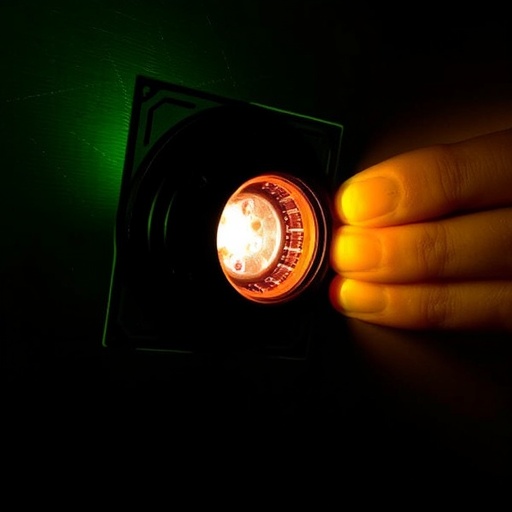
The sensor consists of an optical interface layered beneath a surface upon which participants stand or perform balance tasks. As the person’s foot applies pressure, the alteration in light path caused by FTIR generates a quantifiable signal indicative of weight distribution and balance adjustments. This approach distinguishes itself by converting biomechanical data into optical signals, circumventing common mechanical degradation issues seen in force sensors and providing more reliable and repeatable measurements.
A core challenge addressed by the researchers is the translation of complex sensor outputs into clinically relevant information. To this end, sophisticated algorithms have been developed to analyze the optical data streams, extracting key postural markers that correlate strongly with fall risk factors. Parameters such as center of pressure displacement, stability indices, and temporal dynamics of balance control are computed in real time, enabling practitioners to obtain actionable insights quickly.
Moreover, the study emphasizes the inclusivity of the sensor system, designed to accommodate the varied physical capabilities of older adults. The FTIR sensor’s high sensitivity allows it to detect even minor balance impairments that often precede falls but evade detection by traditional assessment tools. This early identification potential could facilitate timely interventions and personalized rehabilitation strategies, ultimately reducing fall incidences.
The non-intrusive nature of the FTIR-based sensor also enhances user compliance and comfort—a critical aspect when working with frail elderly populations. Unlike bulky laboratory equipment or wearable devices that can impose a psychological burden or restrict natural movement, the sensor can be seamlessly embedded into everyday environments such as standing mats, floor panels, or supportive platforms.
From a technical perspective, the FTIR approach benefits from minimal response latency and does not require frequent recalibration, aspects vital for longitudinal monitoring in clinical or home settings. The sensor surfaces are engineered for durability and hygiene, addressing practical concerns in eldercare facilities. Combined, these features position the FTIR balance sensor as an attractive candidate for widespread deployment in fall risk assessment frameworks.
In addition to its primary application, the FTIR sensor technology shows promise for broader use cases in neurorehabilitation, physiotherapy, and sports medicine. Its capability to provide precise mechanical feedback on postural control dynamics opens doors to novel therapeutic monitoring tools that track patient progress or athletic performance with unparalleled fidelity.
The research protocol outlines a comprehensive validation plan, including testing the sensor’s accuracy against established force platforms and motion analysis systems. This comparison aims to confirm the FTIR sensor’s reliability and ensure that its measurements align with the current gold standards for biomechanical evaluation. Additionally, clinical trials involving diverse elderly cohorts will evaluate the system’s responsiveness to varying degrees of balance impairment.
Importantly, the study is positioned as a collaborative effort, integrating expertise from optics, biomedical engineering, geriatrics, and data science to push the boundaries of fall prevention strategies. Through this interdisciplinary approach, the FTIR-based sensor emerges not just as a novel device but as a component of a larger movement toward leveraging cutting-edge technologies for aging population health challenges.
The vision driving this work is profound: by embedding advanced balance monitoring within daily routines, the scientific community hopes to shift fall risk assessment from episodic clinical evaluations to continuous health surveillance models. Such a transition could transform eldercare, fostering independence and safety while reducing healthcare burdens associated with falls.
Looking ahead, the team anticipates expanding the sensor’s capabilities through integration with machine learning techniques that could refine predictive models and personalize fall risk profiling further. The dynamic nature of aging and balance deterioration demands adaptable tools, and the FTIR sensor platform appears well-poised to meet these evolving needs.
In conclusion, the evaluation of this FTIR-based balance sensor represents a significant stride forward in objective, accessible, and accurate fall risk assessment technologies. Its innovative use of frustrated total internal reflection to capture nuanced balance data heralds a promising frontier for geriatric care and preventive health technologies globally. If validated and adopted widely, this technology could mark a pivotal moment in safeguarding the wellbeing of older adults.
As this study progresses beyond its protocol phase, the FTIR sensor’s integration into clinical practice and community settings will be carefully observed. Enthusiasm is high for its potential to disrupt existing paradigms and improve outcomes for a vulnerable population while inspiring further innovation at the intersection of optics and healthcare technology.
The implications of this research extend beyond geriatric fall prevention, illustrating how fundamental physics concepts can inspire solutions to pressing biomedical challenges. With an aging global population, technological solutions that combine precision, ease of use, and scalability are desperately needed—and this FTIR-based balance sensor is a compelling example of such innovation.
Subject of Research: Evaluation of an FTIR-based balance sensor for objective fall risk assessment in older adults.
Article Title: Evaluation of a Frustrated Total Internal Reflection (FTIR) based balance sensor for objective fall risk assessment in older adults: a study protocol.
Article References:
Liu, H., Cai, L., Ma, X. et al. Evaluation of a Frustrated Total Internal Reflection (FTIR) based balance sensor for objective fall risk assessment in older adults: a study protocol. BMC Geriatr (2026). https://doi.org/10.1186/s12877-026-07253-9
Image Credits: AI Generated
Tags: advanced balance sensor technologybalance detection in elderlyfall risk assessment technologyFrustrated Total Internal Reflection sensorgeriatric fall prevention toolsinnovative fall detection systemsnon-invasive fall risk evaluationobjective fall risk measurementoptical physics in healthcarepostural control assessment methodspublic health and elderly care innovationssensory deficits in older adults