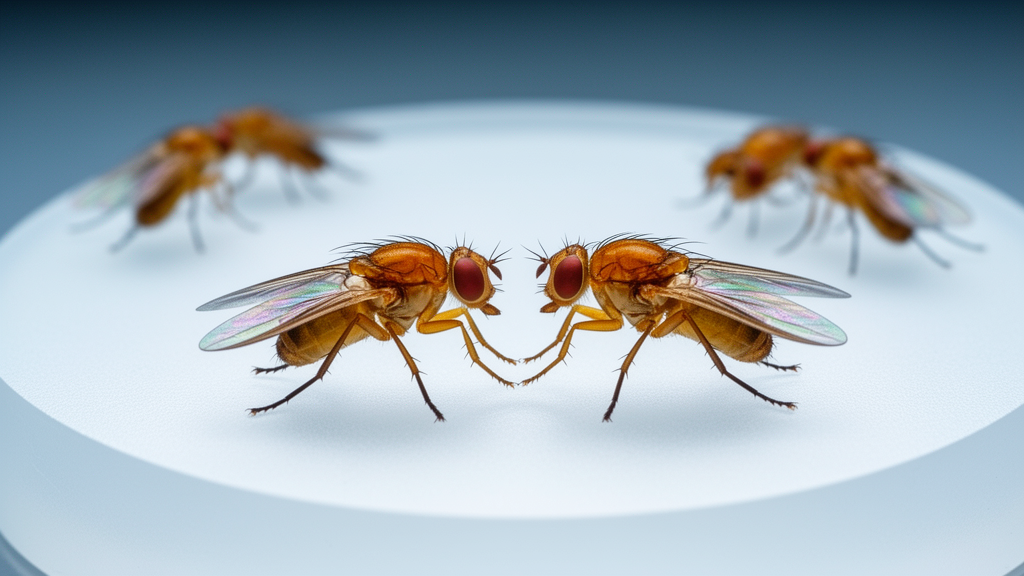
Biologists investigating the behavioral architecture of the fruit fly Drosophila melanogaster have discovered that sociability is not a single unified personality trait, but rather a complex multidimensional phenomenon governed by distinct context-dependent pathways. In a comprehensive study examining 105 sequenced inbred lines from the Drosophila Genetic Reference Panel, researchers assessed how genetically distinct strains interact with conspecifics across three independent experimental paradigms: preference for communal versus solitary egg-laying, egg-laying latency within a group, and the frequency, duration, and spatial configuration of spontaneous social interactions. While the tested lines displayed wide and statistically significant genetic variation across every measured behavior, an individual strain’s performance in one social context showed no statistical correlation with its performance in another, demonstrating that an animal’s propensity to affiliate with others depends fundamentally on the specific sensory modalities and behavioral demands of the situation.
Across the animal kingdom, group living and social aggregation confer critical fitness advantages, such as reduced predation risk, communal resource exploitation, and enhanced reproductive success, while simultaneously imposing costs including resource competition and pathogen exposure. Within species, individuals often vary widely in their sociability, which is traditionally defined as the tendency to affiliate with others outside of purely mating and aggressive encounters. In human psychological research and many vertebrate studies, this tendency has frequently been collapsed into singular composite metrics or solitary distance proxies. By contrast, the authors reasoned that social behaviors involve disparate biological mechanisms—ranging from olfactory detection of aggregation pheromones to visual motion tracking and tactile communication—which may operate independently across distinct ecological contexts.
To rigorously evaluate whether social tendencies generalize across contexts, the researchers utilized the Drosophila Genetic Reference Panel, a widely recognized population of fully sequenced, inbred fruit fly lines derived from a single natural population in North America. Out of 205 available reference panel lines, the investigators excluded strains that exhibited severe physiological infirmity, such as complete immobility for more than one hour or total reproductive infertility over a twenty-four-hour span, yielding a core cohort of 105 healthy lines. Across all experimental assays involving female flies, virgin females from each reference line were systematically mated to males from the standardized wild-type Oregon-R laboratory strain. This rigorous genetic standardization ensured that maternal behavioral changes and post-mating physiological responses were not confounded by genetic variation among mating partners, while multi-day testing schedules controlled for potential day-to-day laboratory variations.
The first behavioral paradigm quantified communal egg-laying site preference, an adaptive cooperation behavior where female flies choose whether to deposit eggs alongside conspecifics. Aggregating eggs in communal clusters benefits future larvae by helping them overcome toxic fungal growth and burrow effectively through dense food substrates, a behavior triggered by female-derived aggregation pheromones deposited on food patches. In this assay, single mated females from each reference panel line were placed in specialized chambers containing two distinct charcoal-black food patches separated by an agar barrier: one patch treated with cuticular hydrocarbon pheromone extract prepared from six-day-old mated females, and an opposing control patch treated with pure hexane solvent. After twenty-four hours under controlled white and deep-red light-emitting diode illumination with continuous airflow to prevent ambient odor accumulation, researchers counted the eggs on both surfaces to calculate a normalized preference index.
Across the 105 tested reference lines, communal egg-laying preference varied significantly, revealing a broad behavioral spectrum ranging from strong communal attraction to active avoidance of aggregation pheromones. While the overall mean preference index across all lines sat near zero at positive 0.052, line-specific averages ranged dramatically from negative 0.42 to positive 0.59, demonstrating profound natural variation in social attraction. To confirm that these differences reflected authentic behavioral preferences rather than physiological disparities in reproductive output, the researchers independently quantified total egg production for each line over twenty-four hours. Total fecundity varied significantly among the strains, yet regression analysis revealed no significant correlation between egg counts and the preference index, yielding a coefficient of determination of only 0.001. This absence of association confirmed that reproductive capacity did not bias or confound the measured sociability values.
The second paradigm examined communal egg-laying latency, capturing how social presence modulates the timing of reproduction. In isolated settings, females of certain standard strains withhold oviposition until darkness, whereas the presence of conspecific companions accelerates egg deposition into the daytime light phase. To measure this response, a single focal mated female from each reference line was housed with five standardized Oregon-R males in a Petri dish fitted with a black food substrate and submerged in agar to ensure surface deposition. Automated camera systems captured time-lapse photographs at fifteen-minute intervals over a full twenty-four-hour light-dark cycle, allowing precise determination of the onset of oviposition. The average egg-laying latency in groups varied substantially across the panel, averaging 339 minutes but spanning from 109 minutes in rapid-responding lines to 702 minutes in delayed strains.
This temporal variation in latency correlated tightly with whether females commenced laying during the daytime light phase or the nocturnal dark phase, yielding a strong coefficient of determination of 0.78 across the 105 lines. To establish whether daylight oviposition represents an active response to companions, the researchers examined a subset of thirty lines under both isolated and grouped conditions. In twenty-three of these thirty lines, isolated females laid eggs predominantly at night, whereas females housed in social groups accelerated their oviposition into earlier hours. Conversely, the remaining seven lines either showed no change or actually delayed oviposition when grouped, reflecting a significant statistical interaction between genotype and social context. Furthermore, separate fecundity assessments confirmed that variation in egg-laying latency was entirely independent of overall reproductive output, showing a negligible coefficient of determination of 0.018.
In the third paradigm, the research team investigated spontaneous social interactions in non-reproductive environments using automated multi-object tracking. Groups of four male flies per line were placed into illuminated rectangular aluminum and glass observation arenas measuring 66 by 30 by 3 millimeters and recorded for ten minutes at thirty frames per second using high-resolution digital cameras. Following initial validation in three reference lines confirming that males and virgin females exhibited comparable baseline interaction patterns, the extensive screening proceeded with male flies. Advanced tracking software segmented individual insects, reconstructed movement trajectories, and applied cubic spline and nearest-neighbor interpolation to resolve brief tracking interruptions. The software computed four distinct parameters: the total frequency of interaction bouts, the cumulative duration of contacts, the mean interindividual distance among all group members, and the nearest-neighbor distance.
Automated trajectory quantification demonstrated continuous phenotypic variation across all four spontaneous interaction measures among the reference lines. The average frequency of social encounters reached 47 bouts per ten-minute session across the population, but varied widely between lines from 16 to 92 bouts, with corresponding significant differences in cumulative contact duration and spatial proximity. Within this single assay, correlation analyses revealed that encounter frequency correlated positively with contact duration, while interindividual distance aligned closely with nearest-neighbor distance. However, spatial distance metrics showed no positive correlation with interaction frequency and were negatively correlated with interaction duration. This internal dissociation demonstrates that maintaining close physical proximity and actively initiating social encounters reflect distinct behavioral facets even within the exact same experimental setting.
Because physical activity and spatial exploration can alter the likelihood of encounters, the researchers evaluated average walking speed and the proportion of time flies spent within the central zone of the arena rather than along its borders. Both locomotor speed and central arena occupancy varied significantly across genotypes. While walking velocity showed no significant relationship with the total number of social encounters, it correlated with interaction duration and spatial distances, while center-zone exploration correlated moderately with encounter numbers and strongly with spatial dispersion. Importantly, in the egg-laying assays, lines exhibiting minimal baseline locomotion still explored both food patches and laid normal clutches, confirming that non-social locomotor differences did not uniformly drive performance across the different behavioral paradigms.
Crucially, when the authors evaluated pairwise correlations between the three primary behavioral paradigms across all 105 lines, no significant relationships emerged. The communal egg-laying preference index did not correlate with egg-laying latency, nor did it correlate with the frequency of spontaneous social encounters. Similarly, communal egg-laying latency showed no correlation with spontaneous interaction frequencies. Strains that demonstrated intense sociability in one test frequently exhibited solitary or indifferent behavior in the others, indicating that a high sociability ranking in one ecological context does not predict sociability elsewhere. Complementary genome-wide association mapping across more than one million genetic variants identified no single-nucleotide polymorphisms meeting strict genome-wide significance thresholds, and suggestive candidate loci showed zero overlap between the different social assays, reinforcing the genetic independence of these behaviors.
These comprehensive empirical findings demonstrate that sociability in fruit flies is intrinsically multidimensional, arising from decentralized, context-dependent neurological circuits rather than a singular master behavioral switch. The sensory modalities driving each response differ fundamentally: egg-laying preference relies on olfactory reception of pheromonal cuticular hydrocarbons processed by female-specific circuits; egg-laying acceleration depends on visual motion detection and neuroendocrine regulation via Juvenile Hormone; and spontaneous physical encounters involve complex combinations of visual, tactile, and chemical inputs. Furthermore, ecological trade-offs likely shape these behaviors independently, as the adaptive benefits of adult predator dilution may favor high spatial clustering while larval resource competition constrains communal clutch sizes. Recognizing that social behavior comprises multiple uncoupled dimensions provides a vital framework for future comparative neurogenetics, cautioning against oversimplified, unidimensional metrics in both invertebrate models and higher vertebrates.
Subject of Research: Multidimensional genetic and behavioral architecture of sociability in Drosophila melanogaster
Article Title: Sociability is a Multidimensional Trait in Drosophila melanogaster
Article References: Bailly, T. P. M., Lamers, S. J. C., Sarma, A., Jansen, A. C. M., Freerks, K., van Dijk, M., Etienne, R. S., Wertheim, B., & Billeter, J.-C. (2026). Sociability is a Multidimensional Trait in Drosophila melanogaster. Behavior Genetics, 56(2), 49-65. https://doi.org/10.1007/s10519-026-10261-5
Image Credits: AI Generated
DOI: 10.1007/s10519-026-10261-5
Keywords: Drosophila melanogaster, sociability, behavior genetics, Drosophila Genetic Reference Panel, communal egg-laying, oviposition latency, spontaneous social interactions, aggregation pheromones, social distance, nearest-neighbor distance, interindividual distance, automated behavioral tracking, genome-wide association study, locomotor activity, centrophobism, phenotypic variation
News Source: Juliet Wilcox. (November 26, 2026). Fruit Fly Sociability Proves Multidimensional Across Distinct Social and Behavioral Contexts. Scienmag.