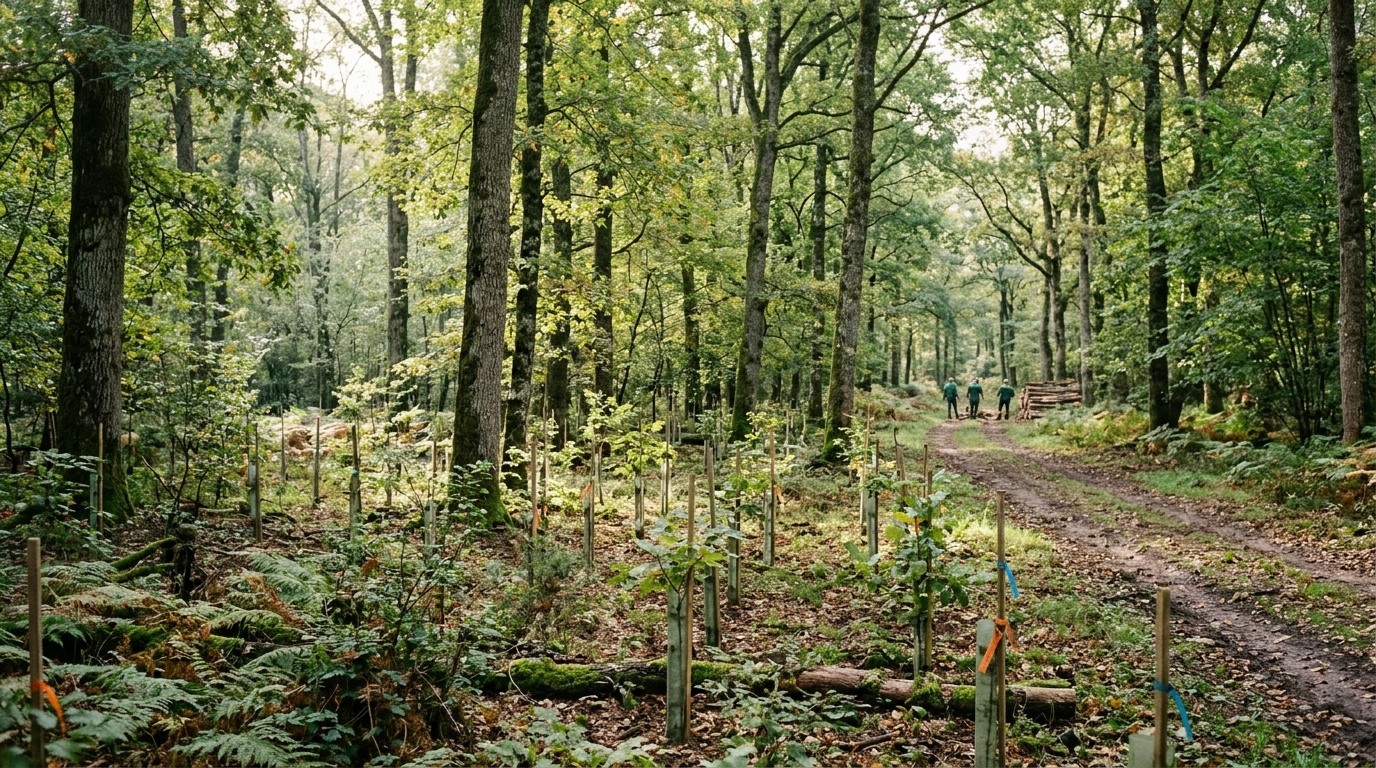
A detailed case study of forest management in France reveals that persistent climate disturbances are fundamentally reshaping traditional forestry planning routines, driving a transition from rigid multi-decade schedules toward adaptive frameworks characterized by shorter revision cycles, continuous remote sensing observation, and collaborative governance. Published in the Annals of Forest Science, the research analyzes how professional forestry administrators confront prolonged ecological uncertainty when historical assumptions of environmental stability and predictable tree growth break down. For centuries, modern forestry frameworks relied on the premise that forest dynamics follow stable trajectories punctuated only by acute, temporary crises after which managers could resume standardized long-term harvesting schedules. However, recurrent droughts, intensifying pest outbreaks, and accelerating dieback have undermined deterministic forecasting models, rendering traditional decadal roadmaps ineffective and forcing public forestry organizations to reorganize operational practices.
To investigate how administrative practices evolve when disruptions become persistent rather than episodic, the research team examined the operational mechanisms of the Office National des Forêts, the public agency responsible for managing state-owned woodlands in France. The investigation centered on ForInnov, an ancient royal hunting forest covering more than 10,000 hectares located approximately one hour north of Paris. Established largely with large-scale plantations of sessile oak, pedunculate oak, and beech during the eighteenth century, the forest is renowned for high-value timber production and landscape heritage while accommodating nearly five million recreational visitors annually. Growing on sandy lowland soils that make tree water supply acutely vulnerable during dry periods, the forest experienced severe decline beginning in the early 2010s. By 2014, managers faced an unprecedented escalation in tree mortality driven by severe drought and widespread cockchafer beetle infestations, which expanded tree decline from approximately twenty percent of the stand area in 2016 to over sixty percent within a few years.
The ecological crisis completely disrupted the standing management plan designed for the 2012 to 2031 period, exposing the operational limits of France’s statutory twenty-year forest planning cycle. Under traditional protocols grounded in the national Forest Law, public forest management is split between a planning unit that crafts long-term projections and an operational unit tasked with field execution. Historically, managers utilized fixed long-term allocations that projected silvicultural operations over time horizons extending as long as 144 years, operating under deterministic assumptions of predictable yield and natural regeneration. At ForInnov, planned conversions of aging pedunculate oak to sessile oak through replanting and natural beech regeneration collapsed when cockchafer larvae attacked root systems beneath the soil while drought degraded mature canopies. Local administrators realized that waiting for conditions to stabilize before revising formal documents was no longer viable because climatic shifts and biotic pressures represented an enduring condition rather than a temporary crisis.
To understand the structural transformation of management practices, the investigators adopted the theoretical framework of organizational routines developed within management and organizational scholarship. Routines are conceptualized as repetitive, recognizable patterns of interdependent actions carried out by multiple actors, maintained and modified through three interconnected dimensions: patterning, performing, and mediating artifacts. Patterning comprises the formal structures, models, and sequences intended to govern organizational action; performing consists of the actual situated activities enacted by personnel in specific physical settings; and artifacts represent formal tools, templates, legal codes, and technical inventories. Historically, organizational theory viewed routines primarily as sources of administrative inertia or studied adjustments following temporary shocks. By analyzing forest planning as an organizational routine, the study evaluated how practitioners navigate tensions between stability and change under conditions of prolonged uncertainty where disruptions are continuous and irreversible.
The research design combined multiple qualitative and empirical methods to reconstruct administrative changes through an abductive, processual framework. Over three weeks of fieldwork that included face-to-face observations despite pandemic constraints, the authors collected primary evidence through sixteen semi-structured interviews divided across distinct operational tiers. An initial round of interviews explored local operational adaptations, mapping the actions of field managers and technical personnel directly managing stand degradation. A second interview stage captured the perspectives of key external stakeholders, including municipal leaders, regional elected officials, community delegates, and non-governmental environmental groups. Supplementary interviews with national executives from the Office National des Forêts situated local observations within countrywide administrative priorities. The researchers corroborated interview narratives against extensive secondary artifacts, including formal twenty-year management plans, emergency silvicultural instructions, operational guidelines, historical archives, and public communications using a narrative network analysis that traced sequences connecting specific actors, actions, and goals.
Empirical findings identified three primary operational shifts that redefined the forest planning routine, led by the deliberate shortening of planning and renewal cycles. Rather than remaining locked into statutory twenty-year management commitments that became obsolete shortly after drafting, foresters sought greater administrative flexibility by reducing the planning horizon. This deviation required significant organizational negotiation because traditional planning schedules are deeply institutionalized in French forestry law and administrative guidelines. When regional planners initially sought ministerial permission to revise their standing commitments, national oversight bodies insisted that departures adhere strictly to current statutory frameworks, where formal exemptions created administrative burdens. Despite these procedural barriers, senior leadership ultimately endorsed the shortened planning framework, establishing an operational precedent that replaces rigid long-term projections with iterative, shorter-interval planning cycles designed to adjust continuously to emergent forest conditions.
The second major shift centered on integrating continuous ecological monitoring directly into the planning cycle, bridging a longstanding temporal divide between plan formulation and field evaluation. Historically, comprehensive forest inventories were performed only once every fifteen to twenty years during formal plan renewal, leaving administrators with outdated structural data during intervening decades. To overcome this limitation, foresters leveraged rapid technological advancements in remote sensing tools, particularly airborne light detection and ranging known as lidar. While satellite observations enable continuous tracking of canopy cover loss and dieback, and aerial drones capture localized damage from logging or construction, lidar delivers high-resolution spatial models of stand topography, canopy height, and timber volume. Incorporating remote sensing reduced reliance on labor-intensive, costly ground inventories, although targeted field plots remain necessary to calibrate remote models and observe parameters undetectable from above, such as juvenile tree regeneration and herbivore browsing pressure.
Continuous technological monitoring also generated professional tensions within forestry ranks regarding the risk of drifting into purely reactive management. Several staff members voiced apprehension that an uncritical emphasis on real-time monitoring could degrade strategic forestry into erratic crisis intervention, disparaged by some personnel as merely collecting dead trees rather than practicing forward-looking silviculture. Practitioners recognized that preserving mature nineteenth-century oak stands required proactive silvicultural cultivation rather than passive observation of mortality. To prevent administrative fragmentation, the agency initiated structural reorganizations to dismantle operational silos, pursuing functional integration between separate planning and monitoring departments. Rather than operating sequentially across multi-decade intervals, monitoring specialists and silvicultural planners established collaborative routines that feed remote sensing metrics into decision-making workflows continuously, enabling prompt corrections when stand developments deviate from projected trajectories.
The third major operational evolution transformed external governance arrangements, replacing traditional top-down administrative announcements with participatory co-construction. In conventional planning routines, public agencies established trajectories internally and conducted formal consultations only after drafting completed documents. Under persistent ecological uncertainty, managers acknowledged that predictable outcomes could no longer be guaranteed unilaterally, fostering a more modest institutional posture that recognized multiple alternative ecological pathways. In response, local directors established collaborative steering tables involving municipal associations, regional agencies, and local non-governmental organizations, including activist groups that had previously criticized public management in the press. Opening planning routines to outside stakeholders allowed civic representatives to contribute directly to setting priorities, resolving historical friction and establishing shared accountability for management choices amid environmental unpredictability.
The authors conclude that adapting public forest administration to prolonged environmental uncertainty requires systemic, multilevel organizational change rather than isolated technical or silvicultural fixes. Technological tools such as lidar do not simply support preexisting tasks; their functional maturity actively reshapes organizational roles, temporal boundaries, and labor divisions, freeing foresters from repetitive manual measuring tasks and creating organizational capacity for transparent public engagement. The researchers emphasize that their single-case analysis reflects the specific legal and institutional context of French public forests, noting that future research should examine whether private forest owners with differing financial and technological resources, or forestry institutions in other countries with distinct planning traditions, adopt similar operational routines when confronting persistent climate instability.
Subject of Research: Adaptation of public forest planning routines to persistent climate change uncertainty
Article Title: Facing prolonged uncertainty: how is forest planning evolving? Insights from the French state forests
Article References: Bonin, F., Fournier, M., Grasser, B., & Legay, M. (2026). Facing prolonged uncertainty: how is forest planning evolving? Insights from the French state forests. Annals of Forest Science, 83(1), Article 27. https://doi.org/10.1186/s13595-026-01344-8
Image Credits: AI Generated
DOI: 10.1186/s13595-026-01344-8
Keywords: Forest Planning, Climate Change Adaptation, Organizational Routines, Remote Sensing, Office National des Forêts, Lidar Monitoring, Forest Management, Ecological Disturbance, Facing, prolonged, uncertainty, forest
News Source: Alan Morgan. (November 8, 2026). French State Forest Study Shows Planning Shifts Under Prolonged Climate Uncertainty. Scienmag.