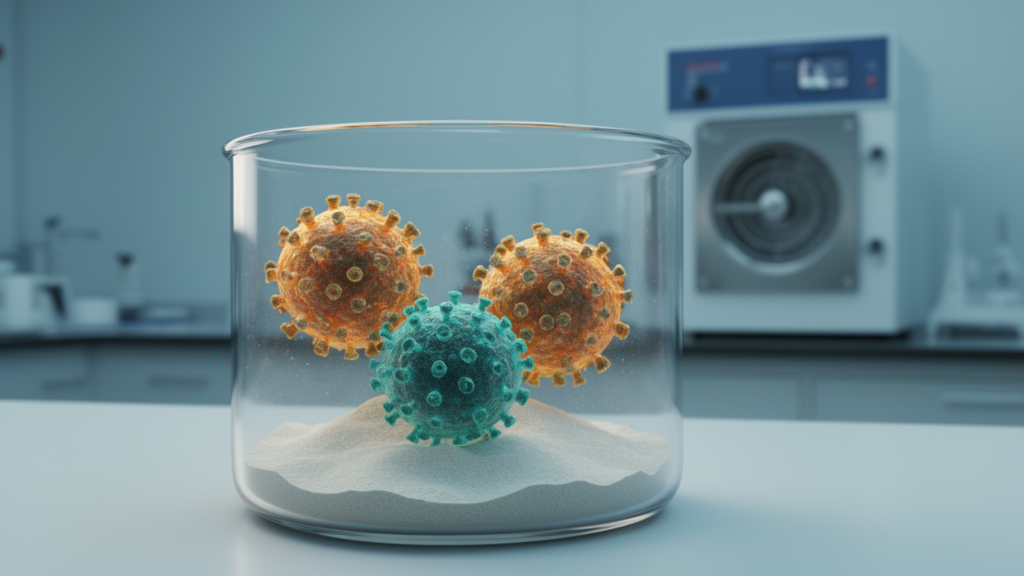
Virus-like particles (VLPs) built from the HIV-1 Gag protein are a promising platform for novel vaccine development, but turning them into a manufacturable product requires solving a formulation problem: how to keep these delicate nanoparticles stable during storage and distribution. A new study published in AMB Express addresses this by optimizing the freeze-drying, or lyophilization, formulation for Gag-based VLPs using a systematic Design of Experiments (DoE) approach.
Lyophilization plays a pivotal role in enhancing stability and facilitating distribution of biological products, but the process itself can inflict damage that compromises product integrity. Freezing and drying stresses particles mechanically and chemically, so the choice of formulation components is critical.
The work centered on Gag::eGFP VLPs, HIV-1 Gag-based particles carrying a fluorescent marker that allows their size, concentration, and quality to be characterized. Using the DoE framework, the team varied the excipient composition and measured how each formulation affected these physicochemical attributes after lyophilization, allowing a rational rather than trial-and-error optimization of the drying recipe.
The optimized formulation performed well. Lyophilized Gag::eGFP VLPs reconstituted after freeze-drying exhibited characteristics akin to those observed in the non-lyophilized particles, indicating that the process preserved the key quality attributes of size, concentration, and overall particle integrity.
Stability testing added an important practical dimension. The researchers evaluated how storage conditions after lyophilization affected the particles, and found that Gag::eGFP VLPs stored at 4 degrees Celsius for four weeks maintained their integrity whether kept in lyophilized form or reconstituted into liquid. This short-term stability at refrigerated conditions is a meaningful proof of concept for a vaccine platform that would ultimately need to survive real-world cold-chain handling.
The authors are explicit about the limits of the finding. Four weeks at 4 degrees Celsius demonstrates short-term stability only, and further studies are required to assess long-term shelf life, including the extended storage durations and possibly higher temperatures that a distributable vaccine product would demand. The study, published on 20 October 2026 as an open-access research article, is therefore a methodological advance rather than a demonstration of a finished, shelf-stable product.
What the work delivers now is a systematic, DoE-based framework for optimizing lyophilized HIV-1 Gag VLP formulations. By quantifying the impact of individual excipient classes on measurable quality attributes, the approach offers other groups developing VLP-based vaccines a reproducible path to formulation design, contributing new insights into the preservation of physicochemical quality attributes during freeze-drying and subsequent storage.
HIV-1 Gag VLPs present a robust platform for vaccine production, and the gap between laboratory production and biomanufacturing has long been formulation and stability. By showing that a rationally optimized freeze-drying formulation can return particles essentially indistinguishable from their liquid counterparts after four weeks of refrigerated storage, the study narrows that gap, while leaving the longer stability questions open for future work.
Subject of Research: Optimization of lyophilization formulations for HIV-1 Gag virus-like particles and their short-term storage stability
Article Title: Lyophilized HIV‑1 Gag virus‑like particles: improved quality and stability
Article References: Lorenzo Romero, E., Gòdia, F., & Cervera, L. (2026). Lyophilized HIV‑1 Gag virus‑like particles: improved quality and stability. AMB Express. https://doi.org/10.1186/s13568-026-02131-4
Image Credits: AI Generated
DOI: 10.1186/s13568-026-02131-4
Keywords: HIV-1 Gag, virus-like particles, lyophilization, freeze-drying, vaccine platform, formulation, Design of Experiments, excipients, stability, biomanufacturing, AMB Express, Lyophilized
News Source: Kristina Jarvis. (October 28, 2026). Freeze-Dried HIV-1 Gag Virus-Like Particles Keep Their Quality for Four Weeks. Scienmag.