Credit: CCO public domain
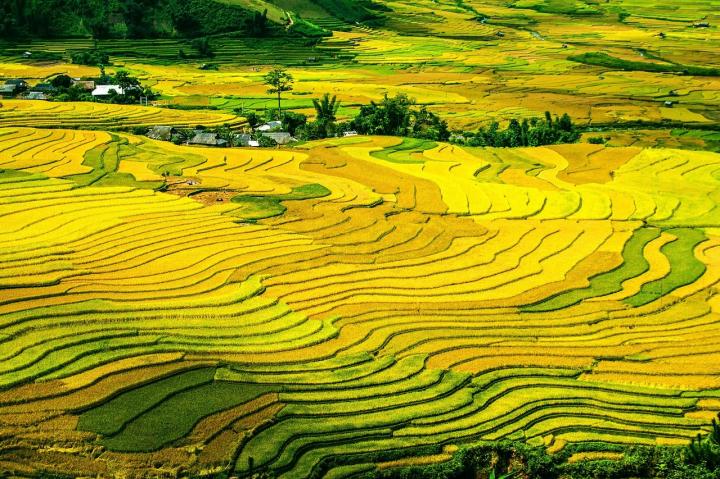
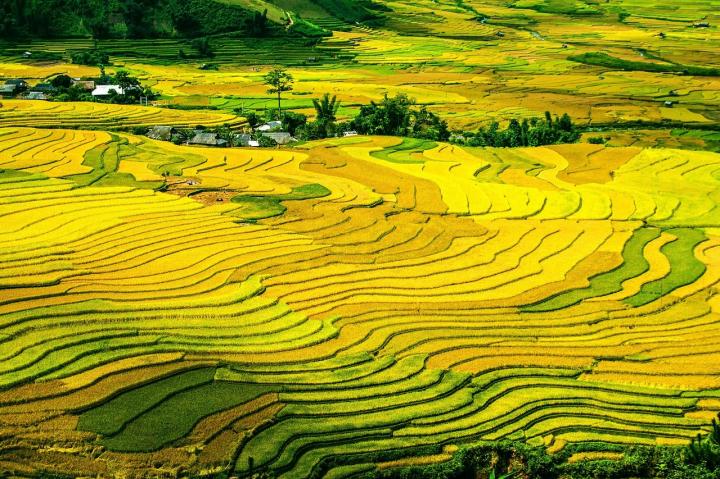
Bali's famous rice terraces, when seen from above, look like colorful mosaics because some farmers plant synchronously, while others plant at different times. The resulting fractal patterns are rare for man-made systems and lead to optimal harvests without global planning.
To understand how Balinese rice farmers make their decisions for planting, a team of scientists led by Stephen Lansing (Nanyang Technological University) and Stefan Thurner (Medical University of Vienna, Complexity Science Hub Vienna, IIASA, SFI), both external faculty at the Santa Fe Institute, modeled two variables: water availability and pest damage. Farmers that live upstream have the advantage of always having water; while those downstream have to adapt their planning on the schedules of the upstream farmers.
Here, pests enter the scene. When farmers are planting at different times, pests can move from one field to another, but when farmers plant in synchrony, pests drown and the pest load is reduced. So upstream farmers have an incentive to share water so that synchronous planting can happen. However, water resources are limited and there is not enough water for everybody to plant at the same time. As a result of this constraint, fractal planting patterns emerge, which yield close to maximal harvests.
"The remarkable finding is that this optimal situation arises without central planners or coordination. Farmers interact locally and take local individual free decisions, which they believe will optimize their own harvest. And yet the global system works optimally," says Lansing. "What is exciting scientifically is that this is in contrast to the tragedy of the commons, where the global optimum is not reached because everyone is maximizing his individual profit. This is what we are experiencing typically when egoistic people are using a limited resource on the planet, everyone optimizes the individual payoff and never reach an optimum for all," he says.
The scientists find that under these assumptions, the planting patterns become fractal, which is indeed the case as they confirm with satellite imagery. "Fractal patterns are abundant in natural systems but are relatively rare in man-made systems," explains Thurner. These fractal patterns make the system more resilient than it would otherwise be. "The system becomes remarkably stable, again without any planning — stability is the outcome of a remarkably simple but efficient self-organized process. And it happens extremely fast. In reality, it does not even take ten years for the system to reach this state," Thurner says.
Spatial patterning often occurs in ecosystems as a self-organizing process caused by feedback between organisms and the physical environment. "The centuries-old Balinese rice terraces are also created by feedback between farmer's decisions and the ecology, which triggers a transition from local to global scale control," explains Lansing. "Our model shows for the first time that adaptation in a coupled human-natural system can trigger self-organized criticality."
The Balinese rice fields could serve as an example that under certain conditions it is possible to reach sustainable situations that lead to maximum payoff for all parties, wherein every individual makes free and independent decisions.
###
Media Contact
Jenna Marshall
[email protected]
@sfi_news
http://www.santafe.edu
Original Source
https://santafe.edu/news-center/news/sustainable-and-maximal-harvest-without-planning-and-control http://dx.doi.org/10.1073/pnas.1605369114
############
Story Source: Materials provided by Scienmag