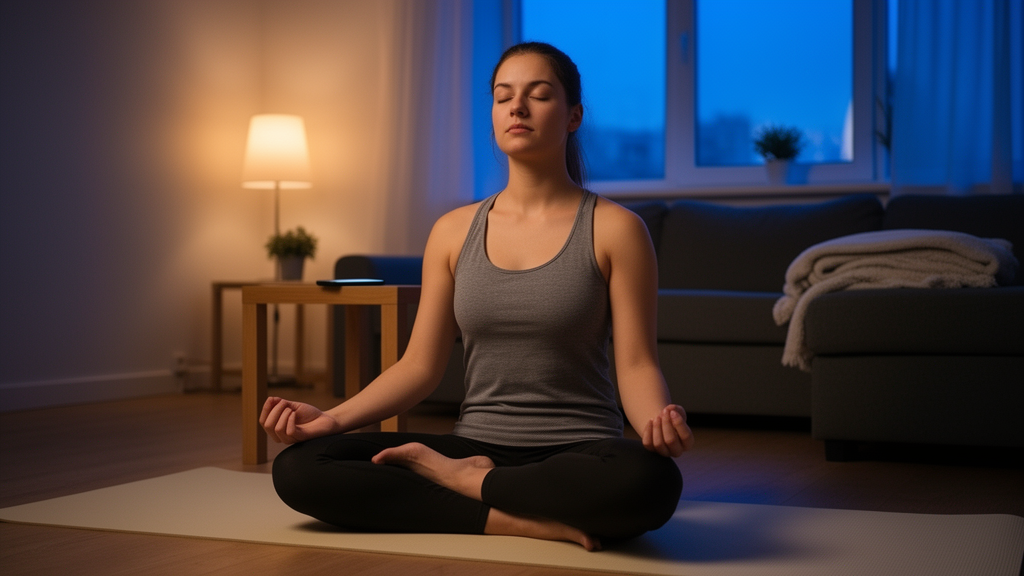
Young adults who spend hours glued to their smartphones often report a familiar cluster of complaints: restless nights, racing thoughts and a body that feels strangely out of tune. A new feasibility study published in BioPsychoSocial Medicine tested whether a structured programme called PhysioYoga, delivered entirely online, could ease that burden. In twenty smartphone-addicted young adults, four weeks of the intervention was associated with significant improvements in five of seven sleep quality components and a clear drop in perceived stress, although two sleep measures unexpectedly worsened.
PhysioYoga is a therapeutic fusion of evidence-based physiotherapy techniques and traditional yogic practices. The physiotherapy side includes proprioceptive exercises and PNF-style sensorimotor facilitation, methods that challenge the body’s awareness of its own position and movement. The yoga side includes asanas, pranayama breathing practices and Shavasana, the guided relaxation posture. The researchers argue that smartphone addiction in young adults produces a convergent triad of sensorimotor dysregulation, insomnia and psychological stress, and that no published intervention had previously addressed all three dimensions with a structured, physiotherapy-integrated, protocol-driven approach.
The study was explicitly designed as a single-arm pre-post feasibility trial, not a definitive test of efficacy. Twenty participants aged 18 to 30 enrolled after meeting validated criteria for smartphone addiction, scoring 31 or higher on the Smartphone Addiction Scale-Short Version, and reporting poor sleep quality, defined as a Pittsburgh Sleep Quality Index score above 5. The sample size of 20 follows standard precedent for single-arm feasibility studies, which conventionally enroll 15 to 30 participants to assess protocol delivery, adherence and retention rather than to achieve formal statistical power. Because the design was a four-week single-arm study, the addiction scale was used only as a screening instrument at enrolment and was not designated as a post-intervention outcome.
The intervention itself was delivered through secure video conferencing in three 60-minute sessions per week, totalling 12 sessions across four weeks. Each session followed seven structured segments. On the feasibility front, the results were striking: a 100 percent recruitment rate, 100 percent session adherence and 95 percent retention. For a population often described as distractible and overcommitted, those numbers suggest the online format and the protocol itself were highly acceptable to participants.
The primary outcomes were the global and component scores of the Pittsburgh Sleep Quality Index and the score on the Perceived Stress Scale, assessed before and after the intervention using the Wilcoxon signed-rank test in IBM SPSS version 29. The global PSQI score fell from 11.53 to 9.29, a statistically significant decrease with a Z statistic of −3.929 and a p value below 0.001. Because PSQI scoring conventions treat higher scores as worse, this drop represents a meaningful improvement in overall self-reported sleep quality over the four weeks.
Five of the seven PSQI component scores improved significantly: subjective sleep quality, sleep latency, sleep disturbances, use of sleep medication and daytime dysfunction. Daytime dysfunction showed the greatest absolute reduction, falling from 1.96 to 1.07, with a Z statistic of −4.233, a p value below 0.001 and a 45.4 percent reduction. That component captures struggles with staying awake and maintaining enthusiasm during daily activities, problems that resonate strongly with the experience of heavy smartphone users.
Two components, however, moved in the wrong direction. The sleep duration component score increased from 2.69 to 3.20, and the habitual sleep efficiency component score increased from 1.86 to 2.41. Under PSQI scoring conventions, higher scores in these domains denote worsening, meaning participants reported shorter sleep and less time actually asleep while in bed after the intervention. The authors flag this deterioration candidly in their conclusions, and it stands as an important caveat against reading the overall results as uniformly positive.
Perceived stress also fell substantially. The Perceived Stress Scale score decreased from 27.25 to 23.05, with a Z statistic of −3.946 and a p value below 0.001. The researchers note that this shift corresponds to a categorical move from the high-stress range into the moderate-stress range. In practical terms, participants ended the study describing their lives as meaningfully less overwhelming than when they began, at least by this self-report measure.
The authors are careful about what these numbers do and do not prove. The proposed sensorimotor integration mechanistic pathway, the idea that proprioceptive and PNF-style facilitation might recalibrate the nervous system dysregulated by constant smartphone use, remains a theoretical proposition in the absence of direct mechanistic measures. Without a control group, randomisation or objective sleep and stress recordings, the improvements cannot be confidently attributed to PhysioYoga rather than to expectation effects, the passage of time or the simple attention of participating in a structured programme. The study was also not powered to detect effects with statistical certainty, given its feasibility framing.
What the study does establish is that the protocol can be delivered, that the target population will complete it and that the outcome measures respond in the expected direction for most but not all domains. The authors conclude that a randomised controlled trial is now warranted, one that incorporates the Smartphone Addiction Scale-Short Version as a primary outcome, adds objective sleep and stress measures, includes sensorimotor integration-specific assessments and uses a dismantling design to isolate which components of the intervention drive any effects. Until such a trial is completed, the findings stand as an encouraging but preliminary signal that a structured, online, physiotherapy-informed yoga programme is feasible for smartphone-addicted young adults and may meaningfully shift how they sleep and how stressed they feel, with the notable exception that their sleep duration and efficiency appeared to worsen over the same four weeks.
Subject of Research: A feasibility study of a four-week online PhysioYoga intervention combining physiotherapy and yoga techniques in smartphone-addicted young adults with poor sleep quality and high perceived stress.
Article Title: PhysioYoga as a structured digital detox intervention: sleep quality and perceived stress outcomes among smartphone-addicted young adults: a pre-post feasibility study
Article References: Nadimpalli, S. N. J., M, M., J, M., Elayaperumal, S., Kanniappan, V., V, B., M, S., & I, M. S. (2026). PhysioYoga as a structured digital detox intervention: sleep quality and perceived stress outcomes among smartphone-addicted young adults: a pre-post feasibility study. BioPsychoSocial Medicine. https://doi.org/10.1186/s13030-026-00371-1
Image Credits: AI Generated
DOI: 10.1186/s13030-026-00371-1
Keywords: PhysioYoga, smartphone addiction, sleep quality, perceived stress, digital detox, feasibility study, PSQI, PSS, young adults, yoga, physiotherapy, pre-post study
News Source: Glenn Wilkins. (October 28, 2026). Four Weeks of Online PhysioYoga Linked to Better Sleep and Lower Stress in Smartphone-Addicted Young Adults. Scienmag.