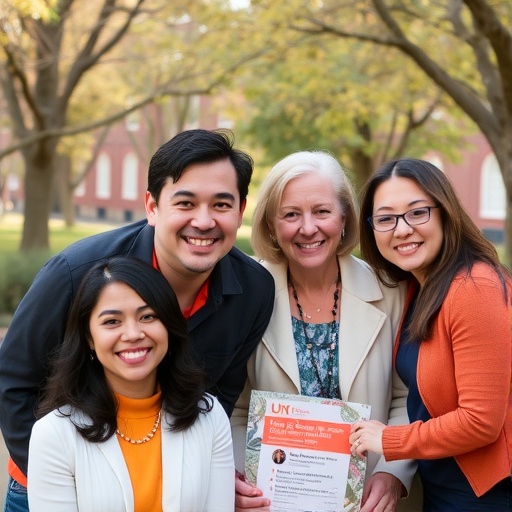
At the University of Tennessee, Knoxville, a landmark moment in scientific recognition has unfolded with the election of four exceptional faculty members as 2025 Fellows of the American Association for the Advancement of Science (AAAS). This prestigious fellowship honors not only breakthroughs in scientific research but also contributions spanning education, technology innovation, and leadership within academic and industrial spheres. These lifetime appointments, granted by peer vote within the AAAS Council, underscore the profound influence of UT’s multidisciplinary research prowess. As a result, the university’s collective has surged to an impressive total of 103 AAAS Fellows, reflecting sustained excellence.
Among those honored is Brad Binder, a distinguished professor and associate head of UT’s Department of Biochemistry and Cellular and Molecular Biology within the College of Arts and Sciences. Binder’s trailblazing work delves into the molecular mechanisms by which plants sense and react to environmental stimuli through signal transduction pathways, with a particular focus on the plant hormone ethylene. Ethylene, notable for being a gaseous hormone capable of diffusing through air to affect neighboring plants, presents unique biological dynamics that challenge traditional hormone signaling paradigms. Binder’s investigations have elucidated how transient ethylene exposure primes plants for enhanced growth and stress tolerance, challenging prior conceptions centered on its well-known role in fruit ripening and decay.
Ethylene’s dual nature as a vital yet economically impactful molecule places Binder’s research at the nexus of fundamental plant biology and agricultural technology. Post-harvest losses attributed to unregulated ethylene exposure amount to billions of dollars annually, making insights into its biological function urgently important. Beyond plants, Binder’s recent research trajectory extends into microbial realms, encompassing bacteria and fungi. This interdisciplinary approach unravels the molecular dialogue connecting ethylene’s effects across kingdoms, illuminating a unifying regulatory molecule with wide-reaching ecological implications.
Jennifer DeBruyn, from the Department of Biosystems Engineering and Soil Science within the UT Institute of Agriculture, also shares in this high distinction. Her work centers on microbial ecology, specifically the composition and functionality of microbial decomposer communities that degrade organic matter in ecosystems. DeBruyn coined a new investigative domain into the necrobiome—the suite of decaying microbial consortia instrumental in nutrient cycling and ecosystem sustainability. Her pioneering studies have bridged forensic anthropology with microbial biology, providing unprecedented insights into microbial succession during decomposition.
DeBruyn’s research further addresses the pressing environmental challenge posed by agricultural plastics and microplastics. With plastic mulches and films ubiquitously employed in modern farming, understanding the interactions between plastics, their microbial colonizers, and subsequent soil health effects is critical. Investigations into microplastic degradation pathways, biodegradation rates, and soil-microbe-plastic dynamics are revealing the complex interplay that influences soil ecosystems. DeBruyn’s exploration of green burial practices also underscores a holistic vision for sustainable decomposition that minimizes ecological footprints and inspires innovation in deathcare technologies.
Elisabeth Schussler, a professor in the Department of Ecology and Evolutionary Biology at UT’s College of Arts and Sciences, has garnered acclaim for her contributions to biology education research, a burgeoning field that applies empirical rigor typically reserved for laboratory science to pedagogical practices. Her research focuses on quantifying and understanding student anxiety within large introductory biology courses, recognizing it as a profound factor shaping educational outcomes. Schussler’s work reveals variability not only among different instructors and course structures but also within sections taught by the same faculty—highlighting previously underappreciated nuances in student experience.
Her scholarship extends into professional development for graduate teaching assistants (TAs), who often serve as frontline educators in large science courses but receive inconsistent training. Since 2013, Schussler has co-led a national research coordination network investigating institutional practices that support or hinder TA development. By identifying departmental cultures and policies that optimize TA training, her work aims to foster more effective teaching environments that benefit both instructors and undergraduate learners. Schussler’s interdisciplinary position within a science department lends her a unique perspective that champions education science as integral to scientific advancement.
Jie Zhuang, also affiliated with the Department of Biosystems Engineering and Soil Science, embodies an innovative approach to soil and environmental engineering. His research elucidates the hydrodynamic complexities governing the movement of water, nutrients, and contaminants through soil matrices under fluctuating natural conditions such as rainfall pulses. Unlike static models in controlled laboratory settings, Zhuang’s investigations account for temporal and spatial variability in soil moisture velocity and pressure that affect contaminant transport and bioavailability. This work is vital for managing soil health, protecting water quality, and mitigating pathogen transmission risks in agricultural landscapes.
Zhuang’s focus on the nexus of food, energy, and water systems underscores a systems-thinking paradigm that seeks to reconcile competing resource demands rather than optimizing them in isolation. His work supports transitioning agriculture towards circular bioeconomy models, particularly in the context of smallholder farms that constitute the vast majority of farming operations in the United States. Recognizing the financial and technological barriers faced by small-scale farmers, Zhuang champions cost-effective, resource-recycling strategies that integrate renewable energy and wastewater reuse. Such models aim to convert agricultural systems into regenerative, self-sustaining enterprises.
A highlight of Zhuang’s career includes his role as corresponding editor for the authoritative Handbook of Circular Bioeconomy, a collective international effort spanning 17 countries that articulates frameworks and innovations driving sustainable bioeconomies worldwide. His leadership in this domain amplifies research-driven policies and practices that promise to reshape the interaction between human activities and ecosystem resilience.
The achievements of these four UT faculty members epitomize the expanding frontiers of science in both theoretical understanding and practical application. Their election as AAAS Fellows not only recognizes individual accomplishments but also signifies the University of Tennessee’s emergent position as a powerhouse for interdisciplinary innovation addressing global challenges. From unraveling fundamental biological signals and microbial ecosystems to revolutionizing science education and pioneering sustainable agriculture, their work charts a bold path forward and inspires future generations of scientists who will continue to advance knowledge and solve complex problems.
Deborah Crawford, UT’s vice chancellor for research, innovation, and economic development, praised the honorees for their transformative contributions, emphasizing how their efforts collectively amplify UT’s research impact internationally. These fellows demonstrate how fundamental discovery, applied engineering, social science integration, and education reform can coalesce to drive societal advancement. The recognition also signals the critical importance of scientific collaboration and leadership in confronting pressing global issues such as food security, environmental degradation, and educational equity.
Together, these fellows represent a microcosm of the powerful, interconnected scientific ecosystem at UT Knoxville, capturing the spirit of inquiry and the pursuit of solutions that define contemporary science. Their work serves as a testament to the university’s commitment to fostering excellence across disciplines, ensuring that research and innovation not only push frontiers but also translate into real-world benefits.
Subject of Research:
The research subjects span molecular plant biology and ethylene signaling mechanisms, microbial ecology in decomposition and plastic degradation, biology education research with focus on student anxiety and teaching assistant training, and soil hydrodynamics, contaminant transport, and circular bioeconomy systems for sustainable agriculture.
Article Title:
University of Tennessee Faculty Named 2025 AAAS Fellows for Trailblazing Advances Across Disciplines
News Publication Date:
2024
Web References:
University of Tennessee News Release (URL not provided)
References:
Not specified in the source material.
Image Credits:
University of Tennessee
Keywords:
AAAS Fellows, University of Tennessee, ethylene signaling, plant hormone, microbial ecology, necrobiome, microplastics, biology education research, student anxiety, graduate teaching assistants, soil hydrodynamics, contaminant transport, circular bioeconomy, sustainable agriculture, environmental microbiology
Tags: 2025 AAAS fellows announcementacademic leadership in scienceadvancements in biochemistry and molecular biologyAmerican Association for the Advancement of Science fellowshipethylene’s role in plant stress toleranceinnovations in plant environmental responsemolecular mechanisms of plant signal transductionmultidisciplinary research at universitiesplant hormone ethylene researchscientific research breakthroughsuniversity faculty scientific achievementsUniversity of Tennessee Knoxville faculty recognition