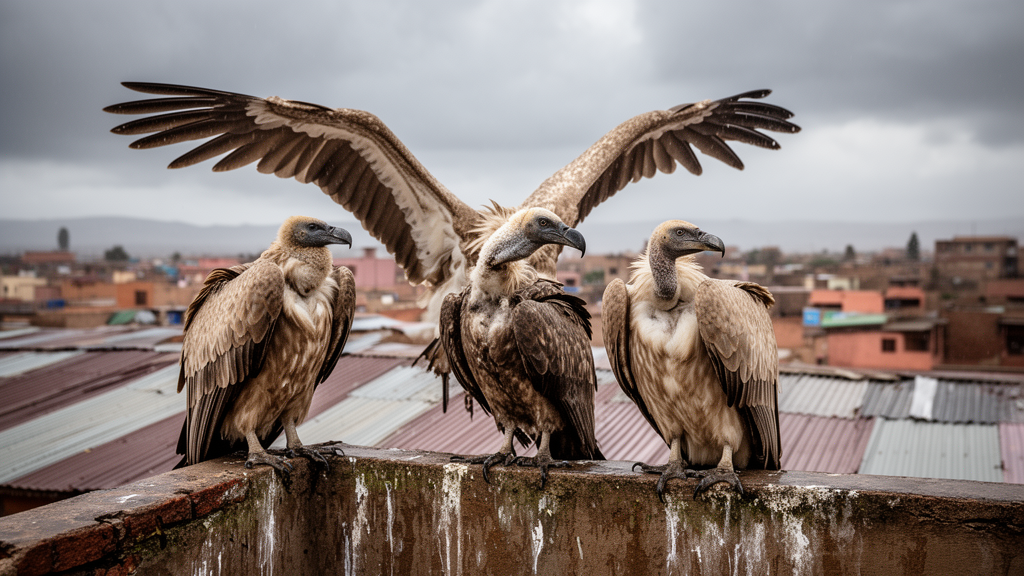
Four globally threatened vulture species are living out at least part of their lives in the middle of a fast-growing Ethiopian city, according to a new field study conducted in Jimma, in southwestern Ethiopia. Their results, published in BMC Zoology, document hooded, African white-backed, Rüppell’s griffon, and lappet-faced vultures within city limits, and identify electric power lines, habitat loss, and poisoning as the leading dangers these birds face.
The survey team, led by Desale Fayera Deressa with co-authors including Tibebu Alemu, Abebayehu Aticho, and Tariku Mekonnen Gutema, selected five study sites based on known vulture activity. These included the city’s central dumpsite, the Jimma City abattoir, and three garbage disposal areas on Jimma University campuses. At each site, two observation points were established roughly 50 meters apart, and observers conducted standardized 10-minute point counts within a 30-meter radius after a five-minute settling period. Counts were made twice per survey day, in the morning and again in the late afternoon, with each site visited twice weekly throughout both seasons. In total, the design yielded 960 point-count sessions across the five sites and two seasons.
The seasonal pattern was striking. Vulture counts were significantly higher during the wet season than the dry season, with 710 observations recorded in the wet months against 476 in the dry months, a difference the authors report as statistically significant at P < 0.001. Mean dry-season counts were 264 ± 9 for hooded vultures, 191 ± 29 for African white-backed vultures, 17 ± 3 for Rüppell’s griffon vultures, and 4 ± 1 for lappet-faced vultures. The corresponding wet-season figures rose to 408 ± 57, 266 ± 25, 29 ± 4, and 7 ± 1 respectively. Monthly trends showed numbers climbing sharply in May, June, and July, while the lowest counts fell in March.
The authors attribute the wet-season surge to enhanced food availability and expanded foraging opportunities. They point to the proliferation of insects in dung, mud, garbage sites, fields, ponds, and shaded trees during the rains, which creates rich foraging grounds. Conversely, the dry-season decline is linked to food scarcity and reduced foraging areas. The team also notes that 87 percent of key informants corroborated the observation of increased vulture sightings during the wet season. No significant differences emerged between morning and evening counts for any species in either season, which the researchers suggest may reflect the close proximity of roosting and feeding sites.
The hooded vulture dominated the urban assemblage, accounting for 57 percent of all recorded observations, while the lappet-faced vulture represented just 1 percent. The African white-backed vulture was the second most abundant species, and Rüppell’s griffon and lappet-faced vultures appeared at comparatively low numbers. All four species belong to the family Accipitridae, and all are globally threatened: three are classified as Critically Endangered and one as Endangered by the IUCN. Species composition did not vary significantly between seasons, with the same four species recorded in both sampling periods, though observed counts differed significantly among study sites.
Spatially, the vultures concentrated around feeding hotspots. The hooded vulture showed the widest distribution across sites, while the African white-backed vulture reached its highest abundance at the abattoir, the city’s sole slaughterhouse. Rüppell’s griffon vultures were mainly recorded at the dumpsite and abattoir, and the scarce lappet-faced vulture was restricted to those same two sites. One-way ANOVA confirmed significant differences in abundance among sites for all four species, with F values ranging from 43.806 to 56.014 and P < 0.001 in each case. The researchers suggest these patterns reflect greater food availability and suitable habitat conditions at sites where animal remains accumulate.
Roosting behavior added another dimension to the findings. Across 125 recorded roosting observations, vultures used trees most often, accounting for 54.4 percent of records, followed by electric poles at 26.4 percent and buildings at 19.2 percent. Post-hoc comparisons showed that mean counts of vultures using trees were significantly higher than those using electric poles or buildings, with no significant difference between poles and buildings. The tree species used included Ficus vasta, eucalyptus, Albizia gummifera, Sapium ellipticum, Podocarpus falcatus, Cordia africana, and Acacia abyssinica, with Ficus vasta the most frequently used. The researchers note that the substantial use of electric poles is directly relevant to conservation, because birds that perch on power infrastructure face electrocution and collision risks.
That risk was not hypothetical. During the study, observers recorded the deaths of eight vultures, four hooded, three white-backed, and one lappet-faced, from collisions with power lines, mainly because the birds roost on electric poles. All respondents in the study area confirmed the danger of electric shock to vultures, with statistically significant agreement. Based on respondents’ rankings, electrocution emerged as the most significant threat overall, followed in descending order by habitat loss, food scarcity, competition, poisoning, disturbance and conflict, and lack of awareness. The study area, including the abattoir and dumpsite, is surrounded by high-voltage power lines.
Habitat loss and food scarcity were also prominent. Nearly all respondents, 98 percent, cited habitat loss as a major threat, and the authors document concrete impacts: two known nesting trees were cut down for construction, and in Ifa Bula Kebele farmers felled two Ficus vasta trees regularly used by vultures, citing concerns that droppings were damaging their crops. Jimma’s built-up area grew from 3,485.35 hectares in 2000 to 5,452.17 hectares in 2021, with urban expansion averaging roughly 128 hectares per year between 1986 and 2020. On the food side, 96 percent of respondents reported food shortage as a threat, and 85.4 percent reported a noticeable decline in livestock numbers, which the authors link to reduced carcass availability. Vultures increasingly rely on horse and dog remains, and carcass management practices, including burial, composting of organic waste with soil, and the routine removal of bones for fertilizer processing, further reduce access to carrion.
Poisoning, disturbance, and limited awareness rounded out the threat picture. Ninety-one percent of respondents identified poisoning as a major threat, and a notable incident occurred two years before the study, when the Jimma City Agricultural Office applied strychnine to control rabies in stray dogs; vultures and hyenas feeding on those carcasses subsequently died, a clear case of secondary poisoning. Respondents denied intentionally poisoning carcasses to target vultures, and reported no trade in vulture parts or use for traditional medicine. At the dumpsite, waste handlers were observed throwing stones during sorting, and trucks regularly mixed edible organic material with soil, while birds were also chased away at the abattoir. Sixty percent of the 363 surveyed households reported limited knowledge of the ecological importance of vultures. The authors caution that their five sites were purposively selected based on known vulture presence, that counts do not necessarily represent unique individuals across the city, and that threat assessments partly reflect respondents’ perceptions. They call for year-round and multi-year monitoring, systematic assessments of mortality and power-line hazards, and investigations of habitat quality and breeding ecology to strengthen conservation planning in Jimma City.
Subject of Research: Seasonal abundance and conservation threats of vultures in Jimma City, Ethiopia
Article Title: Vulture populations, seasonal dynamics, and conservation threats in the Urban landscape: a case study in Jimma, Southwest Ethiopia
Article References: Deressa, D. F., Alemu, T., Aticho, A., & Gutema, T. M. (2026). Vulture populations, seasonal dynamics, and conservation threats in the Urban landscape: a case study in Jimma, Southwest Ethiopia. BMC Zoology, 11(1), Article 37. https://doi.org/10.1186/s40850-026-00299-7
Image Credits: AI Generated
DOI: 10.1186/s40850-026-00299-7
Keywords: vultures, Jimma, Ethiopia, urban ecology, seasonal abundance, power-line mortality, poisoning, habitat loss, scavengers, conservation, BMC Zoology, point counts
News Source: Margaret Porter. (October 28, 2026). Four threatened vulture species persist in Ethiopian city, wet season counts surge. Scienmag.