Credit: Andrius Pasukonis/Eva Ringler
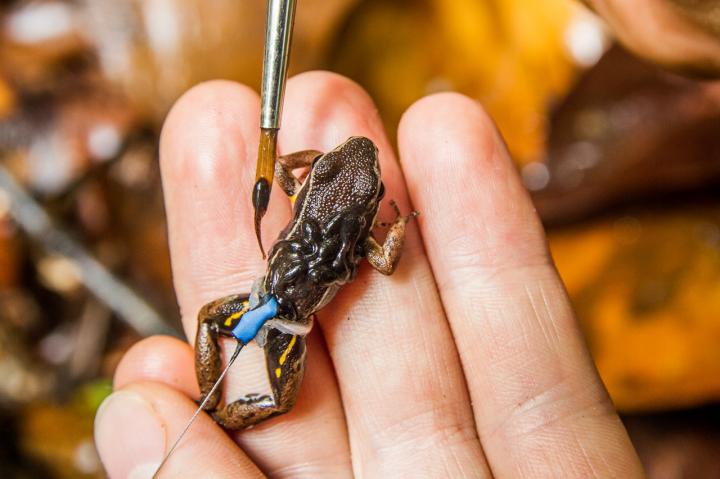
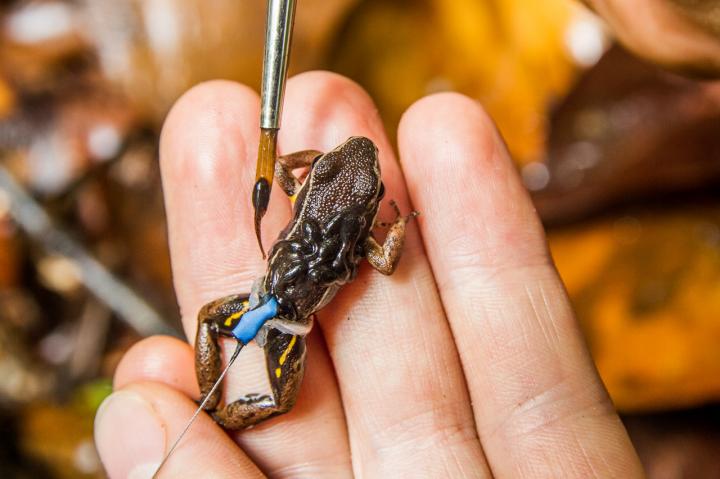
Parental care is widespread in the animal kingdom. Poison frogs are also known to be dedicated parents. They pick up their tadpoles after they hatch and piggyback them to distant pools spread around the forest. Until now, the processes that trigger parental care have been mostly studied in birds and mammals. But the exact stimulus that triggers frogs to carry their offspring to the pools remains unstudied. Researchers from Vetmeduni Vienna, the University of Vienna and Harvard University have now investigated whether adult frogs will only transport tadpoles if they pick up a clutch themselves or if this behaviour could be triggered experimentally. The team of researchers placed unrelated tadpoles on the backs of different frogs. The study showed that the amphibians are exemplary foster parents and that even females, which under natural conditions only rarely perform the role of "transporter", assumed their parental duties just like males when tadpoles were placed on their backs.
Piggyback for all, no matter if the "children" were natural or adopted
After the foster tadpoles were placed on the backs of male and female frogs, the adults were fitted with miniature transponders for tracking. "We wanted to know if foster tadpoles were also transported to the pools. The results show that the tadpoles do not have to be picked up, but that contact with the backs of the adult frogs was enough to trigger the transport," explains Andrius Pašukonis of the University of Vienna, who led the study together with Kristina Beck and Eva Ringler. "We observed that all tested frogs, both males and females, transported the experimentally placed tadpoles to pools," says Eva Ringler of the Vetmeduni Vienna's Messerli Research Institute. Their behaviour was the same as if they had decided to pick up and transport the tadpoles themselves. This shows that the parental care instinct in these frogs can be triggered by placing tadpoles on the backs of the adult animals whether they are related or not. However, the experiment could not yet clearly identify the mechanism that triggers this instinctive behaviour.
Tactile stimuli from the tadpoles could play a predominant role even among frog mothers
"We suspect that tactile stimuli, certain touching or movement patterns by the tadpoles, play a role. These findings are interesting, as they show how one stimulus can trigger such complex behaviour. The adult poison frogs don't just march off; the touching also stimulates memories of distant pool locations in the forest," says Pašukonis. Also interesting was that the female frogs voluntarily carried the foster tadpoles to the pools. "In this species, females naturally transport tadpoles only in rare cases," explains Ringler. The instinctively triggered behaviour therefore does not appear to be sex-specific. Among both males and females, the physical presence to the tadpoles placed on their backs was sufficient to make the frogs transport the tadpoles to the pools and so to ensure the survival of unrelated young. The study was the first to show in the wild and among amphibians that such complex behaviour can be triggered by one external stimulus.
###
Service:
The article "Induced parental care in a poison frog: a tadpole cross-fostering experiment" by Andrius Pašukonis, Kristina Barbara Beck, Marie-Therese Fischer, Steffen Weinlein, Susanne Stückler und Eva Ringler was published in Journal of Experimental Biology.
http://jeb.biologists.org/content/early/2017/08/31/jeb.165126
About the University of Veterinary Medicine, Vienna
The University of Veterinary Medicine, Vienna in Austria is one of the leading academic and research institutions in the field of Veterinary Sciences in Europe. About 1,300 employees and 2,300 students work on the campus in the north of Vienna which also houses five university clinics and various research sites. Outside of Vienna the university operates Teaching and Research Farms. http://www.vetmeduni.ac.at
Scientific Contact:
Eva Maria Ringler
Messerli Research Institute
University of Veterinary Medicine Vienna (Vetmeduni Vienna)
T 43-650-9780208 [email protected]
and
Andrius Pasukonis
Department of Cognitive Biology
University of Vienna
T 43-1-4277-76101 [email protected]
Media Contact
Eva Ringler
[email protected]
43-650-978-0208
http://www.vetmeduni.ac.at
Original Source
http://www.vetmeduni.ac.at/en/infoservice/presseinformation/press-releases-2017/foster-tadpoles-trigger-parental-instinct-in-poison-frogs/