Fossilized coral reef ecosystems preserved above modern sea level are providing researchers with historical benchmarks to evaluate long-term reef resilience and guide modern restoration initiatives across the Caribbean. In two investigations published in PALAIOS and Conservation Biology, scientists led by researchers from The University of Texas at Austin examined ancient coral assemblages in northeastern Jamaica to determine which species dominated past warm periods. By integrating paleontological data with ecological niche modeling and climate projections, the researchers aimed to forecast which marine environments may offer suitable thermal and salinity conditions for sensitive reef-building corals in the coming decades.
Modern Caribbean coral reefs have experienced severe ecological declines over the past 70 years, leaving contemporary marine scientists with degraded baselines that obscure how balanced communities functioned before widespread anthropogenic disturbances. Because the fossil reefs are now above sea level, the researchers adapted a modern coral monitoring transect method by walking along the deposits and photographing fossils to estimate coral numbers and distribution.
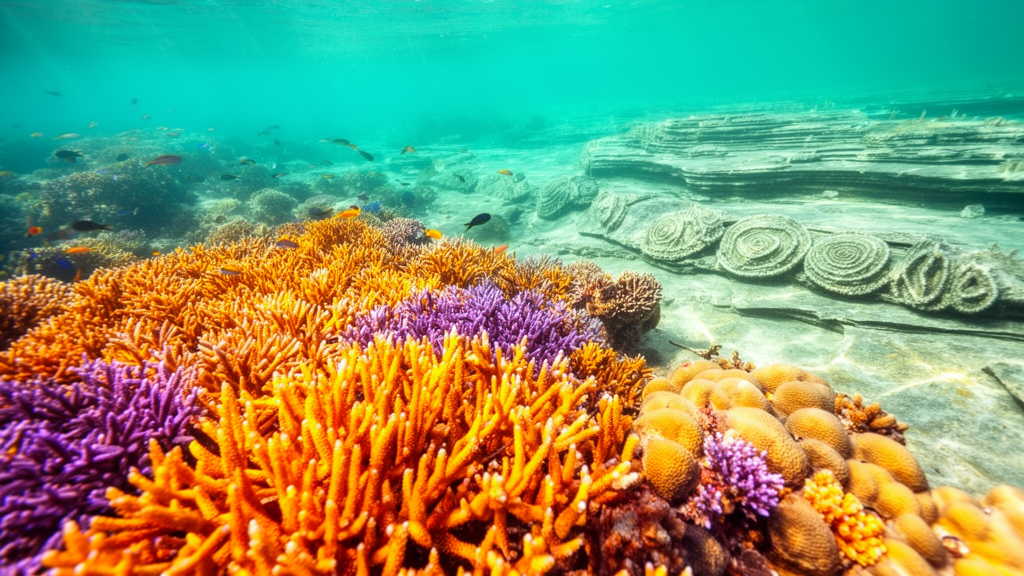
Field investigations focused on two coastal locations in Jamaica where Late Pleistocene fossil reefs date to between 130,000 and 125,000 years ago. This geological interval represents an interglacial warming period that climate scientists consider a viable analog for the sea-surface temperature conditions projected to occur across the globe within the next 50 to 100 years.
When researchers compared the fossil reef data to modern Caribbean sites, they found that branching Acropora corals abundant during the Pleistocene are now largely dead and covered by algae.
In contrast to the historical dominance of branching taxa, modern reef assessments identified Porites astreoides as the predominant remaining coral species. While this globular, mounding coral exhibits notable demographic resilience and can recruit rapidly following environmental disruptions, it does not build the complex three-dimensional architecture characteristic of large branching colonies.
The study authors emphasized that restoring degraded ecosystems cannot rely solely on standard nursery propagation and outplanting efforts, commonly termed coral gardening. Co-author Rowan Martindale, an associate professor in the Jackson School’s Department of Earth and Planetary Sciences, noted that introducing nursery-grown Acropora colonies into degraded areas risks catastrophic mortality if local waters exceed physiological heat thresholds. This vulnerability was demonstrated in the summer of 2023, when an intense regional marine heatwave triggered mass bleaching and widespread mortality among corals transplanted by the Alligator Head Foundation.
To overcome the limitations of localized transplantation, the researchers conducted an ecological niche modeling study that evaluated the specific water temperature and salinity ranges tolerated by Caribbean coral taxa over geological time. In addition to the Pleistocene data, the team incorporated fossil records from the mid-Holocene epoch dating between 5,000 and 7,000 years ago.
The ecological niche models were coupled with contemporary climate simulations to project which Caribbean marine regions will maintain sea-surface temperature and salinity profiles compatible with healthy reef-building corals in the future. The projections identified specific prospective geographic refugia where environmental conditions are most likely to remain viable for conservation and targeted restoration, including sections of the Northern Caribbean, the Florida Keys, and the waters adjacent to the Yucatan Peninsula.
Despite identifying potential regional conservation targets, the research team cautioned that predictive models based on temperature and salinity represent an initial baseline rather than guaranteed outcomes. The researchers emphasized that surviving localized stressors—such as infectious coral diseases, land-based pollution, sedimentation, and destructive storm events—will dictate whether prospective refugia can successfully harbor transplanted colonies over the long term, requiring continuous monitoring and adaptive conservation frameworks that incorporate evolving field observations.
The research, supported by funding from the National Science Foundation and The University of Texas Program in British, Irish and Empire Studies, underscores the utility of paleontological baselines in guiding marine resource preservation.
Martindale emphasized that safeguarding these reef ecosystems is vital for coastal human populations that depend directly on reef architecture for fisheries production and storm surge reduction, arguing against the abandonment of regions that rely heavily on functional marine barriers.
Subject of Research: Paleontological evidence and ecological niche modeling for Caribbean coral reef conservation
Article Title: Caribbean corals are in crisis: Fossil reefs can help point to where corals may persist
Article References: Caribbean corals are in crisis: Fossil reefs can help point to where corals may persist. Original publication (Bibliographic details unavailable.)
Image Credits: AI Generated
DOI: Not provided
Keywords: Caribbean coral reefs, fossil reefs, Pleistocene epoch, Holocene epoch, Acropora palmata, Acropora cervicornis, Porites astreoides, ecological niche modeling, coral bleaching, marine conservation, Jamaica, Florida Keys, Yucatan Peninsula, sea surface temperature, ocean salinity, paleoecology
News Source: Drew Townsend. (November 20, 2026). Fossil Reef Records Identify Potential Future Refuges for Caribbean Corals. Scienmag.