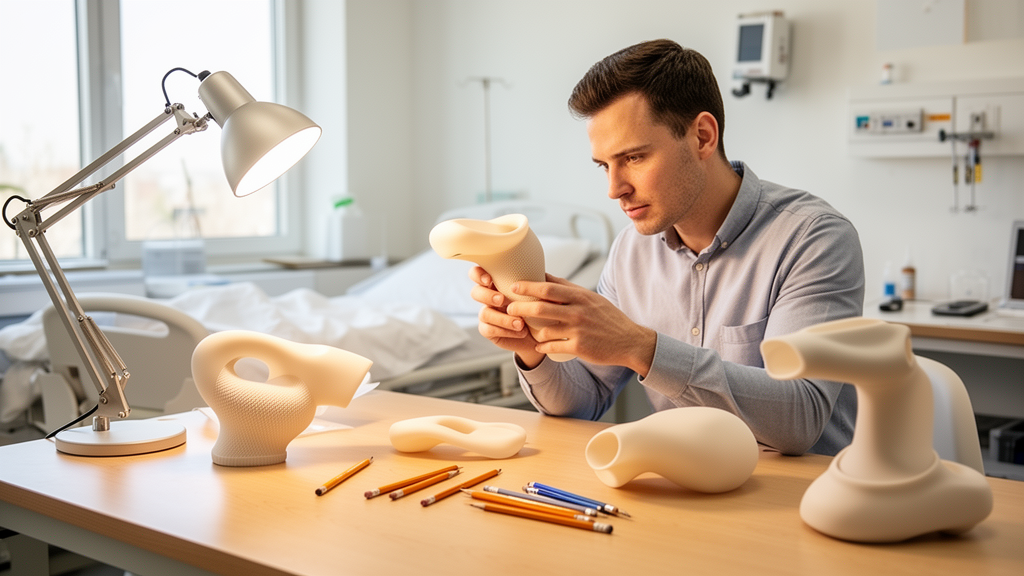
Supporting urinary elimination for bedbound women who retain continence remains an enduring clinical challenge, as traditional bedpans and absorbent products frequently impose postural strain, discomfort, dependence, and hygiene concerns. To explore alternative solutions that do not depend on urethral catheterisation, adhesives, or continuous suction, researchers conducted a sequential, complementary mixed-methods formative human factors evaluation of ERGOMIC, a pre-commercial reusable female voiding interface designed for bed-based care. The investigation examined how directly observed interaction events, participant-reported experiences, and healthcare professionals’ assessments could be systematically organized and translated into traceable engineering requirements. Rather than attempting to validate a final commercial product or demonstrate clinical efficacy, the study focused on establishing an auditable pathway from early-stage use difficulties to iterative design actions, ensuring that user capabilities, external genital anatomy, material behaviour, and clinical workflow constraints are addressed prior to summative or clinical testing.
The ERGOMIC prototype under evaluation was manufactured using multi-material additive manufacturing techniques, comprising three principal functional elements: a proximal anatomical interface designed to contact the vulvar and labial anatomy, an elongated rigid photopolymer body providing a urine-conduction conduit, and a compliant connection element coupling the proximal interface to the body. The connection component featured a nominal hardness of approximately Shore 80A, while the anatomical contact interface was fabricated from a softer elastomeric polymer selected for body-contact compliance. Distally, the device connected via flexible tubing to a standard collection bag to permit gravity-driven drainage. The design was conceived to establish a reliable external seal without invasive placement or chemical adherence, relying on proper anatomical positioning and mechanical stability during micturition. Because semi-critical mucosal contact occurred during repeated testing, all prototypes underwent an institutional high-level chemical disinfection and enzymatic cleaning protocol between uses, although material durability and microbiological efficacy were not evaluated as formal study endpoints.
To capture distinct aspects of interaction, the investigation adopted a sequential two-phase design separating direct observed use from professional evaluation. Phase I examined direct interaction among thirteen adult women in a controlled, non-clinical setting configured to reproduce the physical constraints of bed-based care. Participants were positioned on a clinical examination couch in a supported semi-reclined posture with the headrest elevated to approximately forty-five degrees, preserving trunk and reach constraints while allowing structured researcher observation. The cohort had a mean age of 59.7 years with a standard deviation of 12.9 years and a range from 40 to 85 years, exhibiting substantial body mass index variation ranging from 18.8 to 45.4 kilograms per square metre. None of the Phase I participants reported prior familiarity with adapted female voiding or urine-collection devices. Data collection integrated a structured task-step observation checklist, use-error classification, the System Usability Scale, device-specific questionnaires, and semi-structured post-use interviews transcribed verbatim.
Phase II subsequently recruited twenty-six unique female healthcare professionals from participating health departments, yielding twenty-eight completed assessment records following unobserved self-use trials conducted in private domestic settings. The professional cohort comprised thirteen nurses, seven nursing care assistants, one healthcare orderly, and five respondents who classified their role as other, with a mean participant age of 49.4 years and a standard deviation of 8.9 years. Only three professionals reported prior experience with comparable urinary management technologies. To explore interface sizing, Phase II introduced two proximal-ring geometries: configuration 1, retaining the original geometry evaluated in Phase I, and configuration 2, featuring an enlarged proximal anatomical ring developed in response to Phase I sizing feedback. Each professional handled both geometries without voiding, selected the configuration perceived to offer superior anatomical fit, completed an unobserved voiding trial, and provided usability ratings alongside open-ended comments regarding bedside feasibility.
During Phase I testing, all thirteen participants reviewed the provided instructional video and twelve read the written instructions independently, demonstrating initial conceptual understanding. Successful voiding through the prototype occurred in eleven of the thirteen observed sessions, with a median device-use duration of ten minutes ranging from three to fifteen minutes and a median initiation latency of 450 seconds. However, two participants were unable to void through the device; one discontinued after approximately twenty minutes due to discomfort and inhibition, while the second reported persistent urinary urge but could not initiate flow until the device was removed. Initial placement was classified by the single external observer as correct on the first attempt in eight participants, while one individual required hands-on external assistance to position the interface. Placement attempt records were interpretable in nine sessions, revealing that six women required one attempt, one required two, one required three, and one required four attempts, while four session records lacked complete or consistent attempt counts.
Direct observation in Phase I uncovered several critical interaction breakdowns that highlighted the physical vulnerability of the interface seal and structural stability. Use errors occurred in five participants, including three critical use errors defined as events capable of compromising functional containment or preventing successful task completion. In one critical instance, reach and visibility constraints caused misplacement and proximal interface detachment, requiring researcher intervention alongside unconfirmed user-reported urine loss. In the second critical case, a participant released manual support and attempted to stabilise the interface using thigh pressure, resulting in observer-confirmed partial fluid escape. In the third critical event, the complete voided volume escaped the collection pathway due to interface displacement, which was directly documented by the observer. Overall, researcher-confirmed visible containment failure occurred in two sessions, whereas three additional participants reported perceived leakage that prompted corrective actions without visible fluid escape outside the intended pathway.
Fluid drainage and component stability presented further operational vulnerabilities during Phase I trials. Visible residual urine requiring compensatory lifting or tilting manoeuvres prior to device removal was documented in two participant sessions, demonstrating that fluid management challenges persist beyond active micturition. General field observations noted that drainage was sensitive to tubing alignment and bag elevation, with fluid pooling when the collection bag was not maintained dependently below the interface. Structural integrity was challenged in three sessions where the compliant proximal component detached or shifted relative to the main body during handling. Furthermore, three participants required supplementary headrest elevation to facilitate manual reach and visibility, reflecting an interaction between individual body habitus, mobility, and the geometric precision demanded by the interface. Delayed or inhibited micturition initiation occurred in six sessions, pointing to the psychological and physiological sensitivity of voiding under observed research conditions.
Quantitative usability evaluations revealed a clear divergence between global satisfaction metrics and specific interaction confidence. Phase I participants awarded ERGOMIC a favourable mean System Usability Scale score of 78.7 with a standard deviation of 15.6, a median of 82.5, and a range spanning from 52.5 to 100. Device-specific questionnaires corroborated general comfort, with eleven participants rating placement comfort positively and eleven reporting good or very good labial adaptation. Twelve considered material hardness adequate, and no participant reported immediate mucosal or dermal irritation. Nevertheless, seal confidence was notably equivocal: only seven of thirteen participants expressed positive confidence in containment security, while three were neutral and three judged the seal unstable. In Phase II, where healthcare professionals performed unobserved trials, the overall mean System Usability Scale score dropped to 50.1 with a standard deviation of 13.4 and a range from 20.0 to 75.0, reflecting more critical professional scrutiny of device mechanics.
The Phase II assessment data and qualitative commentary further underscored operational concerns regarding interface compliance, sizing, and clinical implementation. Professionals who chose configuration 1 recorded a mean System Usability Scale score of 47.3 across thirteen assessments, whereas those selecting the larger configuration 2 recorded a mean of 52.5 across fifteen assessments. Across all twenty-eight assessments, twenty-three rated containment security as unstable or somewhat unstable, and nineteen characterized the proximal material as excessively rigid. While immediate irritation remained low, with twenty-six reporting no discomfort, free-text feedback raised serious concerns regarding assisted placement in dependent patients, distal connector leakage, flow resistance, reflux risks, and the hygiene burden of cleaning reusable channels. Importantly, the researchers treated these professional extrapolations regarding bedbound patient handling as anticipated implementation judgements rather than verified observational performance data, maintaining strict analytical separation between experienced self-use and speculative clinical workflow impact.
To synthesize these heterogeneous data streams, the investigators established an explicit evidence-to-requirement framework distinguishing empirical findings, inferred requirement gaps, actionable requirements, design responses, and future verification targets. Findings grounded in direct-use difficulties were categorized as Route A evidence-derived requirements, whereas considerations derived from professional extrapolation, design-team risk analyses, or ungrounded preferences were assigned to Route B design considerations. For example, observer-documented placement ambiguity, fluid leakage, and proximal component detachment generated Route A requirements mandating self-evident positioning cues, enhanced sealing tolerance against minor handling shifts, reinforced mechanical coupling, and optimized gravity-dependent fluid pathways. Conversely, professional preferences for hypoallergenicity, cleanability, liquid resistance, and non-stick surface behaviour were catalogued under Route B, as their technical necessity was not directly established by interaction failures during the trial.
The formative findings directly informed an intermediate computer-aided design revision of the ERGOMIC interface, illustrating the practical translation of human factors evidence into concrete engineering features. The revised model incorporated an enlarged, reshaped proximal contact geometry to accommodate wider labial variability, an overhauled mechanical interface-to-body coupling to eliminate accidental detachment, a modified body contour to lower reach and visibility burdens, and a re-engineered distal connector intended to improve conduit security. However, the study authors emphasize that these computer-aided design modifications represent unverified design hypotheses rather than proven clinical improvements. The technical responses have not yet undergone mechanical retention testing, flow-rate quantification, or repeated-use evaluation. Subsequent developmental stages will require dedicated benchtop flow testing, standardized fluid-volume trials, and separate caregiver-assisted evaluations measuring physical workload, posture, and assisted placement success before any summative usability or clinical trials can be justified.
Subject of Research: Formative human factors evaluation of the ERGOMIC female bed-based voiding interface
Article Title: From use difficulties to design requirements: Formative human factors evaluation of a female voiding interface for bed-based care
Article References: La Guardia, A. M., Valls, M. T. P., Cabedo, M. M., Domenech-Climent, N., Verdoy, P. J., & Ortí, J. G. (2026). From use difficulties to design requirements: Formative human factors evaluation of a female voiding interface for bed-based care. Human Factors in Healthcare, 10, Article 100160. https://doi.org/10.1016/j.hfh.2026.100160
Image Credits: AI Generated
DOI: 10.1016/j.hfh.2026.100160
Keywords: ERGOMIC, human factors engineering, formative evaluation, female urinary care, bed-based urination, medical device usability, System Usability Scale, interaction breakdowns, anatomical interface, non-invasive collection, continence care, healthcare professionals, evidence-to-requirement synthesis, fluid containment, additive manufacturing, vulvar anatomy
News Source: Denise Maddox. (November 22, 2026). Formative Evaluation Translates Female Bedside Voiding Interface Difficulties into Design Requirements. Scienmag.