Agricultural scientists evaluating forage crop performance in Mediterranean environments have demonstrated that foliar applications of sodium selenate significantly increase forage yield and selenium accumulation in triticale without degrading overall nutritional quality when applied at an optimal rate of twenty grams per hectare. The two-year field investigation, conducted in Badajoz in southern Spain across the 2017/18 and 2018/19 cropping seasons, addressed widespread livestock micronutrient deficiencies driven by low plant-available selenium in regional soils. Farm animals require a minimum dietary selenium intake between 0.05 and 0.10 milligrams per kilogram of dry matter to maintain health, fertility, and antioxidant protection against oxidative stress. In many semi-arid pastoral regions, natural forage falls well below this baseline, exposing grazing ruminants to chronic disorders such as white muscle disease. The research team evaluated whether field-scale agronomic biofortification of triticale, an adaptable cereal grown widely across Mediterranean zones for livestock feed, could resolve dietary deficits efficiently while maintaining forage biomass production under contrasting rainfall conditions.
Selenium functions as an indispensable micronutrient within animal metabolism, serving as an enzymatic cofactor for protective systems that neutralize reactive oxygen species during periods of physiological stress. Despite global soil selenium concentrations averaging 0.4 milligrams per kilogram, expansive agricultural zones across Europe, the United Kingdom, the Middle East, Oceania, and the Americas report suboptimal soil levels falling below 0.02 milligrams per kilogram. When soil-extractable selenium drops below 0.1 milligrams per kilogram of dry matter, cereal crops absorb negligible amounts of the trace element, creating widespread deficiencies along pastoral food chains. While conventional livestock management historically addressed these shortages through direct oral supplementation using inorganic salts, research demonstrates that organic selenium incorporated directly into plant tissues provides greater bioavailability and safety for animals. Agronomic biofortification through foliar nutrient sprays bypasses unfavorable soil chemistry, reducing environmental runoff and minimizing immobilization risks by delivering soluble selenate directly onto established foliage during vegetative growth.
Triticale represents a prime candidate for targeted forage biofortification under Mediterranean semi-arid conditions. The crop produces high forage biomass with favorable organic matter digestibility and protein content while demonstrating marked resilience against biotic pressures and drought stress typical of southern European farming systems. To assess the practical efficacy of selenium enrichment, researchers established a randomized complete block trial with four replications at a research station located at 38 degrees 54 minutes North and 6 degrees 44 minutes West at an elevation of 186 meters above sea level. The local soil was classified as a Xerofluvent oxyaquic soil characterized by a clay-loam texture, a slightly acidic pH of 6.4, an organic matter content of 1.31 percent, and a very low extractable selenium level of 1.27 micrograms per kilogram. Baseline soil analysis also indicated low extractable zinc at 0.38 milligrams per kilogram, normal total nitrogen at 0.12 percent, normal extractable potassium at 0.82 milliequivalents per hundred grams, and very high extractable magnesium at 3.72 milliequivalents per hundred grams.
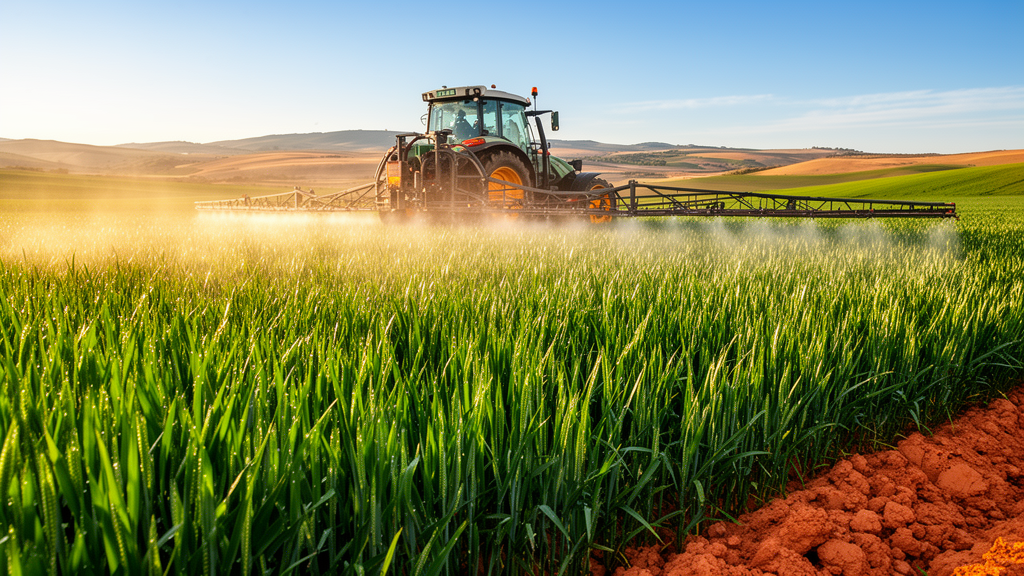
The experimental treatments tested four foliar application rates of sodium selenate supplying zero, ten, twenty, and thirty grams of selenium per hectare dissolved in three liters of water per plot. Each experimental plot measured fifteen square meters, configured as three by five meter blocks. The research team applied the foliar treatments on calm, dry days at the commencement of the tillering phase across plots that had received basal applications of compound nitrogen-phosphorus-potassium fertilizer at two hundred kilograms per hectare followed by top-dressed urea supplying one hundred kilograms of nitrogen per hectare at tillering. The short-to-medium cycle cultivar Bondadoso was sown at a target density of 350 viable seeds per square meter following conventional seedbed preparation in early November 2017 for the first season and late December 2018 for the second season due to heavy autumn rains. Pre-emergence chemical weed control utilized an active blend of clortoluron and diflufenican applied at 2.5 liters per hectare to maintain clean stands.
The two growing seasons exhibited starkly contrasting meteorological patterns that allowed the investigators to evaluate biofortification efficacy under fluctuating climate conditions. The 2017/18 season registered 477 millimeters of precipitation, which aligned with regional historical norms and delivered 252 millimeters across March and April to support robust crop development during the spring vegetative surge. In contrast, the 2018/19 season proved exceptionally dry, recording only 295 millimeters of total precipitation, representing a 35 percent rainfall deficit marked by acute moisture shortages during February and March. Forage harvesting took place at the milky grain phenological stage by cutting whole plants above ground level. Harvested biomass samples were immediately oven-dried at 65 degrees Celsius to determine total dry matter yields before being milled for comprehensive nutritional and mineral profiling using certified analytical procedures.
Nutritional forage evaluation tracked crude protein through the Kjeldahl distillation method, calculating protein percentage by multiplying measured nitrogen by a factor of 6.25. Structural carbohydrate fractions including neutral detergent fiber, acid detergent fiber, and acid detergent lignin were quantified using an automated fiber analyzer, while mineral ash content was determined by combusting dry samples inside a muffle furnace at 600 degrees Celsius. In vitro organic matter digestibility and relative feed value indices were calculated from the fiber fractions using validated animal nutrition equations. Total elemental concentrations of calcium, magnesium, iron, zinc, and selenium were measured using microwave-assisted nitric acid and hydrogen peroxide digestion followed by inductively coupled plasma mass spectrometry, validated against standard reference tomato leaves showing a 94 percent recovery rate. Total nutrient removal rates per hectare were calculated by multiplying individual elemental concentrations by dry forage yield to account for biological dilution effects.
Statistical evaluation via two-way analysis of variance confirmed that foliar selenium fertilization significantly boosted triticale forage productivity. Unfertilized control plots generated a mean dry matter yield of 13,855 kilograms per hectare, whereas selenium-fertilized treatments achieved an overall average of 15,796 kilograms per hectare across both seasons, representing a statistically significant 14 percent increase in total forage biomass. The broader growing environment exerted a strong influence over absolute productivity, with the rain-favored 2017/18 season yielding approximately 1,000 kilograms per hectare more biomass than the drought-stressed 2018/19 season, equivalent to a 7 percent seasonal margin. The interaction between study year and fertilization rate demonstrated that the intermediate rate of twenty grams of selenium per hectare produced the greatest dry matter accumulation in the wetter first year, whereas the highest rate of thirty grams per hectare maximized biomass production during the drought conditions of the second year.
Foliar sodium selenate applications induced dramatic, rate-dependent increases in forage selenium concentration, effectively transforming deficient herbage into nutrient-rich livestock feed. Triticale harvested from untreated control plots exhibited selenium levels below the critical livestock threshold of 0.05 milligrams per kilogram in both seasons, confirming that unamended forage grown on low-selenium Mediterranean soils leaves livestock vulnerable to nutritional deficiency. Applying ten, twenty, and thirty grams of selenium per hectare elevated forage selenium concentrations by factors of 2.1, 3.0, and 4.4 relative to the control, respectively. The intermediate dose of twenty grams per hectare reliably delivered an average forage concentration of approximately 120 micrograms of selenium per kilogram across both seasons, satisfying recommended animal feeding standards without risking toxicity. Total selenium uptake per hectare showed a sequential rise with increasing application rates, producing 2.3-fold, 3.3-fold, and 5.0-fold increases in selenium removal compared to untreated forage.
The study demonstrated nuanced inter-annual interactions between weather variables and nutrient uptake mechanisms within the triticale canopy. Across the dry 2018/19 season, forage selenium concentrations were 13.5 percent higher than in the wetter 2017/18 season, an outcome attributable to lower biomass dilution and drought-induced physiological adaptations. The researchers noted that under drought conditions, cereals often exhibit increased root growth as a survival strategy, which may facilitate greater selenium absorption because sodium selenate can stimulate root development and pass directly into plant roots. However, when total seasonal selenium removal was calculated by combining tissue concentrations with overall forage yields, the absolute difference in selenium extraction between the two years was largely neutralized, demonstrating that foliar sodium selenate remains exceptionally reliable across contrasting Mediterranean rainfall regimes.
Detailed examination of forage quality revealed that excessive selenium fertilization carries measurable drawbacks for feed digestibility. While crude protein content and relative feed value remained unaffected by selenium fertilization, the highest application rate of thirty grams per hectare caused a statistically significant increase in acid detergent fiber content, which triggered a corresponding decline in organic matter digestibility compared to control forage. In addition, growing conditions heavily influenced structural fiber components: the moist 2017/18 season yielded forage with 16.6 percent lower neutral detergent fiber and 18.7 percent lower acid detergent fiber, although acid detergent lignin was higher under favorable moisture. The reduced organic matter digestibility observed at thirty grams per hectare indicates that excessive selenium supplementation can impair cell wall degradability, demonstrating that biofortification strategies must be calibrated to avoid compromising the ruminant feeding value of harvested forage.
The evaluation of secondary mineral uptake highlighted complex interactions between applied selenium and essential micronutrients in the plant tissue. Magnesium accumulation peaked under the twenty grams per hectare treatment, suggesting a synergistic physiological response at moderate selenium levels before plateauing. Iron removal per hectare was promoted by all selenium treatments, with intermediate doses optimizing removal during the moist first season and the thirty-gram dose maximizing extraction during the dry second season. Conversely, zinc concentrations and total zinc removal exhibited an antagonistic pattern at elevated selenium rates, declining significantly under thirty grams of selenium per hectare compared to the twenty-gram rate. Because zinc deficiency already affects vast semi-arid agricultural landscapes, avoiding higher selenium application rates prevents unwanted competitive inhibition between trace elements. Calcium concentrations remained remarkably stable across both years and all treatment levels, averaging 2,699 milligrams per kilogram with an average removal of 40,703 grams per hectare.
In synthesizing the two-year experimental dataset, the authors concluded that agronomic biofortification of triticale through foliar sodium selenate represents an effective, sustainable intervention to counter livestock selenium deficiency in Mediterranean agroecosystems. Applying twenty grams of selenium per hectare at the tillering stage achieved the optimal agronomic equilibrium, boosting dry forage yield by 14 percent, raising forage selenium content to safe, bioavailable concentrations of approximately 120 micrograms per kilogram, and maximizing magnesium accumulation while preserving organic matter digestibility and avoiding competitive depression of zinc uptake. Because rainfall fluctuations markedly influence dry matter accumulation and nutrient assimilation patterns, the researchers emphasize that flexible, adaptive nutrient management tailored to seasonal precipitation will allow Mediterranean livestock producers to harvest high-yielding, mineral-balanced forage that protects livestock health without recurring reliance on synthetic mineral licks or veterinary supplements.
Subject of Research: Foliar selenium biofortification in triticale forage crops under Mediterranean growing conditions
Article Title: Selenium Biofortification in Triticale (x Triticosecale Wittmack) Under Mediterranean Conditions: Effects on Forage Yield and Quality Parameters
Article References: García-Latorre, C., Rivera-Martín, A., & Poblaciones, M. J. (2026). Selenium Biofortification in Triticale (x Triticosecale Wittmack) Under Mediterranean Conditions: Effects on Forage Yield and Quality Parameters. Agricultural Research. https://doi.org/10.1007/s40003-026-00980-w
Image Credits: AI Generated
DOI: 10.1007/s40003-026-00980-w
Keywords: triticale, selenium biofortification, foliar application, sodium selenate, forage yield, forage quality, acid detergent fiber, organic matter digestibility, livestock nutrition, Mediterranean agriculture, Badajoz Spain, micronutrient deficiency, mineral accumulation, semi-arid farming, drought response, nutrient removal
News Source: Alan Morgan. (November 24, 2026). Foliar Selenium Spray Boosts Triticale Forage Yield Under Mediterranean Conditions. Scienmag.