• HOME
  • NEWS
  • EXPLORE
    • CAREER
      • Companies
      • Jobs
    • EVENTS
    • iGEM
      • News
      • Team
    • PHOTOS
    • VIDEO
    • WIKI
  • BLOG
  • COMMUNITY
    • FACEBOOK
    • INSTAGRAM
    • TWITTER
Friday, April 10, 2026
BIOENGINEER.ORG
No Result
View All Result
  • Login
  • HOME
  • NEWS
  • EXPLORE
    • CAREER
      • Companies
      • Jobs
        • Lecturer
        • PhD Studentship
        • Postdoc
        • Research Assistant
    • EVENTS
    • iGEM
      • News
      • Team
    • PHOTOS
    • VIDEO
    • WIKI
  • BLOG
  • COMMUNITY
    • FACEBOOK
    • INSTAGRAM
    • TWITTER
  • HOME
  • NEWS
  • EXPLORE
    • CAREER
      • Companies
      • Jobs
        • Lecturer
        • PhD Studentship
        • Postdoc
        • Research Assistant
    • EVENTS
    • iGEM
      • News
      • Team
    • PHOTOS
    • VIDEO
    • WIKI
  • BLOG
  • COMMUNITY
    • FACEBOOK
    • INSTAGRAM
    • TWITTER
No Result
View All Result
Bioengineer.org
No Result
View All Result
Home NEWS Science News Biology

Folding poisons

Bioengineer by Bioengineer
September 11, 2018
in Biology
Reading Time: 2 mins read
0
Share on FacebookShare on TwitterShare on LinkedinShare on RedditShare on Telegram
IMAGE

Credit: Source: Klaus Aktories

Treating bacterial infections with antibiotics often kills intestinal flora, leading to diarrhoea and inflammation of the gut. Often it is bacteria known as Clostridium difficile which are responsible; they proliferate when the normal microbiome is killed by antibiotics. A working group headed by Professor Dr. Dr. Klaus Aktories of the Institute of Experimental and Clinical Pharmacology at the University of Freiburg, collaborating with Professor Dr. Andreas Schlosser of the Rudolf Virchow Center in Würzburg, has shown how the microbes' poisonous proteins penetrate intestinal cells. The results of their study are published in the highly respected journal, the Proceedings of the National Academy of Sciences.

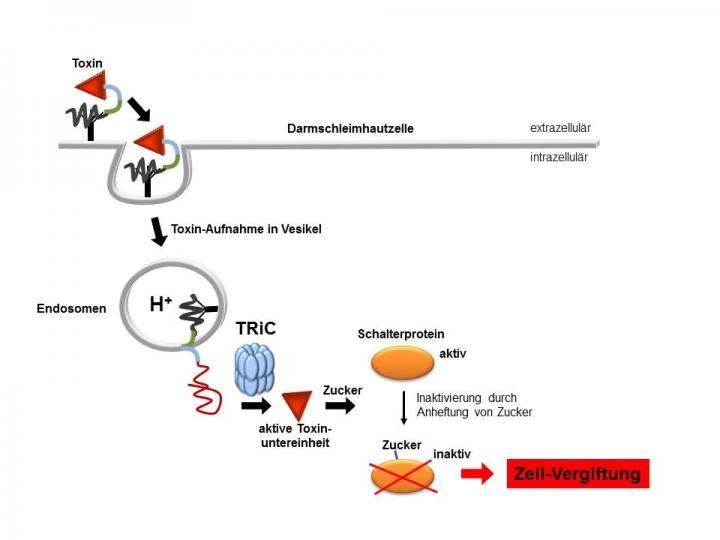
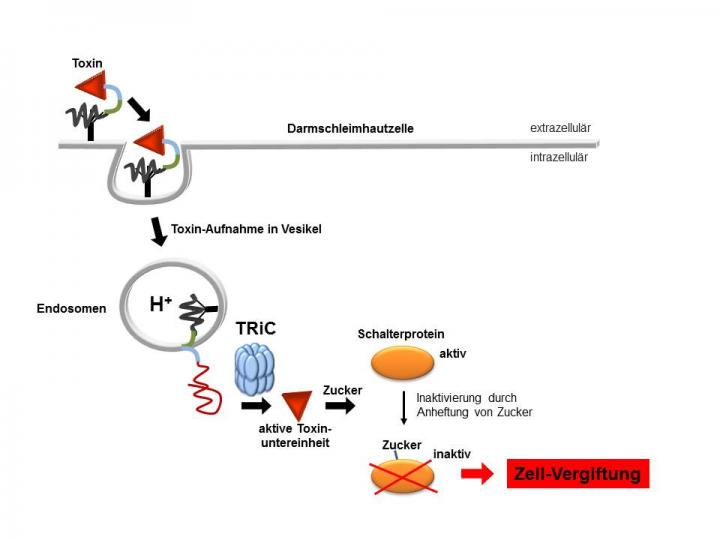
Clostridium difficile produces toxins in the gut which get into cells in the intestinal mucosal surface, disrupting their barrier function. Researchers have long known how these toxins affect cells. They transfer sugar to switch proteins, rendering them inactive. This leads to disintegration and death of the cell. But it was not known how the relatively large proteins in the toxins were able to enter the host cell. It was only known that the bacterial toxins bind with the surface of intestinal cells and enter via tiny pores from blister-like structures in the cytoplasm called vesicles.

As the working group has shown, further up-take of the toxins depends on the protein TRiC. It is responsible for folding proteins – which occur as long chains of amino acids in the cell – giving them their three-dimensional structure. The researchers found that TRiC also plays an essential role in folding bacterial toxins, which are transferred through the cell membrane as long chains and, once inside, have to be re-folded. When the researchers blocked TRiC with an inhibitor or switched it off genetically, poisoning of the cell did not occur.

The effect of other bacterial toxins which can transmit sugars is also dependent on TRiC. These latest findings may help researchers find active agents to combat the toxins.

###

Media Contact

Prof. Dr. Dr. Klaus Aktories
[email protected]

Startseite

Original Source

http://www.pr.uni-freiburg.de/pm-en/press-releases-2018/folding-poisons http://dx.doi.org/10.1073/pnas.1807658115
Share15Tweet8Share2ShareShareShare2

Related Posts

Epigenetic Alterations at Birth Linked to Infant Microbiome and Neurodevelopment

Epigenetic Alterations at Birth Linked to Infant Microbiome and Neurodevelopment

April 10, 2026
Lung Cancer That Alters Its Identity Could Be Concealed in Plain Sight

Lung Cancer That Alters Its Identity Could Be Concealed in Plain Sight

April 10, 2026

Neuronal Motor Protein Composition Determines Cargo Specificity

April 10, 2026

How Your Housemates Might Be Altering Your Gut Microbiome

April 10, 2026
Please login to join discussion

POPULAR NEWS

  • Boosting Breast Cancer Risk Prediction with Genetics

    47 shares
    Share 19 Tweet 12
  • Popular Anti-Aging Compound Linked to Damage in Corpus Callosum, Study Finds

    44 shares
    Share 18 Tweet 11
  • Imagine a Social Media Feed That Challenges Your Views Instead of Reinforcing Them

    1012 shares
    Share 400 Tweet 250
  • Revolutionary Theory Transforms Quantum Perspective on the Big Bang

    41 shares
    Share 16 Tweet 10

About

We bring you the latest biotechnology news from best research centers and universities around the world. Check our website.

Follow us

Recent News

MARCH2 Guards Heart by Stabilizing NR1H2, Clearing Cells

Bisphenol S and Female Reproductive Toxicity Reviewed

Scalable Laser-Made Flexible Bismuth Telluride Thermoelectrics

Subscribe to Blog via Email

Enter your email address to subscribe to this blog and receive notifications of new posts by email.

Join 78 other subscribers
  • Contact Us

Bioengineer.org © Copyright 2023 All Rights Reserved.

Welcome Back!

Login to your account below

Forgotten Password?

Retrieve your password

Please enter your username or email address to reset your password.

Log In
No Result
View All Result
  • Homepages
    • Home Page 1
    • Home Page 2
  • News
  • National
  • Business
  • Health
  • Lifestyle
  • Science

Bioengineer.org © Copyright 2023 All Rights Reserved.