In a theoretical analysis published in Biology & Philosophy, philosopher Francesca Bellazzi argues that protein functions are fundamentally defined by their three-dimensional native structures rather than their linear primary sequences alone. The study develops what Bellazzi terms the shape is everything thesis, addressing a persistent challenge at the intersection of biochemistry and philosophy: determining precisely what proteins do and which physical entities bear those functions. Bellazzi resolves this inquiry by bifurcating it into two related investigations, identified as the structure problem and the function problem. The structure problem asks which structural level of a macromolecule bears functional responsibility, while the function problem asks which philosophical account of function best captures molecular operations. Bellazzi concludes that protein functions are dispositional properties associated with specific chemical and geometrical properties of the folded native state that contribute directly to evolved biological processes.
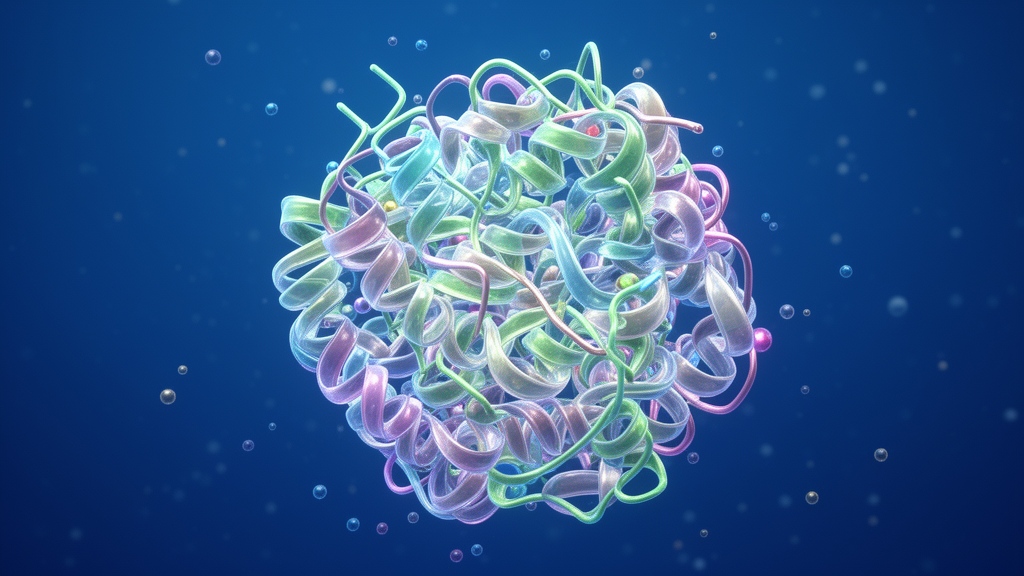
Biochemists and structural biologists recognise that proteins exhibit up to four hierarchical structural levels, each characterised by distinct physical interactions and spatial arrangements. The primary structure consists of a linear sequence of amino acids joined together predominantly by covalent peptide bonds. The secondary structure emerges as localized hydrogen bonds between amino hydrogen atoms and carboxyl oxygen atoms in the peptide backbone cause the chain to fold into repeating geometrical motifs, notably alpha helices and beta pleated sheets. The tertiary structure develops when complex side-chain interactions—including hydrophobic packing, hydrophilic attractions, ionic bonds, hydrogen bonding, and covalent disulphide bridges—force the polypeptide into a compact three-dimensional geometry. Finally, in multi-subunit assemblies, multiple folded polypeptide chains aggregate to form a quaternary structure. The resulting stable, folded three-dimensional conformation that actively carries out biological tasks is designated as the native state or native structure.
The central debate within the structure problem focuses on whether the primary sequence alone can serve as the legitimate bearer of protein function. Reductionist views, such as those historically advanced by Goodwin and Tahko, maintain that primary structure represents the most fundamental property of proteins because it remains chemically stable and ultimately dictates subsequent folding steps. Conversely, researchers such as Slater, Tobin, and Santos argue that linear sequence lacks a direct link to ultimate biological roles. Bellazzi supports this critique by demonstrating that the relationship between sequence and function is disrupted by multiple realisability. In multiple realisability, distinct amino acid sequences fold into effectively identical tertiary and quaternary geometries to carry out identical physiological duties. For example, human haemoglobin requires the coordinated folding of globin chains that can be realised by at least six different polypeptide sequences, demonstrating that primary sequences alone do not provide functional specificity.
A parallel challenge identified in the paper is multiple determinability, where a single structural entity manifests multiple functional outcomes. Multiple determinability operates in two primary ways across molecular systems. First, identical amino acid sequences can fold into entirely distinct tertiary and quaternary structures, as observed in intrinsically disordered proteins that retain flexible polypeptide backbones capable of adopting alternate conformations depending on cellular conditions. Second, a single folded protein can perform diverse, unrelated functions across distinct physiological environments without altering its sequence, a phenomenon known as protein moonlighting. For example, mammalian crystallin proteins maintain a stable globular architecture that provides optical transparency in the lens of the eye while simultaneously acting as active metabolic enzymes during digestion. Because the same primary sequence yields divergent biological operations across tissues, Bellazzi argues that linear sequences lack the requisite specificity to serve as autonomous function bearers.
To establish the folded shape as the genuine function bearer, Bellazzi emphasizes that a protein native state must not be conceptualized as a rigid, static geometry. Citing biophysical analyses by Mishra and Jha, the paper highlights that a native state corresponds to the thermodynamic minimum free-energy conformation, operating as an ensemble of closely related conformational substates rather than an immutable crystalline lattice. This conformational heterogeneity is biologically indispensable, as flexible shifts between substates permit proteins to engage in catalytic cycles and bind metabolic partners. Furthermore, as noted by Gupta and Uversky, proteins frequently preserve their overall native state even when localized domains undergo structural adjustments in response to fluctuating environmental signals. The functional bearer in macromolecules can also incorporate non-amino acid constituents, such as the prosthetic heme group in conformational proteins, which becomes integrated directly into the tertiary and quaternary framework to execute physiological tasks.
Having established the native structure as the primary function bearer, Bellazzi examines the function problem by evaluating existing philosophical theories of biological functionality. The causal theory of function, originally formulated by Cummins and later developed by Craver, defines function strictly as the causal contribution an entity makes to the overall activity of an encompassing complex system. While the causal account operates effectively for basic chemistry—where discrete chemical functional groups exhibit specific reactivity profiles, such as the hydroxyl group providing ascorbic acid with its acidic properties—it fails to provide sufficient specificity for macromolecular biochemistry. In a biological organism, haemoglobin displays a vast array of potential chemical interactions across its numerous amino acid side chains. Treating every possible causal chemical reaction as a genuine biological function obscures the specific physiological responsibilities of the molecule, such as loading and unloading respiratory oxygen.
The alternative evolutionary approach, represented by selected effect theories advanced by Millikan, Neander, and Garson, defines a trait’s function as the historical effect for which ancestral variants were favored and retained by natural selection. When applied to macromolecules, however, selected effect theory encounters severe conceptual obstacles, including the trait individuation problem and the function ascription problem. Traditional biological traits are macroscopic phenotypic properties of organisms, making it contentious to treat chemical macromolecules as autonomous selectional traits. Furthermore, classical selected effect models tend to explain the evolutionary emergence of the overall biosynthetic machinery or the encoding genetic sequence rather than attributing function directly to the completed macromolecule itself. Reducing protein function entirely to retained nucleotide sequences reintroduces the limitations of primary structure, bypassing the intricate thermodynamic and environmental dependencies governing three-dimensional folding.
To overcome the limitations of both isolated causal accounts and purely historical models, Bellazzi constructs an expanded dispositional framework rooted in her earlier biochemical view of functions. Under this refined formulation, proteins’ functions are explicitly defined as dispositions associated with specific chemical and physical properties of the folded native state that create defined binding sites, with the functional specificity of these native properties determined by the evolutionary selected biological processes to which the macromolecule contributes. Functions are thus understood as complex, response-dependent, and multi-track dispositions that manifest only under appropriate biochemical triggers. By anchoring the dispositional properties directly to the physical topography and active sites of the three-dimensional native structure, the framework avoids pure discipline-relativity while simultaneously drawing upon evolutionary selection history to distinguish biologically legitimate functional contributions from accidental chemical side reactions.
The practical explanatory power of this folded-structure framework is demonstrated through a detailed re-examination of human haemoglobin. Haemoglobin possesses the vital biological function of cooperatively loading and releasing molecular oxygen across circulatory networks. In Bellazzi’s model, this activity represents a complex disposition grounded in the assembled quaternary structure and its embedded iron-bearing porphyrin heme groups. The plastic quaternary architecture creates specialized binding sites for allosteric modulators, such as 2,3-bisphosphoglycerate, which systematically alter subunit affinities for oxygen under shifting tissue conditions. When oxygen molecules bind to individual globin subunits, localized conformational changes propagate across the quaternary interface, dynamically facilitating oxygen uptake in adjacent subunits. These finely tuned, responsive physiological shifts cannot be explained by isolated amino acid functional groups alone; they depend entirely upon the collective geometrical dynamics of the folded native state operating within an evolved circulatory system.
The dual functionality of crystallins provides a complementary test case for multi-track dispositional structures. In ocular tissue, crystallins pack into dense, exceptionally stable arrays that preserve lens transparency and refractive power; in gastrointestinal contexts, identical polypeptide sequences undergo subtle structural transitions toward dynamic conformations that facilitate catalytic enzymatic activity. Bellazzi points out that crystallins do not unfold or denature to execute these contrasting roles. Instead, the native state ensemble encompasses both rigid structural conformations and catalytically active substate configurations, allowing distinct surfaces of the same folded architecture to interact selectively with disparate molecular environments. The functional specificity of each role is governed by the independent evolutionary histories of the visual system and metabolic pathways, demonstrating that one-to-one mapping between primary sequence and biological purpose is unnecessary when functions are grounded in environmentally responsive native geometry.
A critical requirement for any robust theory of biological functionality is its capacity to distinguish between legitimate functions, benign side effects, and pathological states. Bellazzi evaluates this normative dimension by distinguishing true biochemical dysfunction from mere physiological malfunction, drawing upon clinical observations of sickle cell anaemia. Sickle cell anaemia arises from a point mutation substituting valine for glutamic acid in two globin chains, altering the macromolecular surface and triggering abnormal polymerization upon deoxygenation. This structural distortion deforms red blood cells into rigid crescent geometries. Bellazzi explains that genuine dysfunction occurs when genetic mutations or aberrant cellular environments disrupt the folding process so severely that the native structural properties supporting the functional disposition are absent. Conversely, a simple quantitative excess or deficiency of structurally intact proteins constitutes a system-level malfunction rather than intrinsic macromolecular dysfunction.
The paper further examines evolutionary mismatches where historical selection diverges from modern environments. In malaria-endemic regions, the structural mutation causing sickle cell anaemia was historically retained because altered erythrocyte physiology impeded plasmodium parasite proliferation, providing a selective survival advantage to heterozygous carriers. In environments lacking malaria, however, the altered molecular geometry manifests purely as debilitating pathology. Integrating native geometry with evolutionary history allows Bellazzi’s model to accommodate systems-level frameworks, including the organizational closure account advanced by Mossio and colleagues, where native configurations serve as physical constraints maintaining biological self-production. Ultimately, Bellazzi demonstrates that macromolecular chemical structure and biological functional purpose are not oppositional categories; rather, folded three-dimensional shape and biological function operate as inseparable aspects of macromolecular reality, providing a cohesive framework for classifying biochemical kinds.
Subject of Research: Philosophical and biochemical characterisation of protein functions based on three-dimensional native structure
Article Title: “Shape is everything: on proteins’ functions”
Article References: Bellazzi, F. (2026). “Shape is everything: on proteins’ functions”. Biology & Philosophy, 41(1), Article 3. https://doi.org/10.1007/s10539-025-10005-5
Image Credits: AI Generated
DOI: 10.1007/s10539-025-10005-5
Keywords: protein function, native structure, tertiary structure, quaternary structure, biochemical kinds, selected effect theory, causal role theory, haemoglobin, crystallins, conformational ensemble, dispositional properties, multiple realisability, multiple determinability, protein folding, allosteric regulation, sickle cell anaemia, organisational account
News Source: Drew Townsend. (November 24, 2026). Folded Native State Determines Biological Protein Functions Beyond Primary Amino Acid Sequences. Scienmag.