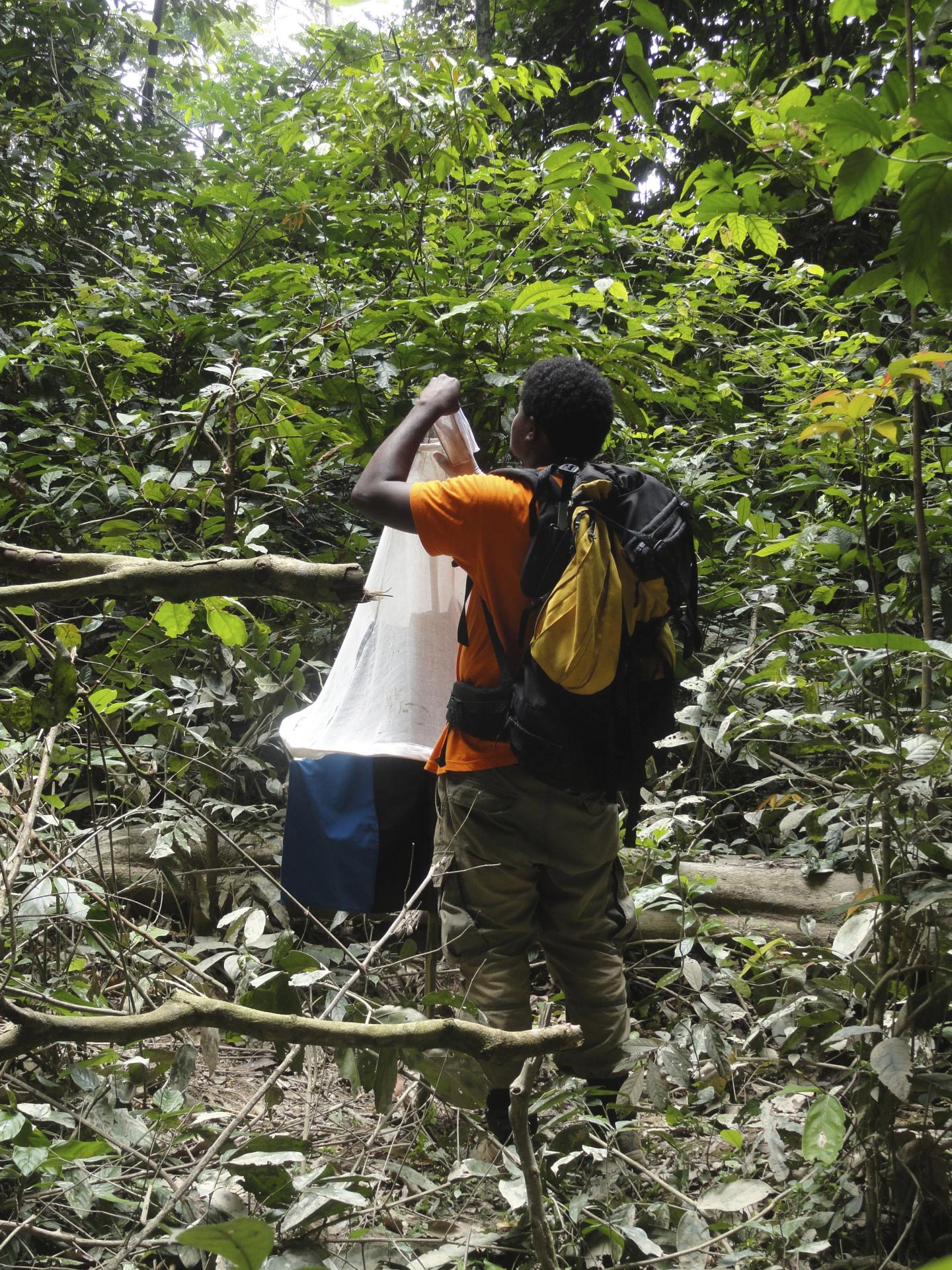
Credit: Franck Prugnolle
Blood-sucking flies can act as 'flying syringes' to detect emerging infectious diseases in wild animals before they spread to humans, according to research published in the journal eLife.
The discovery has significant implications for our ability to control the global outbreak of new and re-emerging infections such as the Ebola and Zika viruses.
Seven new pathogens are identified worldwide each year, and this is predicted to reach 15-20 every year by 2020 because of increased human contact with wildlife species that are potential reservoirs of disease. Despite significant scientific advances, researchers are still unable to predict where, when and how epidemics arise.
"This is a huge public health issue that urgently requires new tools for the active monitoring of outbreaks and rapid diagnosis of the pathogens involved," explains senior author and evolutionary geneticist Franck Prugnolle, from the National Center for Scientific Research (CNRS) in Montpellier, France. "We wanted to investigate whether blood-feeding insects could act as a sampling tool out in the wild environment, allowing us to monitor the presence and emergence of infectious disease."
Existing methods for studying the circulation of pathogens in wild habitats involve analysing animals caught for food, which represent only a fraction of a region's wildlife, or directly trapping animals to study the presence of infection in their organs and tissues, which is difficult and dangerous to protected species.
Previous research had shown that DNA from host animals, and from pathogens such as malaria, is preserved in the blood meals of flies. This prompted Prugnolle and his team to see whether blood meals could be used as an indirect, non-invasive way of studying the circulation of pathogens in wild animals.
Over a 16-week period, they conducted a field study in four national parks in the forests of Gabon, Central Africa, setting traps for three types of fly. They then analysed the insects' blood meals to determine the origin of the blood and the species of any malaria parasites present.
More than 4,000 flies were captured, of which 30% – mostly tsetse flies, which spread African sleeping sickness – were engorged with blood. Lead author Paul-Yannick Bitome-Essono, from the National Center for Scientific and Technological Research, France, explains: "We thought the tsetse fly might be a good candidate in our study, as both sexes feed on blood, they are large and easily trapped, present in large numbers in Central Africa, and are opportunistic feeders with no strong preference for a particular host animal, so would feed on a large range of wildlife."
Using a new technique for closely studying host blood DNA, the team determined the host origin for three-quarters of these samples, showing that the flies had fed on over 20 different species ranging from elephants and hippopotamuses to reptiles and birds. They found malaria parasites in nearly 9% of the blood meals, including 18 cases of previously undocumented malaria species. The method also allowed them to identify the natural hosts of some malaria species whose preferred host was previously unknown.
"These results show that blood meals of the engorged flies can be successfully used to analyse the diversity of known malaria parasites," says Prugnolle.
He adds that the next step is to look at ways to improve the method with next-generation sequencing and high-throughput pathogen detection methods. "This approach of 'xenosurveillance' could detect pathogens before they spread to humans, as well as the emergence of new diseases in wild animals that may threaten their long-term survival."
###
Reference
The paper 'Tracking zoonotic pathogens using blood-sucking flies as "flying syringes"' can be freely accessed online at http://dx.doi.org/10.7554/eLife.22069. Contents, including text, figures, and data, are free to reuse under a CC BY 4.0 license.
Media contact
Emily Packer, eLife
[email protected]
01223 855373
About eLife
eLife is a unique collaboration between the funders and practitioners of research to improve the way important research is selected, presented and shared. eLife publishes outstanding works across the life sciences and biomedicine — from basic biological research to applied, translational and clinical studies. All papers are selected by active scientists in the research community. Decisions and responses are agreed by the reviewers and consolidated by the Reviewing Editor into a single, clear set of instructions for authors, removing the need for laborious cycles of revision and allowing authors to publish their findings quickly. eLife is supported by the Howard Hughes Medical Institute, the Max Planck Society, and the Wellcome Trust. Learn more at elifesciences.org.
Media Contact
Emily Packer
[email protected]
01-223-855-373
@elife
http://www.elifesciences.org