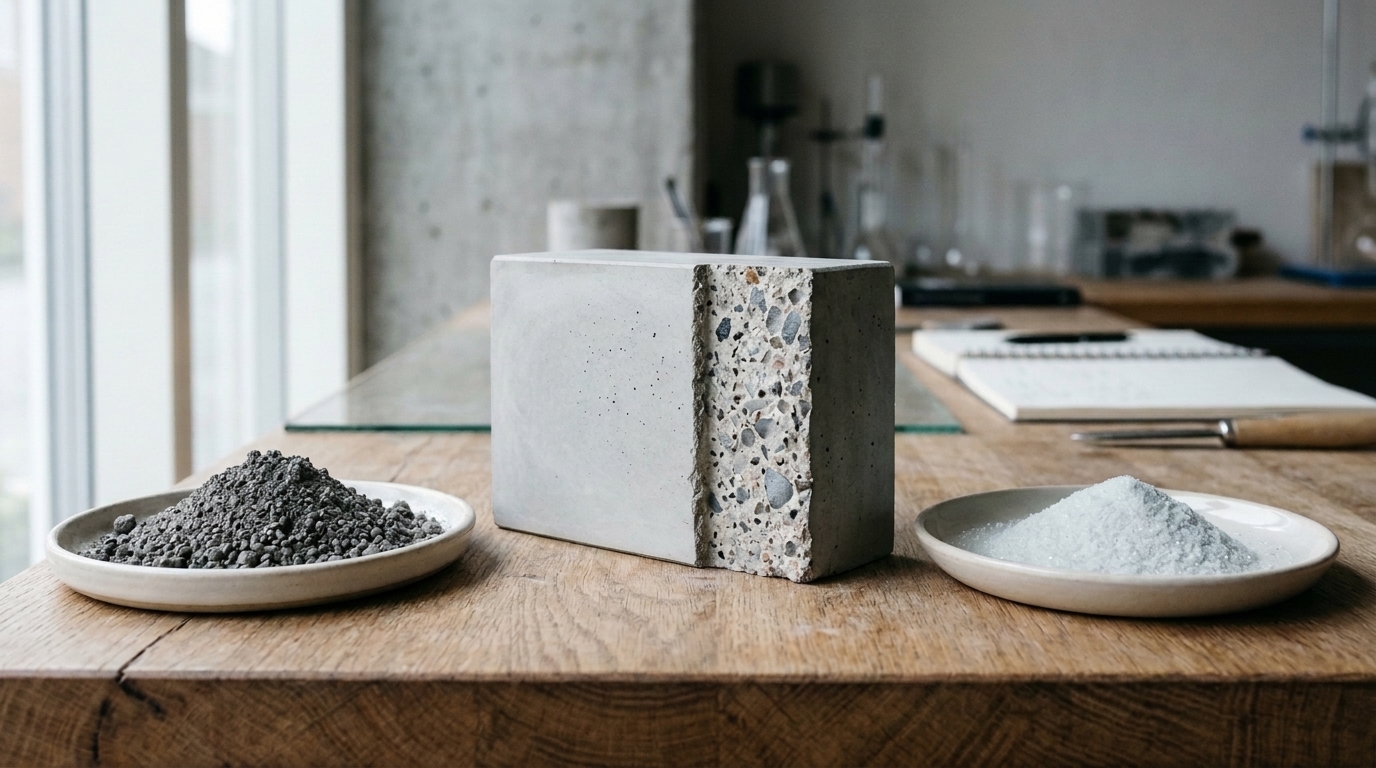
A multi-material experimental screening study published in Discover Concrete and Cement demonstrates that combining industrial by-products can enhance concrete strength while decreasing carbon emissions, provided substitution levels remain strictly controlled. Researchers Hamilton Mugisho Zigabe and Ömer Damdelen evaluated concrete mixtures incorporating fly ash, silica fume, and bottom ash as cement replacements, alongside glass powder and recycled plastic as fine aggregate replacements. Across eight trial mixes evaluated against an ordinary Portland cement control, Mix 1, containing 10 percent fly ash and 15 percent glass powder, achieved the best overall performance. Mix 1 increased compressive strength by 7.9 percent at 14 days and 9.2 percent at 28 days, while boosting indirect tensile strength by 48.2 percent and 42.31 percent. In contrast, formulations with elevated plastic content suffered severe mechanical collapse, with compressive strength plunging by over 95 percent in a 50 percent plastic mix.
The research responds directly to escalating global resource depletion and greenhouse gas emissions associated with modern construction. Concrete is the second most consumed material globally after water, with annual production surpassing ten billion tons. Manufacturing Ordinary Portland Cement generates roughly 7 to 8 percent of global carbon dioxide emissions, with clinker production accounting for over 90 percent of manufacturing energy and nearly all fuel consumed. Concurrently, natural aggregate mining consumes around 40 billion tons per year, depleting natural gravel beds and damaging local ecosystems. At the same time, non-biodegradable waste disposal poses an escalating environmental crisis. Global plastic production reached 359 million tons in 2018 and is projected to expand to 590 million tons by 2050. Post-consumer glass requires more than 1,000 years to degrade naturally, while coal-fired utilities generate vast volumes of fly ash and bottom ash that can pollute land and water when mismanaged in landfills.
To examine how multi-material substitutions influence performance, the experimental methodology tested eight composite mixtures alongside an unmodified control mix. Across all formulations, total binder content was held constant at 436 kilograms per cubic meter, and the water-to-binder ratio was fixed at 0.47. Water and coarse aggregate amounts remained identical across every batch. Coarse aggregates of 10-millimeter and 20-millimeter sizes were obtained from a Northern Cyprus quarry and conditioned to saturated surface dry standards under ASTM C127. Crushed fine aggregates smaller than 4.75 millimeters were sieved in accordance with ASTM C136 and batched in a saturated surface dry state per ASTM C128. Chemical admixtures like superplasticizers were deliberately excluded from the testing matrix. This design decision enabled the researchers to observe intrinsic rheological and mechanical behavior without confounding chemical dispersants, while identifying thresholds beyond which waste incorporation compromises structural viability.
Material selection followed strict engineering criteria. The primary binder was CEM II cement conforming to TS EN 197-1, having a specific gravity of 3.18 grams per cubic centimeter, Blaine fineness of 290 square meters per kilogram, and particle size between 10 and 15 microns. Tap water complied with ASTM C1602 with pH 6.5 to 7.5. Class F fly ash imported from Turkey possessed a 75-micron particle size and specific gravity of 2.10. Silica fume exhibited spherical particles below 0.5 microns, surface area of 20 square meters per gram, and specific gravity of 2.20. Coal bottom ash was air-cooled and sieved to 75 microns. Post-consumer glass bottles were cleaned and milled to pass a 75-micron sieve, producing angular powder with specific gravity of 2.55. Recycled plastic consisted of shredded pellets spanning 300 microns to 4.75 millimeters, blending high-density polyethylene, medium-density polyethylene, and polyvinyl chloride.
Fresh evaluations using ASTM C143 slump and ASTM C138 fresh density revealed major rheological shifts across modified mixtures. Spherical fly ash particles generally promote fluidity via a ball-bearing effect that reduces interparticle friction, but multi-material blends sharply depressed slump. Mix 1, containing fly ash and glass powder, suffered an 82 percent slump reduction, while Mix 4 dropped by 88.2 percent. Mix 2 showed an 82 percent slump loss with a 0.7680 compaction factor due to the high water demand of ultrafine silica fume. Mix 3 experienced a 29 percent slump drop from porous bottom ash, while Mix 7 saw an 82.4 percent slump decline. Conversely, Mix 5 recorded a 5.9 percent slump increase because non-absorptive plastic surfaces increased available water. Fresh density fell across all modified batches, decreasing from 2400.54 kilograms per cubic meter in the control to 2356.86 in Mix 1, 1985.56 in Mix 6, and 1380.96 in Mix 7, where plastic reduced unit weight by 42.5 percent.
Mechanical testing under BS EN 12390-3 for compression and BS EN 12390-6 for splitting tension highlighted clear performance divergences. Mix 1, combining 10 percent fly ash and 15 percent glass powder, attained the highest compressive strength, rising 7.9 percent above the control at 14 days and 9.2 percent at 28 days, while its indirect tensile strength climbed 48.2 percent and 42.31 percent. This superior strength was attributed to fly ash pozzolanic reactions forming calcium silicate hydrate gel and glass powder refining interfacial packing. In contrast, Mix 2 suffered compressive drops of 37 percent at 14 days and 38 percent at 28 days, alongside tensile losses of 8.7 percent and 30.1 percent, because hydrophobic plastic weakened bonding despite silica fume densification. Mix 3 produced compressive strengths of 52.54 megapascals at 14 days and 55.34 at 28 days versus 61.59 and 65.19 for the control; analysis of variance confirmed this reduction was statistically significant only at 28 days, while 14-day tensile strength rose 41.1 percent.
Heavily substituted formulations identified critical boundaries where waste loading compromised mechanical integrity. Mix 4, replacing 45 percent of cement with fly ash, silica fume, and bottom ash, suffered compressive drops of 77.8 percent at 14 days and 54.6 percent at 28 days, alongside tensile decreases of 14.3 percent and 7.2 percent, reflecting delayed pozzolanic activity. Mix 5 showed compressive reductions of 46.9 percent and 43.7 percent at 14 and 28 days. Mix 6 recorded compressive declines of 52.4 percent and 48.4 percent. The most drastic decline occurred in Mix 7, combining 50 percent plastic with fly ash and silica fume, where compressive strength collapsed by approximately 95 percent across both curing ages, with tensile strength plunging by 72.8 percent and 79.3 percent. This catastrophic loss occurred because plastic particles exceeded a percolation threshold, disrupting packing and preventing cement paste from bridging grains. Mix 8, utilizing 50 percent glass powder, suffered compressive reductions of 73.9 percent and 54.9 percent at 14 and 28 days, alongside tensile drops of 21.2 percent and 31.6 percent.
Physical testing of hardened specimens revealed internal pore structures that aligned with mechanical trends. In Mix 1, dry density decreased by 6.7 percent at 14 days and 2 percent at 28 days, while water absorption fell by 31.4 percent and 19.6 percent, and void ratio declined by 35.4 percent and 26.7 percent, proving that fine pozzolans densified capillary pores. Conversely, Mix 2 exhibited void ratio increases of 77 percent at 14 days and 78.6 percent at 28 days, with water absorption rising 41.1 percent and 56.4 percent. Mix 3 showed void ratio increases of 28.6 percent and 51.9 percent. In Mix 4, void ratio increased by 26.7 percent and 20.7 percent, while water absorption shifted from a 43.8 percent rise at 14 days to a 7.31 percent drop at 28 days. Mixes 5 and 6 experienced void expansions reaching 85.2 percent. Mix 7 recorded a 94.3 percent surge in 14-day water absorption and a 60.4 percent void expansion, confirming permeable micro-cracks along plastic interfaces. Mix 8 showed void ratio increases of 50.3 percent and 54.7 percent, with 28-day water absorption rising 76.8 percent.
The sustainability evaluation balanced ecological savings against mechanical performance using embodied carbon calculations and the eco-strength efficiency metric. Embodied carbon factors from published literature, placing cement between 0.82 and 1.008 kilograms of carbon dioxide equivalent per kilogram, confirmed that clinker substitution governs emissions reductions. Mix 4 achieved the greatest carbon savings, lowering embodied carbon by 37.53 percent relative to the control through a 45 percent replacement of cement with industrial by-products. In contrast, Mixes 5, 6, and 8 increased emissions by 0.99 percent, 1.79 percent, and 2.23 percent because glass powder carries an embodied carbon factor approximately 174 percent higher than natural sand due to processing, while cement content was unchanged. To evaluate structural utility per unit of emissions, eco-strength efficiency was calculated as 28-day compressive strength divided by embodied carbon per cubic meter. Mix 1 was the only blend that surpassed the control, achieving an 18.41 percent increase. Mix 4 suffered an efficiency deficit from strength loss, while Mix 7 collapsed by 93.58 percent.
The authors emphasize that their screening design was non-factorial without full replication, meaning observed behaviors reflect net combined performance rather than mathematically isolated interaction effects. Microstructural characterization via scanning electron microscopy and mineralogical testing with X-ray diffraction were not conducted on tested specimens. Furthermore, curing was restricted to 28 days, leaving potential long-term strength gains from delayed pozzolanic reactions unmeasured. For construction practice, the findings indicate that moderate substitutions like Mix 1 are immediately promising for general structural elements, whereas high plastic contents must be restricted to non-structural applications.
Subject of Research: Mechanical and environmental performance of concrete incorporating supplementary cementitious materials, glass powder, and recycled plastic
Article Title: Mechanical performance and eco-strength efficiency of sustainable concrete incorporating supplementary cementitious materials (SCMs), glass powder, and recycled plastic
Article References: Zigabe, H. M., & Damdelen, Ö. (2026). Mechanical performance and eco-strength efficiency of sustainable concrete incorporating supplementary cementitious materials (SCMs), glass powder, and recycled plastic. Discover Concrete and Cement, 2(1), Article 94. https://doi.org/10.1007/s44416-026-00138-5
Image Credits: AI Generated
DOI: 10.1007/s44416-026-00138-5
Keywords: sustainable concrete, fly ash, glass powder, recycled plastic, silica fume, bottom ash, eco-strength efficiency, compressive strength, Mechanical, performance, eco-strength, efficiency
News Source: Denise Maddox. (November 7, 2026). Fly Ash and Glass Powder Optimize Concrete Strength and Environmental Efficiency. Scienmag.