A multicenter retrospective study evaluating endovascular treatment for intracranial aneurysms found that patients receiving flow diverter devices experienced zero procedure-related complications or deaths beyond eighteen months of follow-up. The research, conducted across two French tertiary care centers, tracked 209 patients harboring 216 cerebral aneurysms treated between February 2011 and July 2016, with clinical and angiographic surveillance extending up to 156 months. The investigators observed that while early and midterm adverse events occurred within the initial year and a half, complication-free survival stabilized at 97.5 percent at eighteen months and remained completely sustained at five years and through final follow-up. The findings establish eighteen months as a critical temporal threshold for post-procedural risk assessment across several flow diversion platforms.
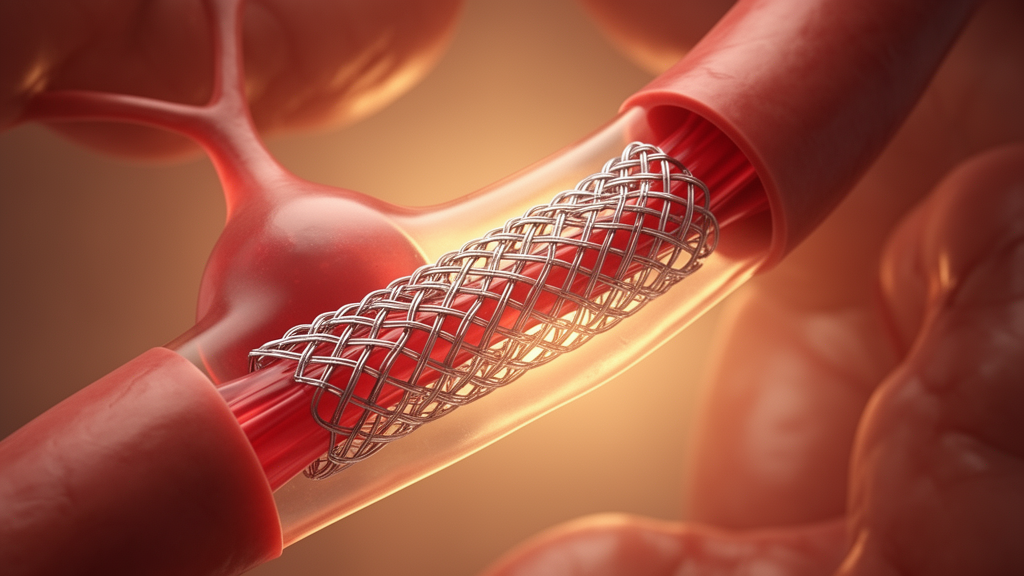
Flow diverter devices mark a distinct paradigm shift in neurointerventional management, moving clinical practice from intrasaccular coil packing toward parent vessel reconstruction. By deploying a high-density braided mesh across the aneurysm neck, the implant alters the hemodynamic interface between the parent artery and the aneurysm sac, promoting intrasaccular thrombosis while providing a scaffold for neointimal endothelial growth that reconstructs the vessel wall. Although endovascular intervention emerged as a primary therapy following the International Subarachnoid Aneurysm Trial, previous clinical literature has focused heavily on short-term outcomes or centered predominantly on a single system, the Pipeline embolization device. The authors sought to resolve these knowledge gaps by analyzing long-term durability, delayed complication patterns, and universal safety profiles across five diverse flow-diverting technologies in real-world practice.
The study protocol received institutional review board approvals from the Scientific and Ethical Committee of Hospices Civils de Lyon and the Comité de Protection des Personnes Est II in Besançon, operating in accordance with the Declaration of Helsinki and the General Data Protection Regulation. Patient selection criteria included large or giant unruptured intradural saccular or fusiform lesions exceeding 10 millimeters, wide-neck aneurysms with dome-to-neck ratios under 2 or neck widths over 4 millimeters, small aneurysms under 3 millimeters unsuitable for coiling, and recurrent aneurysms following prior treatment failure. The study excluded procedures performed prior to February 2011 to eliminate early learning-curve bias and first-generation device effects, interventions after July 2016 to ensure adequate follow-up, cases with pre-existing parent artery stenosis of 50 percent or higher at the intended placement site, and patients unable to tolerate dual antiplatelet therapy.
The treated cohort of 209 patients had a mean age of 54.2 years, with females comprising 78.5 percent of the group. Among the 216 target aneurysms, which exhibited a mean size of 8.4 millimeters, 143 lesions were unruptured, 67 were recanalized following previous treatments, and 6 were ruptured. Anatomically, 91.2 percent arose within the anterior circulation and 8.8 percent in the posterior circulation, specifically distributed across the internal carotid artery in 142 cases, the anterior cerebral artery in 32 cases, the middle cerebral artery in 23 cases, and the posterior circulation in 19 cases. Deployments were performed under general anesthesia via a standardized triaxial femoral approach in all but one patient, who required brachial artery access due to challenging aortic arch anatomy.
Technical execution achieved successful device deployment in 212 of 216 procedures, representing a 98.1 percent procedural success rate against four deployment failures. A total of 258 devices were implanted across the cohort, consisting of 98 Pipeline, 89 SILK, 41 Surpass, 18 p64, and 12 FRED devices. Delivery utilized 0.027-inch microcatheters for Pipeline, Surpass, p64, and FRED systems, and 0.023-inch microcatheters for SILK devices. A single flow diverter was deployed in 181 procedures, while two devices were utilized in 31 procedures, three devices in two procedures, and four or five devices in one procedure each. Access site complications arose in eight procedures, including six subcutaneous hematomas, one retroperitoneal hematoma, and one femoral arteriovenous fistula, all of which resolved with conservative management.
Pharmacological protocols incorporated standardized dual antiplatelet therapy comprising 75 milligrams of clopidogrel and 150 milligrams of aspirin daily, initiated five to seven days before endovascular treatment. Platelet function was systematically evaluated prior to the procedure using VerifyNow P2Y12 and aspirin assays, allowing protocol modifications such as administering abciximab or double-dose clopidogrel for nonresponders, or half-dose clopidogrel for hyper-responders. Dual antiplatelet administration continued for three to six months postoperatively based on intimal hyperplasia and clinical presentation, transitioning thereafter to lifelong aspirin monotherapy. Independent neurologists blinded to procedural execution assessed neurological outcomes via the modified Rankin scale at structured clinical intervals and through supplemental structured telephone interviews.
Periprocedural complications developed in nine patients, with parent artery occlusion occurring in five individuals across the carotid cavernous segment, posterior communicating artery, A1–A2 junction, anterior choroidal artery, and carotid terminus–M1 junction. Five patients presented with symptomatic periprocedural events, resulting in two patients achieving a modified Rankin scale score of zero at discharge, two sustaining permanent morbidity with an mRS score of 3, and one fatality following anterior cerebral artery perforation. Early postprocedural adverse events within thirty days affected thirteen patients, encompassing two transient ischemic attacks, three ischemic events, two parenchymal hemorrhages, one right-sided Terson syndrome, one fatal aneurysm rupture, one fatal brainstem compression, one incomplete Horner syndrome, one presentation of blurred vision with central scotoma, and one case of confusion.
Short-term evaluations between one and twelve months recorded adverse events in three patients, including a parenchymal hemorrhage at three months and two ischemic episodes at three and five months. Four unrelated patient deaths occurred between 9 and 14 months due to pancreatic disease, cardiac stroke, trauma, and contralateral stroke. Between 12 and 18 months post-procedure, midterm complications arose in five of 202 patients, of whom three were symptomatic. These midterm events comprised two ischemic episodes in patients treated with multiple overlapping devices, one delayed rupture at twelve months in a patient exhibiting proximal stent migration within a posterior communicating artery aneurysm, one case of silent intrastent stenosis in a dissecting middle cerebral artery aneurysm managed conservatively, and one unique episode of epileptic seizures developing two weeks after aspirin cessation at one year, which resolved following aspirin resumption.
Long-term clinical data were gathered for 202 patients over a median follow-up of 48 months. Beyond the eighteen-month mark, no procedure-related complications or fatalities occurred, with functional neurological status remaining stable in 201 patients and improving in one individual. Digital subtraction angiography, complemented by magnetic resonance angiography or computed tomography angiography at extended intervals, revealed complete aneurysm occlusion in 81.0 percent of evaluated lesions and adequate occlusion in 93.3 percent at final follow-up. Retreatment was required for eight target aneurysms, using additional flow diverters in seven and coil embolization in one. Among 28 adjacent un targeted aneurysms covered by the stents, 53.6 percent reached occlusion by one year, four exhibited neck recanalization at two to three years, and three maintained persistent filling.
Statistical evaluation identified multiple overlapping flow diverter deployment as the sole independent predictor of delayed complications occurring beyond twelve months. Univariate screening highlighted several potential factors with significance levels below 0.20, including multiple devices, an aneurysm aspect ratio greater than 1.6, intrasaccular thrombus, active smoking, and previous failed treatment. In the final multivariate conditional logistic regression model, multiple device placement demonstrated an odds ratio of 7.066, reflecting a sevenfold elevation in delayed complication risk. Overall procedural mortality remained at 1.4 percent, with device-related major stroke or death dropping from 2.8 percent at thirty days to 0.48 percent at one year and zero percent after eighteen months.
The study authors noted inherent methodological limitations, including the retrospective observational design, the inclusion of single-case presentations such as antiplatelet withdrawal-associated seizures, off-label treatments reflecting real-world clinical practice, and a historical intervention period from 2011 to 2016 preceding recent iterations in device engineering. Nonetheless, the research confirms that durable occlusion and long-term device safety profiles remain consistent across multiple manufacturing platforms. The authors concluded that treatment strategies should prioritize single-device deployment whenever anatomically feasible, while reserving enhanced clinical surveillance and tailored antiplatelet management protocols for complex cases requiring multiple overlapping devices during the initial eighteen-month window.
Subject of Research: Long-term safety, durability, and complication risk factors of intracranial aneurysm flow diverter devices
Article Title: Long-term clinical follow-up of intracranial aneurysms treated with flow diverter devices: a bicentric retrospective study
Article References: Moubark, M., Biondi, A., Othman, M., Findler, M., Vitale, G., & Turjman, F. (2026). Long-term clinical follow-up of intracranial aneurysms treated with flow diverter devices: a bicentric retrospective study. Chinese Neurosurgical Journal, 12(1), Article 10. https://doi.org/10.1186/s41016-026-00429-7
Image Credits: AI Generated
DOI: 10.1186/s41016-026-00429-7
Keywords: intracranial aneurysms, flow diverter devices, endovascular treatment, Pipeline embolization device, SILK stent, Surpass device, p64 flow diverter, FRED device, digital subtraction angiography, delayed aneurysm rupture, intrastent stenosis, dual antiplatelet therapy, modified Rankin scale, parent vessel reconstruction, neurointerventions, Kaplan-Meier analysis, stent migration, cerebral hemodynamics
News Source: Ophelia Keating. (November 13, 2026). Flow Diverters Show Zero Delayed Complications After Eighteen Months in Long-Term Study. Scienmag.