• HOME
  • NEWS
  • EXPLORE
    • CAREER
      • Companies
      • Jobs
    • EVENTS
    • iGEM
      • News
      • Team
    • PHOTOS
    • VIDEO
    • WIKI
  • BLOG
  • COMMUNITY
    • FACEBOOK
    • INSTAGRAM
    • TWITTER
Friday, December 19, 2025
BIOENGINEER.ORG
No Result
View All Result
  • Login
  • HOME
  • NEWS
  • EXPLORE
    • CAREER
      • Companies
      • Jobs
        • Lecturer
        • PhD Studentship
        • Postdoc
        • Research Assistant
    • EVENTS
    • iGEM
      • News
      • Team
    • PHOTOS
    • VIDEO
    • WIKI
  • BLOG
  • COMMUNITY
    • FACEBOOK
    • INSTAGRAM
    • TWITTER
  • HOME
  • NEWS
  • EXPLORE
    • CAREER
      • Companies
      • Jobs
        • Lecturer
        • PhD Studentship
        • Postdoc
        • Research Assistant
    • EVENTS
    • iGEM
      • News
      • Team
    • PHOTOS
    • VIDEO
    • WIKI
  • BLOG
  • COMMUNITY
    • FACEBOOK
    • INSTAGRAM
    • TWITTER
No Result
View All Result
Bioengineer.org
No Result
View All Result
Home NEWS Science News

Flies and bees act like plant cultivators

Bioengineer by Bioengineer
March 14, 2017
in Science News
Reading Time: 2 mins read
0
Share on FacebookShare on TwitterShare on LinkedinShare on RedditShare on Telegram
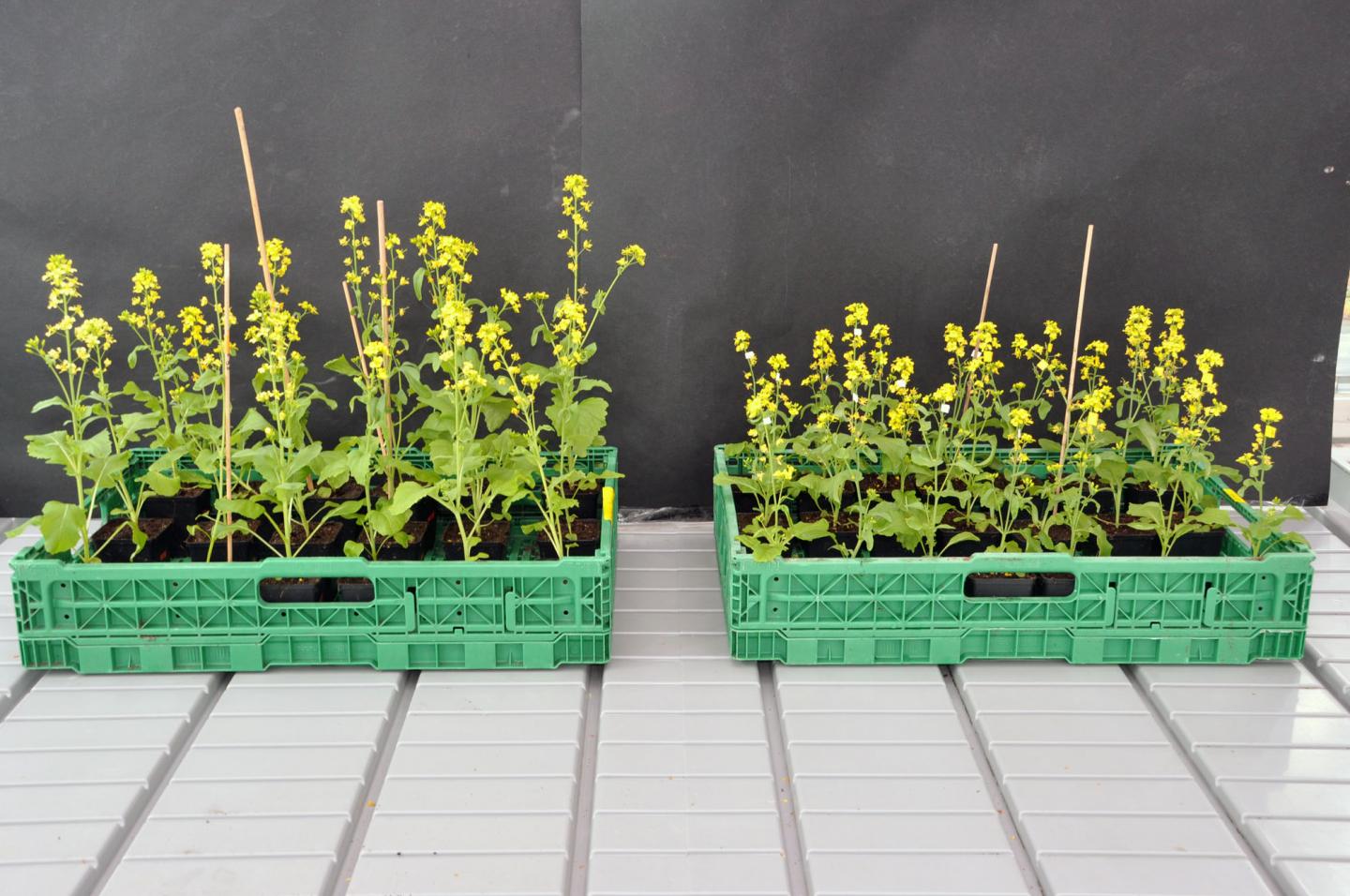
IMAGE

Credit: UZH

Not much plant sex happens without pollinator insects: Bees, flies or butterflies transfer the male pollen grains to the stigma of a plant's female style, thereby ensuring its sexual reproduction. Researchers from the Department of Systematic and Evolutionary Botany at the University of Zurich now reveal that pollinator insects also have a surprisingly strong influence on plant evolution.

Plants pollinated by bumblebees become more fragrant

For their experiment, UZH professor Florian Schiestl and doctoral student Daniel Gervasi used field mustard – a kind of cabbage species and a close relative of oilseed rape. The researchers allowed one plant group to be pollinated solely by bumblebees for nine generations, another only by hoverflies and a third by hand. Afterwards they analyzed the plants, "which differed greatly," as Florian Schiestl explains. The plants pollinated by bumblebees were larger and had more fragrant flowers with a greater UV color component, which bees and their relatives see. The plants pollinated by hoverflies, on the other hand, were smaller, their flowers were less fragrant and they self-pollinated considerably more. According to Schiestl, the mechanism of evolutionary change is fact that different pollinators differ in their preferences and thus preferentially cross-pollinate specific plant individuals, much like a plant breeder using individuals with favorable properties. The flies' considerably lower pollination efficiency is the cause of the increase in self-pollination. The plants essentially help themselves if the pollinator transfers too little pollen.

Pollinator insects hasten plant evolution

The fact that the plants change so significantly already after nine generations came as a surprise to the researchers: "The traditional assumption is that evolution is a slow process," explains Schiestl. The evolutionary biologist from UZH draws the following conclusion from his results: "A change in the composition of pollinator insects in natural habitats can trigger a rapid evolutionary transformation in plants." This is particularly interesting as certain pollinator insects such as bees have been vastly decimated by the extensive use of pesticides and the depletion of the landscape in recent decades. According to Schiestl, it would thus be conceivable for plants to increasingly rely on flies as pollinators, which would result in the evolution of weaker flower fragrances and more self-pollination. In the longer term, this would reduce a plant population's genetic variability and the plants would become more susceptible to disease.

###

Literature:

Daniel Gervasi, Florian Schiestl. Real-time divergent evolution in plants driven by pollinators. Nature Communications. March 14, 2017. DOI: 10.1038/NCOMMS14691

Contact:

Prof. Florian Schiestl

Department of Systematic and Evolutionary Botany

University of Zurich

Phone: +41 44 634 84 09

E-mail: [email protected]

Media Contact

Dr. Florian Schiestl
[email protected]
41-446-348-409
@uzh_news

http://www.uzh.ch

############

Story Source: Materials provided by Scienmag
Share12Tweet8Share2ShareShareShare2

Related Posts

Optimizing Polyhydroxybutyrate from Waste Oil: Economic Insights

Optimizing Polyhydroxybutyrate from Waste Oil: Economic Insights

December 19, 2025

Connecting Individual and Community Health Insights: A Study

December 19, 2025

RECQL4 Mutations Impact Helicase Function and Chemotherapy Response

December 19, 2025

Assessing ICU Nurses’ Nutritional Care Skills in China

December 19, 2025
Please login to join discussion

POPULAR NEWS

  • Nurses’ Views on Online Learning: Effects on Performance

    Nurses’ Views on Online Learning: Effects on Performance

    70 shares
    Share 28 Tweet 18
  • NSF funds machine-learning research at UNO and UNL to study energy requirements of walking in older adults

    70 shares
    Share 28 Tweet 18
  • Unraveling Levofloxacin’s Impact on Brain Function

    53 shares
    Share 21 Tweet 13
  • MoCK2 Kinase Shapes Mitochondrial Dynamics in Rice Fungal Pathogen

    72 shares
    Share 29 Tweet 18

About

We bring you the latest biotechnology news from best research centers and universities around the world. Check our website.

Follow us

Recent News

Optimizing Polyhydroxybutyrate from Waste Oil: Economic Insights

Connecting Individual and Community Health Insights: A Study

RECQL4 Mutations Impact Helicase Function and Chemotherapy Response

Subscribe to Blog via Email

Success! An email was just sent to confirm your subscription. Please find the email now and click 'Confirm' to start subscribing.

Join 70 other subscribers
  • Contact Us

Bioengineer.org © Copyright 2023 All Rights Reserved.

Welcome Back!

Login to your account below

Forgotten Password?

Retrieve your password

Please enter your username or email address to reset your password.

Log In
No Result
View All Result
  • Homepages
    • Home Page 1
    • Home Page 2
  • News
  • National
  • Business
  • Health
  • Lifestyle
  • Science

Bioengineer.org © Copyright 2023 All Rights Reserved.