Structural researchers have formulated a mechanics-based flexure-shear coupling framework capable of predicting the progressive deformation of ultra-high performance concrete beams subjected to concentrated shear loading. Ultra-high performance concrete provides exceptionally high compressive strength, superior tensile toughness, and minimal permeability compared to conventional concrete mixtures. Within structural elements, embedded steel fibers arrest crack opening and bridge newly formed fractures, substantially enhancing cracking resistance, sectional stiffness, and structural ductility. While traditional engineering frameworks reliably predict flexural deflections using established beam theories, predicting shear deformations in concrete members has historically posed significant difficulties due to diagonal crack growth, continuous stiffness deterioration, and complex interactions between shear and flexural forces. By incorporating fiber bridging mechanics into both transformed cross-section stiffness calculations and post-cracking truss deformations, the newly developed analytical method provides an integrated procedure to track structural deflections from the onset of matrix cracking up to ultimate failure.
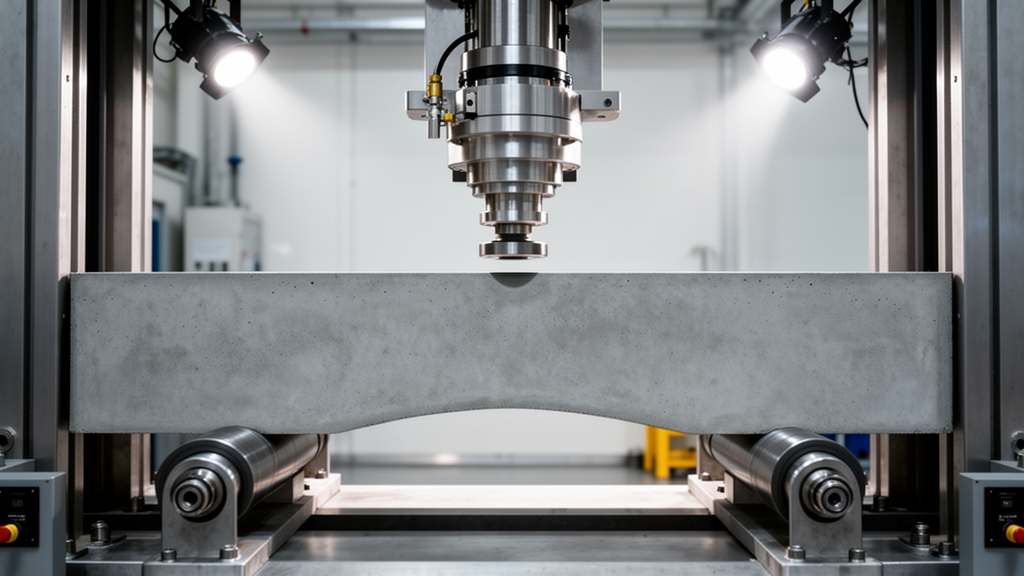
To establish and validate the theoretical framework, the research team conducted experimental investigations on seven simply supported ultra-high performance concrete beams subjected to three-point loading across a 1200 mm clear span with an identical shear span of 600 mm. All test members shared a consistent rectangular cross-section measuring 150 mm in width and 300 mm in total depth. The experimental program was systematically designed to examine the effects of steel fiber volume fractions ranging from 0% to 3%, transverse stirrup ratios spanning from 0% to 0.75%, and longitudinal reinforcement ratios varying between 1.5% and 6.3%. Beam-1 was fabricated without stirrups or steel fibers, while Beam-2, Beam-3, and Beam-5 maintained identical geometric dimensions, stirrup spacings of 100 mm corresponding to a stirrup ratio of 0.38%, and longitudinal reinforcement ratios of 4.2%, varying exclusively in steel fiber dosages from 1% to 3%. To ensure that shear failure mechanisms preceded flexural yielding, longitudinal reinforcement was proportioned in accordance with strong flexure-weak shear principles.
The material matrix comprised ordinary Portland cement, silica fume with a specific surface area between 15 and 27 m²/g, quartz sand sized between 0.045 and 2 mm with a silica content exceeding 99.7%, water, and a polycarboxylate superplasticizer providing 30% to 40% water reduction. Straight, smooth steel fibers measuring 7 mm in length and 0.18 mm in diameter were incorporated into the mixes. Material characterization tests conducted concurrently on ambient-cured specimens revealed compressive strengths of 82.5 MPa, 110.4 MPa, 115.7 MPa, and 124.9 MPa for mixtures containing 0%, 1%, 2%, and 3% steel fibers, respectively. Direct tensile testing of dog-bone specimens yielded tensile strengths of 2.22 MPa for the plain mixture, increasing progressively to 4.38 MPa, 4.77 MPa, and 5.63 MPa as fiber content reached 1%, 2%, and 3%. Longitudinal tension reinforcement consisted of HRB500 steel bars with diameters of 20 mm and 25 mm, exhibiting average yield strengths of 543.8 MPa and 543.0 MPa, while two-legged 6 mm diameter HRB400 stirrups exhibited an average yield strength of 423.4 MPa and an ultimate tensile strength of 628.4 MPa.
During loading tests, all seven beam specimens failed in classic shear-compression modes characterized by concrete crushing within the compressive zone near the loading point alongside stirrup yielding across the primary inclined crack. In plain concrete specimen Beam-1, an initial flexural crack appeared at mid-span under an applied load of 31 kN, followed by the nucleation of a critical diagonal shear crack at 89 kN that rapidly widened to 2 mm at 112 kN before triggering complete shear-compression collapse at 120 kN. In contrast, specimens reinforced with steel fibers developed multiple, densely spaced fine diagonal cracks with substantially reduced crack widths. In specimen Beam-6, which contained 3% steel fibers and a 0.25% stirrup ratio, an initial flexural crack formed at 125 kN, while the primary diagonal shear crack emerged only when the load reached 348 kN. Dense crack networks distributed across the shear span continued widening until critical shear cracking and localized concrete cover spalling culminated in ultimate failure at 873 kN.
Experimental load-deflection measurements demonstrated that the structural response of the ultra-high performance concrete beams progressed through three characteristic stages: an initial linear elastic segment, a post-cracking working segment, and a post-peak softening phase. Prior to cracking, sectional stiffness remained stable and was predominantly governed by the concrete matrix. After cracking initiated, embedded steel fibers restrained crack propagation through crack-bridging and pull-out mechanisms, mitigating rapid stiffness degradation and preventing brittle collapse. Comparing Beam-2, Beam-3, and Beam-5 demonstrated that increasing fiber volume fractions from 1% to 3% increased ultimate shear resistance from 303 kN to 463 kN, representing a 52.8% capacity enhancement, while peak mid-span deflection increased from 4.64 mm to 9.09 mm, an increase of 95.9%. Furthermore, reducing stirrup spacing from 200 mm in Beam-7 to 150 mm in Beam-6 increased ultimate capacity from 364 kN to 436 kN, confirming that fibers and transverse stirrups establish a cooperative resistance system that stabilizes post-peak load carrying.
Stirrup strain measurements captured along the shear span revealed three distinct behavioral regimes separated by two distinct slope transition points. In the initial loading phase prior to diagonal cracking, stirrups experienced minimal stress, recording only slight compressive strains induced by localized bearing stresses near the support and loading point. Following the onset of diagonal cracking, shear transfer across the concrete matrix was partially interrupted, inducing a sudden increase in stirrup tensile strains as force transferred across open crack interfaces while fiber bridging simultaneously shared a portion of the applied shear demand. As loading progressed toward ultimate capacity, bridging fibers progressively debonded and pulled out, shifting dominant shear resistance onto the transverse reinforcement until stirrup steel reached its yield plateau. Higher steel fiber dosages substantially delayed the rate of stirrup strain accumulation, enabling specimens to sustain additional shear force even after transverse reinforcement yielded.
To model this coupled response analytically, the total beam deflection was decoupled into flexural and shear deformation components. Flexural deformations were calculated using classical deflection differential equations combined with an effective moment of inertia formulation. To incorporate fiber reinforcement into the transformed cross-section, the spatial stochastic distribution of fibers was integrated up to a maximum effective pullout inclination angle of π/3, avoiding numerical singularities and experimental overestimations. This derivation yielded an equivalent transformed fiber area per unit crack interface of 0.49 times the fiber volume fraction Vf. Consequently, the transformed cracked cross-section accounted directly for residual tensile stresses sustained by fibers crossing the crack plane. Transition between uncracked and fully cracked sectional stiffness was evaluated using the empirical effective moment of inertia equation from ACI 318-11, defining beam short-term flexural stiffness under varying bending moments.
Shear deformations were modeled using a combination of elastic shear mechanics and a variable-angle truss model formulated via the virtual work principle. In the uncracked elastic regime, shear deformation was computed using gross cross-sectional area and an elastic shear modulus derived from cube compressive strength. Following diagonal crack initiation, post-cracking shear stiffness was calculated from the virtual work done by tension ties and inclined compression struts within an infinitesimal beam segment. The tensile tie explicitly combined the mechanical resistance of transverse stirrups and bridging steel fibers. To account for direct compressive force transfer, total shear resistance was partitioned into truss action and arch action using an arch-action coefficient α, where the shear carried by arch action was defined as αV and the remaining portion (1-α)V was allocated to truss action. A simplified regression formula expressed α as a function of stirrup ratio, longitudinal reinforcement ratio, and fiber content.
Evaluation of ultimate shear strength combined concrete shear-compression contributions, transverse stirrup tension, and fiber tensile stresses across inclined cracks using a modified Bresler octahedral stress failure criterion. The cracking shear load Vcr, which governs the onset of post-cracking shear stiffness degradation, was determined via empirical regression based on an experimental database of 57 ultra-high performance concrete beams compiled from published literature, covering compressive strengths between 93.4 and 164.8 MPa, fiber contents between 1% and 3%, and shear span-to-depth ratios from 1.5 to 4.5. Because shear capacity interacts with internal stress distributions, an iterative computational procedure was implemented to converge predicted shear strength within a relative error tolerance of 0.1%, subsequently calculating total cracking and ultimate mid-span deflections through equivalent superposition of flexural and shear components.
Validation against experimental data from the authors’ tests and external published studies demonstrated close overall agreement across evaluated structural metrics. For cracking shear capacity, the model achieved an average predicted-to-measured ratio of 1.08 with a coefficient of variation of 0.10, while cracking deflection exhibited an average ratio of 0.99 with a coefficient of variation of 0.13. Predictions for ultimate shear capacity demonstrated the highest consistency, yielding an average ratio of 1.02 with a coefficient of variation of 0.05, and ultimate mid-span deflections averaged a prediction ratio of 1.04 with a coefficient of variation of 0.10. While individual specimens exhibited localized scatter in cracking thresholds due to material heterogeneity and crack detection variations, the model showed no systematic bias across fiber contents, shear span ratios, or stirrup ratios within the investigated ranges.
Subject of Research: Deformation analysis and flexure-shear modeling of ultra-high performance concrete beams
Article Title: Deformation analysis of UHPC beams under shear loading: A flexure-shear coupled method
Article References: Wang, Z., Zhang, C., Cao, Z., Liang, X., Weng, X., & Zhang, J. (2026). Deformation analysis of UHPC beams under shear loading: A flexure-shear coupled method. Case Studies in Construction Materials, 25, Article e06713. https://doi.org/10.1016/j.cscm.2026.e06713
Image Credits: AI Generated
DOI: 10.1016/j.cscm.2026.e06713
Keywords: ultra-high performance concrete, shear deformation, flexure-shear coupling, steel fibers, crack bridging, variable-angle truss model, virtual work principle, arch action, beam action, stirrup ratio, transformed section, shear capacity, diagonal cracking, structural testing, stiffness degradation, reinforced concrete
News Source: Denise Maddox. (November 12, 2026). Flexure Shear Model Predicts Ultra High Performance Concrete Beam Deformation Under Load. Scienmag.