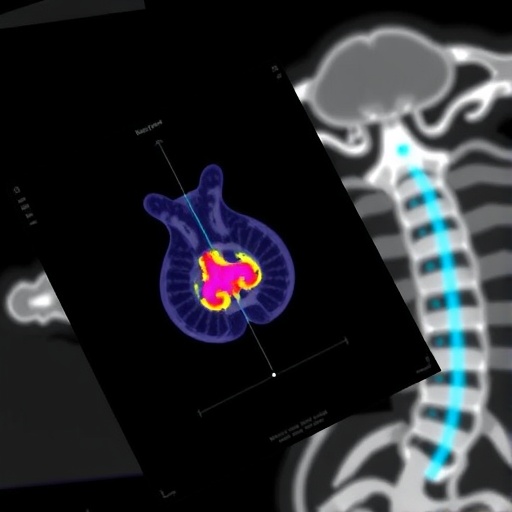
In the rapidly evolving landscape of surgical technologies, a groundbreaking development has emerged from the collaborative efforts of researchers Kim K.Y., Ryu J., Kang J., and their colleagues, as described in their recent 2026 publication in npj Flexible Electronics. This new innovation centers on a conformable multimodal imaging marker, poised to revolutionize surgical navigation systems by enhancing precision, safety, and adaptability during complex procedures. The implications of this advancement extend far beyond conventional imaging, addressing core challenges surgeons face in real-time visualization and navigation within the human body.
At the heart of this breakthrough lies the concept of conformability, which introduces a flexible and adaptive interface between the imaging marker and the patient’s anatomical structures. Unlike traditional rigid markers that often compromise comfort and accuracy, this new design seamlessly conforms to irregular surfaces and dynamic tissue movements. This capability ensures that imaging data remain consistent and reliable throughout surgical interventions, even in minimally invasive environments, where spatial constraints and tissue deformation pose significant obstacles.
This conformable multimodal imaging marker leverages a sophisticated integration of various imaging modalities, including optical, electromagnetic, and acoustic signals. Each modality contributes unique information: optical signals offer high-resolution surface detail, electromagnetic markers provide spatial orientation data, and acoustic waves assist in visualizing subsurface structures. The fusion of these modalities into a single marker presents an unprecedented multidimensional imaging capability, granting surgeons a comprehensive, multispectral view of the operative field.
One of the paramount challenges in surgical navigation is achieving both spatial accuracy and real-time feedback. The researchers address this by embedding ultra-thin sensors and microelectronic components within a flexible substrate, enabling high fidelity tracking without compromising the marker’s conformability. These embedded systems operate wirelessly, reducing cumbersome connections and significantly lowering the risk of contamination or obstruction during surgery. This wireless communication also supports instantaneous data transfer to external displays, allowing surgeons to adjust their techniques dynamically.
The materials science behind this innovation draws heavily upon advances in bio-compatible polymers and nanomaterials. By employing elastomers with tailored mechanical properties and conductive inks printed via flexible electronics techniques, the researchers have engineered a device that behaves like a second skin. This bio-mimetic characteristic not only enhances patient comfort but also minimizes inflammatory responses and the risk of allergic reactions, thereby fostering safer clinical outcomes.
Furthermore, the marker’s multimodal imaging capability is augmented by an intelligent algorithmic framework capable of interpreting diverse data streams. Machine learning models embedded in the surgical navigation system extract meaningful patterns from the complex datasets, enabling adaptive calibration and predictive analytics. For instance, the system can anticipate tissue shifts due to respiration or surgical manipulation, adjusting the marker’s spatial coordinates in real time to maintain alignment with preoperative scans.
The application scope for this conformable multimodal imaging marker is vast, spanning neurosurgery, cardiovascular interventions, and oncological resections. In neurosurgery, where millimeter accuracy can dictate patient outcomes, the device dramatically improves the surgeon’s ability to localize critical neural pathways. Cardiologists benefit from enhanced guidance during minimally invasive catheterizations, while oncologists gain more precise tumor localization to maximize resection margins and preserve healthy tissue.
Clinical trials of the device have demonstrated remarkable improvements in procedure times and reduction in intraoperative imaging errors. Surgeons reported increased confidence and better ergonomic workflow when utilizing the flexible marker compared to conventional rigid markers. Additionally, patient feedback indicated lower postoperative discomfort associated with the use of these minimally intrusive devices, highlighting their potential for broader adoption in routine surgical practice.
The integration of this conformable marker within existing surgical navigation frameworks was intentionally designed to be seamless. Standard protocols and hardware interfaces do not require extensive modifications, ensuring that hospitals can adopt the technology with minimal disruption. This plug-and-play nature facilitates faster translation from experimental validation to commercial availability, a critical factor in accelerating the pace at which such innovations reach clinical patients.
Beyond immediate clinical benefits, this technology also sets a precedent for the future of smart surgical tools. The convergence of flexible electronics, multimodal imaging, and AI-driven data analysis encapsulates a paradigm shift toward more autonomous surgical assistance. Future iterations may incorporate nanoscale sensors capable of biochemical analysis, offering surgeons not only spatial but also molecular information during operations.
Environmental considerations were not overlooked. The device architecture incorporates biodegradable components for certain disposable sections, aiming to reduce medical waste—a significant concern in modern healthcare ecosystems. This thoughtful approach balances cutting-edge performance with sustainability, reinforcing the social responsibility embedded in the researchers’ vision.
The significance of this advancement can also be appreciated in the context of global health disparities. By enhancing the accessibility and ease of use of surgical navigation systems, this technology promises to democratize advanced surgical care in resource-limited settings. Its adaptable design can be customized for diverse anatomical and procedural requirements, supporting a wide range of healthcare providers worldwide.
Looking ahead, the potential for integrating this imaging marker with augmented reality (AR) and virtual reality (VR) platforms opens new horizons in surgical education and intraoperative guidance. Surgeons could leverage holographic projections aligned perfectly with patient anatomy, supported by the highly accurate positional data provided by this flexible marker. Such synergies may redefine the limits of human-machine collaboration in the operating theater.
In conclusion, the conformable multimodal imaging marker introduced by Kim et al. embodies a fusion of interdisciplinary innovation, addressing longstanding challenges in surgical navigation. By enhancing the precision, comfort, and interoperability of imaging markers, this technology paves the way for safer, faster, and more effective surgeries across multiple specialties. Its ripple effects will indubitably extend into training, patient outcomes, and healthcare accessibility, marking a pivotal moment in the evolution of surgical technology.
Subject of Research: Surgical Navigation Systems and Multimodal Imaging Markers
Article Title: A conformable multimodal imaging marker for surgical navigation systems
Article References:
Kim, K.Y., Ryu, J., Kang, J. et al. A conformable multimodal imaging marker for surgical navigation systems. npj Flex Electron (2026). https://doi.org/10.1038/s41528-025-00525-1
Image Credits: AI Generated
Tags: adaptable imaging solutionsanatomical structure mappingcollaborative research in healthcareconformable imaging systemsenhancing surgical safetyflexible multimodal imaging markerinnovative surgical technologiesminimally invasive surgery toolsmulti-signal imaging integrationprecision in surgeryreal-time surgical visualizationsurgical navigation technology