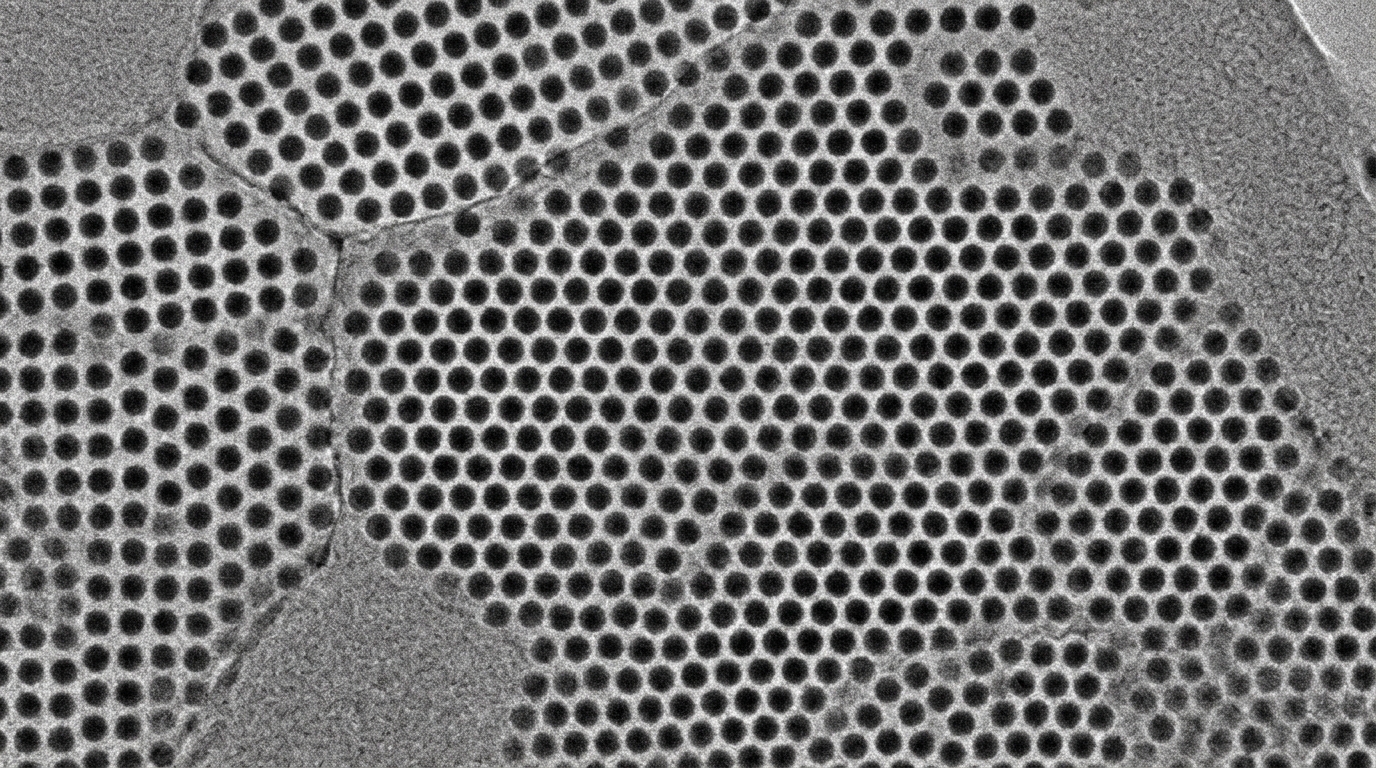
Researchers at the Massachusetts Institute of Technology have developed a new way to control how nanoparticles assemble into larger materials, and the trick is to make the connectors between them as floppy as possible. The approach, described in a paper set to appear in Nature Materials, uses highly flexible linker molecules that deform in response to their surroundings, allowing the team to tune the structure of nanoparticle networks and build crystal arrangements that had not been seen before.
For two decades, the dominant thinking in nanoparticle assembly has been that the molecules linking particles together must be rigid. Stiff connectors hold particles at precise angles, which helps researchers lock in a desired structure. But rigidity comes at a cost: it constrains the kinds of materials that can be formed and makes the synthesis difficult to scale up. The MIT-led team took the opposite view. Instead of engineering the connectors to point in fixed directions, they made them so flexible that their initial orientation no longer matters, and the connectors reorganize themselves as the particles come together.
“People are interested in nanoparticle superlattices because of the promise of building designer materials where you have more say in what types of structures they can actually build into,” says Rob Macfarlane, the Richard P. Simmons (1953) Professor in Metallurgy in MIT’s Department of Materials Science and Engineering. “This is a new approach in nanoparticle assembly that hasn’t been investigated before. It’s exciting to have a new tool that is so counterintuitive. It’s the exact opposite of what the dogma has been for 20 years: that you need to make connector ligands rigid, and any deviation causes assembly to fail. We showed if you just crank it all the way to the opposite extreme, it works just as well.”
The underlying principle is a foundational one in materials science: a material’s structure governs its function. If researchers know what the building blocks are and how they are arranged, they can explain and, in principle, design the properties the material will have. Nanoparticles are attractive building blocks because their shapes and sizes can be customized, and individual nanoparticles are already used in applications ranging from drug delivery and energy storage to computing and sensing. The difficulty has always been assembling them into larger structures, because nanoparticles tend to pack together very tightly.
Previous strategies for controlling that assembly have relied on changing the shapes of the particles themselves or making only specific parts of their surfaces sticky so they connect in particular patterns. Macfarlane notes that both approaches are hard to carry out synthetically. The methods for defining surface stickiness, he says, are always bespoke: they work for one material, at one size scale, in one condition, which is useful for studying a system but not for doing much with it. Both strategies also require the connector molecules, called ligands, on the particle surfaces to be rigid so they hold the specific angles needed to maintain the intended formation, further limiting what the resulting materials can do.
The new system flips that logic. The nanoparticles in the study carry flexible polymer ligands whose tips are electrically charged, some positively and some negatively. Because opposite charges attract, the ligands bend in order to connect with partners of the opposite charge. “We thought, ‘Let’s do the exact opposite: make the bonds so flexible it doesn’t matter what direction they’re initially pointing.’ The ligands can then reorganize as the particles come together, and that reorganization itself limits how many neighbors each particle can bind,” Macfarlane says. In other words, the flexibility of the connectors is not a flaw to be engineered away; it is the very mechanism that regulates how the network forms.
“The idea is, instead of defining a specific direction the bonds are going to occur in with complicated synthesis methods, we just said, ‘The bonds are going to be as flexible as they want to be, and they’ll spontaneously go to whatever valency is going to maximize bond stability,’” Macfarlane says. Valency, the number of connections each particle makes, is normally fixed by design choices made before assembly begins. Here, it emerges on its own: the amount of flexibility of the polymer dictates how many bonds each particle forms. That gives the researchers a dial they can turn simply by changing the sizes of the nanoparticles and the lengths of the ligand chains.
In experiments led by Nicholas Sbalbi, an MIT PhD candidate and the paper’s lead experimentalist, the researchers demonstrated that they could control the connections in this way and used the technique to assemble nanoparticles into previously unseen crystal structures. “Without having to predesign where the particles connect or what their shapes are, we can control the number of bonds each particle has,” Macfarlane explains. “It allows us to lower the number of bonds each particle has and make lattices we have never seen before.” Lowering the connectivity is what breaks the dense-packing limit that has constrained nanoparticle assembly, opening the door to more open, less crowded architectures.
That matters because densely packed nanoparticle arrays, while useful, restrict what the materials can be used for. “Nanoparticle superlattices offer a way to create designer materials where your building blocks have all sorts of unique properties,” Macfarlane says. “But just densely packing these nanoparticles together limits your applications. This offers a way to get less dense formations of nanoparticles, and that’s where a lot of the interesting applications are.” The team says the approach could offer a more versatile route to high-performing materials for photonics, chemical catalysis, medicine, agriculture and other fields, since it establishes ligand flexibility as a path to material structures that can be customized at scale.
Macfarlane believes the system is a step toward getting custom nanoparticle-based materials out of the research lab and into the world. Researchers in the nanoparticle assembly community have long spoken of having completely independent control over what a particle is and what assembly it goes into, he notes, but in reality that has not been achieved. The work was supported in part by the National Science Foundation, the Department of Energy, the U.S. Army and the U.S. Navy. Alongside Sbalbi, the paper’s co-authors include University of Delaware doctoral student Stephen Kronenberger, MIT undergraduate Hana Shinzawa, Matthew Ye PhD ’26, and former University of Delaware professor Arthi Jayaraman.
Subject of Research: Controlling nanoparticle assembly with flexible ligands to create tunable superlattice materials
Article Title: A flexible new route to designer materials built from nanoparticles
Article References: A flexible new route to designer materials built from nanoparticles. Original publication (Bibliographic details unavailable.)
Image Credits: AI Generated
DOI: Not provided
Keywords: nanoparticles, nanoparticle assembly, superlattices, ligand flexibility, materials science, MIT, Nature Materials, photonics, chemical catalysis, drug delivery, crystal structures, polymer ligands
News Source: Neil Sanderson. (November 8, 2026). Flexible molecular links let nanoparticles assemble into new crystal structures. Scienmag.