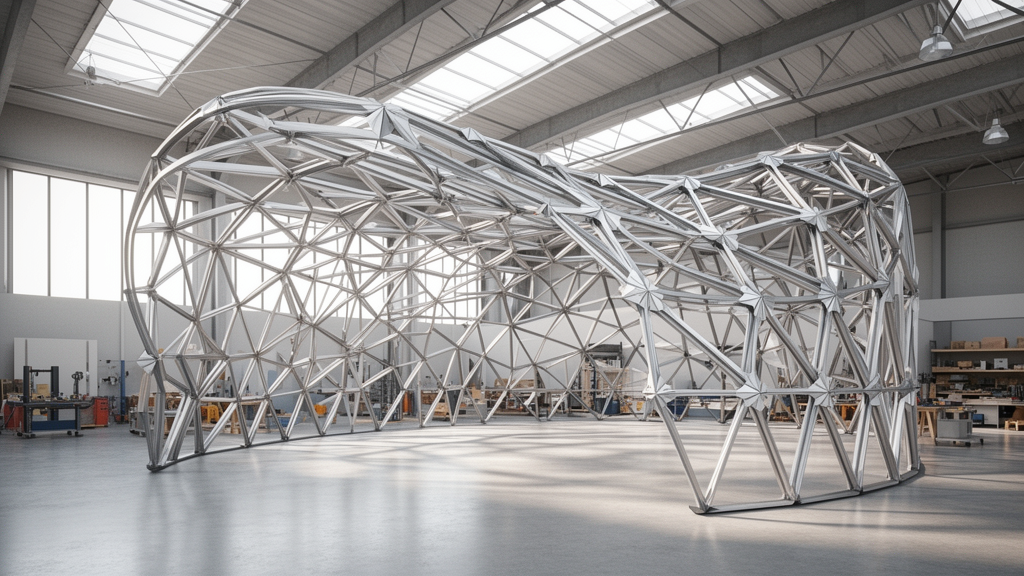
Researchers Ting-Uei Lee, Yuanpeng Liu, and Yi Min Xie have introduced an origami-inspired engineering method to design and construct flat-foldable nodes for free-form space frame structures. In an investigation published in Architectural Intelligence, the authors demonstrated that compliant curved-crease mechanisms allow two-dimensional sheet components to transform into functional three-dimensional connectors with predetermined member directions. Free-form architectural space frames enable visually striking enclosures but traditionally depend on complex solid joints with irregular spatial angles, resulting in high fabrication and assembly costs. By replacing customized solid connectors with flat-foldable compliant sleeves, the proposed system enables non-specialists to erect complex spatial assemblies using simple folding procedures. The thin-walled nodes feature an internal self-locking mechanism that activates once the component reaches its target three-dimensional geometry, preventing unfolding and establishing a secure connection when reinforced by inserted structural members. Physical prototypes and numerical models confirmed that the folding process remains predictable and geometrically stable across diverse structural configurations.
Space frame structures function as three-dimensional networks of straight linear members intersecting at geometric nodes that together define the overall architectural form. Free-form architectural surfaces characterized by double curvature require custom three-dimensional nodes that demand specialized manual labor and expensive manufacturing techniques. In standard practice, generating free-form structures begins by discretizing a surface into a polygonal mesh of n-gonal faces, each associated with distinct multi-directional joint geometries. Previous research has explored simplifying panel complexity to ease fabrication, as well as rationalizing nodes through fixed-direction Zometool systems, spherical nodes with multi-angle hole patterns, specialized meshes with curved members, or clustering algorithms that group nodes into similar geometric families. However, clustered and customized connectors remain complex three-dimensional solids that typically require additive manufacturing. Although metal additive manufacturing has progressed, printing large volumes of custom nodes for full-scale building systems remains expensive and commercially unfeasible, keeping many previous designs confined to small-scale demonstrations.
Origami-inspired techniques offer an alternative pathway by utilizing flat sheet materials that transform into intricate spatial structures along predefined crease patterns. Folding sheet components provides significant logistical benefits, enabling flat packaging, compact shipping, and efficient job-site storage before final deployment. In structural engineering, origami systems are broadly divided into rigid mechanisms, where flat facets pivot strictly along creases without material bending, and compliant mechanisms, which rely on elastic material deformation during transformation. Compliant mechanisms that incorporate curved-crease patterns induce large elastic bending across facets, yielding lighter, simpler, and more efficient transformations than rigid counterparts. Because thin bent sheets naturally tend to spring back toward an unbent state, integrating a self-locking mechanism is necessary to preserve the target three-dimensional shape without permanent external restraints. The authors achieved self-locking through a geometric collision mechanism, where component boundaries contact one another upon reaching the desired three-dimensional profile, physically preventing further displacement.
To design the physical nodes, the researchers formulated a parametric modeling procedure within Rhino-Grasshopper using an extension of the mirror reflection method. Applying a mirror plane to a linear shell with a uniform arc curvature defined by a semicircle of diameter D generates the base curved-crease origami geometry. Under this reflection, the mirror plane angle eta_A and the resulting edge angle theta_A obey the mathematical relationship where theta_A equals pi minus two eta_A. Two additional components are then integrated with the base curved-crease geometry to produce a multi-piece compliant mechanism that maintains flat-foldability. Assembling two of these compliant mechanisms creates the complete four-branch node, which features a central main branch and two lateral sub-branches containing circular apertures for structural members. The target geometry of the assembled node is governed by nine fundamental parameters: the circular aperture diameter D, four branch edge lengths designated L_1 through L_4, and four edge angles designated theta_A, theta_a, theta_B, and theta_b.
The structural node incorporates two strict geometric constraints: planarity and straightness. To satisfy these design criteria, the sum of all four edge angles must equal two pi radians, while the pairwise sums of theta_A plus theta_a and theta_B plus theta_b must each equal pi radians. These mathematical relationships simplify three-dimensional node construction into a two-dimensional geometric problem defined by four coplanar lines. Planarity guarantees that the connected member axes reside within a single geometric plane, while the straightness requirement forces one diagonal pair of lines to form an unbroken 180-degree straight line, establishing a continuous straight main branch. Mirror reflection ensures developability across the out-of-plane curved surfaces, allowing components to be manufactured directly from flat sheet materials. Because the angular equations enforce strict dependencies, choosing angles theta_A and theta_B automatically fixes complementary angles theta_a and theta_b, giving designers direct control over sub-branch directions while preserving developability and planarity across varying node geometries.
Transforming the node from a flat sheet into a spatial sleeve requires carefully tailored kinematic boundary conditions. If all folding creases acted as continuous hinges, sub-branches attached to the main branch would remain kinematically locked. To enable transformation, the researchers disconnected one curved hinge on each sub-branch, leaving each sub-branch connected to the main branch by a single curved hinge. In its initial flat state, the node lies in a two-dimensional plane. Applying edge compression bends the main branch, causing the sub-branches to flex and rotate around their curved hinges while a visible gap opens along the disconnected boundary. When edge compression drives the node into its target configuration, this gap closes completely as sub-branch edges collide with the main branch, preventing further deformation through contact interference. The folding motion closely mimics a single-degree-of-freedom variation of the classic Miura pattern, restricting elastic deformation to pure bending. Once the target state is reached, rigid circular members are inserted into the openings, securing the closed geometry and reinforcing self-locking without requiring fasteners or adhesives.
By selectively omitting or shortening individual branches from the base four-branch geometry, the design achieves vertex valences of two, three, and four. Valence-two nodes are formed by removing one sub-branch and utilizing only two holes, which allows designers to introduce kinks along polylines whose angles depend on theta_A, or create three-dimensional spatial polylines by rotating nodes around connected members. Valence-three nodes feature two distinct geometric variations. Type A retains a straight main branch with one lateral sub-branch, making it well-suited for ruled surfaces like cones, cylinders, and tangential surfaces where line rulings follow the straight main branch and sub-branches bridge adjacent rulings. Type B omits the straightness constraint by utilizing only one hole on the main branch while keeping both sub-branches, facilitating hexagonal grids and non-planar hexagonal networks. Finally, valence-four nodes employ all four openings simultaneously, requiring strict adherence to both planarity and straightness constraints to assemble quadrangle-based structural space frames.
To verify whether arbitrary input meshes satisfy these design constraints, the researchers created a computational optimization tool implemented in C# as a plugin for Rhino-Grasshopper. Solved using the nonlinear conjugate gradient method on a personal computer equipped with an Intel Core i7-7700HQ processor and 8 GB of memory, the tool identifies mesh vertices, counts neighboring members to establish vertex valence, and evaluates nodes accordingly. The optimization objective minimizes an error function combining planarity error E_p and straightness error E_s multiplied by corresponding weighting factors omega_p and omega_s. Planarity error E_p is calculated using least squares fitting, summing the squared perpendicular distances between each node and its neighbors relative to the node best-fit plane. Straightness error E_s evaluates valence-four nodes by determining which opposing edge pair is closer to forming a straight line and minimizing its squared deviation from pi radians. Numerical evaluations demonstrated that the optimization drove the total residual error E below 1E-13, approaching machine precision across evaluated mesh models.
The investigation showed that double-ruled surfaces naturally satisfy the planarity and straightness constraints required by valence-four nodes. In double-ruled geometries, two intersecting families of straight rulings define the surface, meaning every node naturally inherits straight main branches along rulings, while the intersection of two straight lines ensures nodal planarity. Fundamentally, only three doubly ruled geometries exist: planes, hyperbolic paraboloids, and single-sheeted hyperboloids. Physical prototypes constructed for hyperbolic paraboloid and single-sheeted hyperboloid models validated these properties. When running the optimization tool on these analytical surfaces, no geometry changes occurred, confirming that they naturally adhere to the node requirements. The authors also extended the concept to connected ruled surfaces by stacking hyperbolic paraboloid layers to construct a helicoid. In this assembly, each node possesses one straight main branch along a ruling while sub-branches follow the local tangent plane. Testing an assembled helicoid network containing 121 nodes and 220 members took less than one second to optimize without altering node geometry, confirming computational efficiency.
Beyond ruled surfaces, the authors established a double-layer node strategy to realize general free-form architectures. By offsetting polylines generated through UV quadrangle mapping, each spatial intersection is replaced by two interconnected valence-three nodes, relaxing the local planarity constraint to produce smooth, continuous free-form approximations. The team also demonstrated structural branching, transforming a two-dimensional fractal tree into a three-dimensional pavilion canopy by rotating valence-three nodes around member axes. While these geometric demonstrations validate kinematics, significant engineering challenges remain. Physical prototypes relied exclusively on 210 grams per square meter certificate paper, leaving structural load capacity, connection slippage, and mechanical stiffness unquantified. Completely flat components can also experience kinematic bifurcation during bending, requiring pre-curving, thermoforming, or four-dimensional printing to enforce proper folding paths. Future research must evaluate fiber-reinforced polymer composites, continuous members, and specialized surface meshing to transform these compliant origami nodes into viable architectural systems.
Subject of Research: Flat-foldable curved-crease origami nodes for space frame structures
Article Title: Design and construction of space frame structures with curved-crease origami-inspired flat-foldable nodes
Article References: Lee, T.-U., Liu, Y., & Xie, Y. M. (2025). Design and construction of space frame structures with curved-crease origami-inspired flat-foldable nodes. Architectural Intelligence, 4(1), Article 16. https://doi.org/10.1007/s44223-025-00097-0
Image Credits: AI Generated
DOI: 10.1007/s44223-025-00097-0
Keywords: origami engineering, space frames, compliant mechanisms, curved-crease folding, structural optimization, free-form architecture, deployable structures, computational geometry, Design, construction, space, frame
News Source: Denise Maddox. (November 10, 2026). Flat-Foldable Origami Nodes Enable Low-Cost Construction of Free-Form Space Frames. Scienmag.