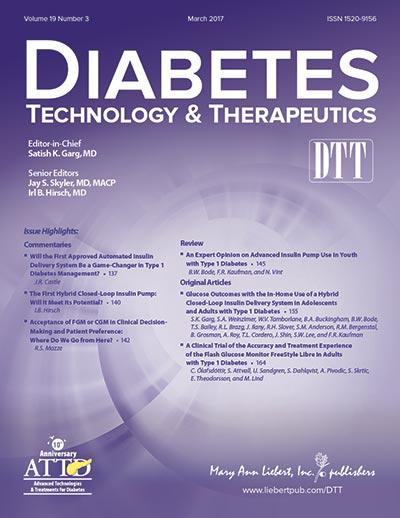
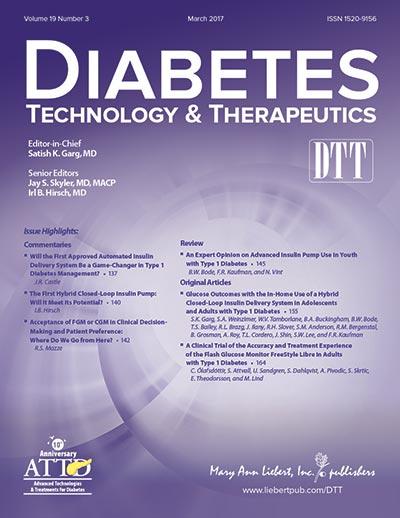
Credit: Mary Ann Liebert, Inc., publishers
New Rochelle, NY, May 30, 2017–Continuous Glucose Monitoring (CGM) sensors are now so accurate that two CGM devices, including the first approved "Flash Glucose Monitoring" system, have received regulatory approval for nonadjunctive use by individuals with type 1 diabetes to guide insulin dosing. The critical factors related to CGM accuracy, clinical implications of accurate CGM and flash glucose monitoring, and results of the most recent clinical trials assessing this technology are the focus of an article published as part of a special supplement on Flash Glucose Monitoring to Diabetes Technology & Therapeutics (DTT), a peer-reviewed journal from Mary Ann Liebert, Inc., publishers. The supplement is available open access on the DTT website.
In the article "Clinical Implications of Accuracy Measurements of Continuous Glucose Sensors," Timothy Bailey, MD, AMCR Institute, Escondido, CA, examines the different measures and approaches used to evaluate the accuracy of CGM devices. Dr. Bailey describes how in silico simulation studies are proving to be more useful for assessing the clinical effects of CGM accuracy than traditional clinical trials. He provides a valuable review and comparison of recent clinical studies that have compared various strategies for using different types of CGM devices, including a flash glucose monitoring device that is approved for use in Europe (with a professional version only approved in the U.S.).
In the Editorial "Flash Glucose Monitoring: The Future Is Here," DTT Editor-in-Chief Satish Garg, MD, Professor of Medicine and Pediatrics at the University of Colorado Denver (Aurora) presents several reasons for the early success and rapid uptake of flash glucose monitoring: low cost; no calibration needed (factory calibrated for 14 days of continuous use); accurate data available on demand; similar/lower mean absolute relative difference (MARD) throughout 14 days of use. Dr. Garg states, "We hope that flash glucose monitoring (FreeStyle Libre personal) will be made available soon in the United States after approval by the FDA. We also hope that it is approved as 'nonadjunctive.'"
###
This supplement was supported by an educational grant from Abbott Diabetes Care Inc.
About the Journal
Diabetes Technology & Therapeutics (DTT) is a monthly peer-reviewed journal that covers new technology and new products for the treatment, monitoring, diagnosis, and prevention of diabetes and its complications. Led by Editor-in-Chief Satish Garg, MD, the Journal covers topics that include noninvasive glucose monitoring, implantable continuous glucose sensors, novel routes of insulin administration, genetic engineering, the artificial pancreas, measures of long-term control, computer applications for case management, telemedicine, the Internet, and new medications. Tables of contents and a free sample issue may be viewed on the Diabetes Technology & Therapeutics (DTT) website. DTT is the official journal of the International Conference on Advanced Technologies & Treatments for Diabetes.
About ATTD
The International Conference on Advanced Technologies & Treatments for Diabetes (ATTD) presents top caliber scientific programs that have provided participants with cutting-edge research and analysis into the latest developments in diabetes-related technology. A unique and innovative conference, ATTD brings the world's leading researchers and clinicians together for a lively exchange of ideas and information related to the technology, treatment, and prevention of diabetes and related illnesses.
About the Publisher
Mary Ann Liebert, Inc., publishers is a privately held, fully integrated media company known for establishing authoritative peer-reviewed journals in many promising areas of science and biomedical research, including Thyroid, Metabolic Syndrome and Related Disorders, Journal of Aerosol Medicine and Pulmonary Drug Delivery, Childhood Obesity, and Population Health Management. Its biotechnology trade magazine, GEN (Genetic Engineering & Biotechnology News), was the first in its field and is today the industry's most widely read publication worldwide. A complete list of the firm's 80 journals, books, and newsmagazines is available on the Mary Ann Liebert, Inc., publishers website.
Media Contact
Danielle Giordano
[email protected]
914-740-2198
@LiebertPub
http://www.liebertpub.com
Original Source
http://www.liebertpub.com/global/pressrelease/flash-glucose-monitoring-offers-accuracy-ease-of-use-and-clinical-benefit-in-type-1-diabetes-management/2181/ http://dx.doi.org/10.1089/dia.2017.0050