Here is a concise and clear summary of the research article based on the detailed description you provided:
Summary of Research Article:
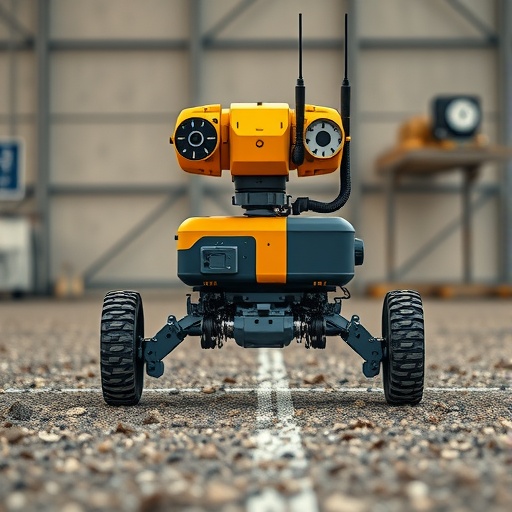
Title: Fixed-time formation behavior control for unmanned ground vehicle-manipulators
Authors: Xue, W., Lu, W., Zhang, X., et al.
Published in: Scientific Reports (2026)
DOI: 10.1038/s41598-026-43223-2
Research Overview:
This pioneering study presents a novel fixed-time formation behavior control strategy designed specifically for coordinated teams of unmanned ground vehicles (UGVs) equipped with robotic manipulators. The approach guarantees that the entire vehicle-manipulator system converges to a desired formation within a known, predetermined time frame, irrespective of initial system states. This marks a significant advancement over traditional asymptotic or finite-time control methods, whose convergence times vary with starting conditions.
Key Contributions:
Fixed-Time Stability:
The control law ensures uniform and predictable convergence time for all UGV-manipulator units, crucial for real-time and safety-critical applications.
Integrated System Modeling:
The method captures the coupled kinematics and dynamics of both mobile UGVs and articulating manipulators, addressing the complexities introduced by multiple degrees of freedom.
Robustness to Disturbances:
Adaptive control elements compensate for environmental uncertainties such as terrain irregularities, sensor noise, and actuator delays, maintaining precise formation despite disturbances.
Decentralized Control Architecture:
Each UGV-manipulator operates autonomously based on local feedback, reducing reliance on inter-vehicle communication. This enhances fault tolerance, scalability, and reduces bandwidth demands.
Experimental Validation:
Real-world tests with multi-joint manipulator-equipped UGV fleets demonstrate the controller’s ability to form, maintain, and rapidly recover complex formations within fixed time intervals under dynamic conditions.
Practical and Theoretical Implications:
Industrial Impact:
Enables reliable and time-predictable multi-robot coordination in logistics, disaster response, precision agriculture, and hazardous environment operations.
Human-Robot Collaboration:
Facilitates safer interactions with fixed-time guarantees on robot behavior convergence, benefiting shared workspaces such as manufacturing and healthcare.
Cross-Disciplinary Opportunities:
The fixed-time control principles and nonlinear feedback design can be extended to aerial or underwater multi-agent systems and other domains like networked cyber-physical systems.
Future Challenges:
Scaling control methods for larger robot fleets while maintaining fixed-time guarantees.
Enhancing sensor fusion to improve state estimation under noisy, real-world conditions.
Developing energy-efficient protocols to prolong mission endurance.
Conclusion:
The fixed-time formation control strategy developed by Xue et al. represents a fundamental step forward in autonomous cooperative robotic systems. By combining rigorous stability theory, integrated dynamics modeling, robust adaptive control, and decentralized implementation, this work lays the groundwork for deterministic, reliable, and scalable multi-robot formations with broad industrial and societal applications.
If you would like, I can also help draft a technical summary, presentation slides, or discuss potential applications of this technology!
Tags: autonomous ground vehicle coordinationcoordinated control of UGV manipulatorsdecentralized control for multi-robot systemsdisturbance rejection in robotic manipulatorsfixed-time formation control for unmanned ground vehiclesformation behavior in mobile robot teamskinematics and dynamics of UGV-manipulator systemspredictable convergence time in roboticsreal-time stability in robotic systemsrobust adaptive control in autonomous vehiclessafety-critical control strategies for UGVsscalability in multi-agent robotic control